Opening a bank account in Armenia
Get your salary into a local account with a card and phone app in your first weeks in Armenia. This page walks through the free ID number, the papers, the fees for non-residents and what to do until payday.
AbroadPin team6 min read
Contents
You don't need a residence card to bank in Armenia. Several banks publish prices for non-residents, and the law doesn't make residence a condition for an account [3]. What you do need is a passport, a free personal number from the migration service, and some proof of where you live, plus patience while the bank checks you. This page covers the order to do things in, which banks to try, what it costs and how to manage until the first salary lands. For the job and permit side, see the main guide to teaching in Armenia.
Which banks to try
Armenia's big retail banks include Ameriabank, ACBA Bank, Ardshinbank, Evocabank, Inecobank, IDBank, Converse Bank, Unibank and AraratBank, and all of them issue cards that work with Apple Pay [9]. Ameriabank publishes a full list of the documents a foreign client brings, which makes it an easy first stop [1]. Evocabank publishes a separate opening fee for non-resident foreigners, so you know the price before you walk in [5].
Approval is the bank's own call, and a bank can say no without giving a reason [6]. Two law firms advise applying at more than one bank at the same time so a refusal doesn't cost you weeks [3] [6]. Citizens of countries a bank treats as high risk face extra checks [6].
Step 1: get your public services number
The public services number (PSN) is a personal ID number issued by the state. Ameriabank asks Armenian citizens for it, and accepts the older social security card number in its place [1]. For non-residents, Vardanyan & Partners, an Armenian law firm, lists it beside the passport as what banks expect, so get it before your first bank visit [3].
- Who can get it. Foreigners who are legally present in Armenia can apply, as well as those with residence status [2]. You don't need a residence permit first [3].
- Where. Any office of the Migration and Citizenship Service of the Ministry of Internal Affairs, in person or through a representative [2]. There is also an online route, but it needs the YesEm strong sign-in [2].
- What to bring. Your passport and a notarized translation of it; with residence status, bring the document that proves it and a photocopy [2]. Vardanyan & Partners also lists proof of lawful entry, such as your entry stamp [3].
- Cost and time. The certificate is free and issued on the spot [2]. Vardanyan & Partners says you may need to book, and the wait for a slot can run from a few days to about two weeks [3].
If you decline a number, for example on religious grounds, you can ask for an official statement saying so, and banks and employers accept that instead [3].
Step 2: gather the papers the bank asks for
Ameriabank's list for foreign clients is a good picture of what any bank will want [1]:
- A passport or other recognised travel document. A residence card also counts as a document of lawful stay [1].
- Proof of address. A utility bill, a reference from your place of residence or a similar paper showing where you're registered or actually live [1]. Your lease, or a letter from the school if it houses you, is worth bringing.
- The bank's own forms. An application, a client data sheet, a contact form for how the bank reaches you, and a signature card, filled in at the branch [1].
- Translations. Documents in a language other than English or Russian need a notarized translation, and you bring originals or notarized copies in person [1].
Banks may also ask why you're in Armenia and where your money comes from [3] [4]. For a teacher that means your work contract or a letter from the school, and a statement from your home bank if you have one. Ameriabank lists statements from another bank covering at least a year and a reference from your employer as optional extras it may request [1]. MB Legal, a law firm, says banks typically want a residence permit, a work contract or a rental agreement of three months or more alongside the passport [6].
US citizens also sign a FATCA form so the bank can report the account to the IRS [6] [7].
Phone number. The bank's forms ask how it should contact you, so have a local number and an email address ready when you go [1].
Step 3: open the account and pick up the card
You must be at the branch in person; MB Legal says remote opening isn't available to non-residents for now, although some banks accept a notarized power of attorney [6]. Timing depends on how much checking the bank does:
- Repat Armenia says an account can be working within 30 minutes of walking in, or take up to 2 weeks for a non-resident [7].
- MB Legal says checks on a non-resident's documents usually take up to two weeks, depending on the bank [6].
Ask for a multi-currency account. Most banks hold AMD, USD, EUR and RUB on one account or card [6]. Ask too whether the card is printed at the branch or mailed, and whether you can collect it at another branch.
What it costs
Fees differ by bank, so ask for the tariff sheet. Here's a published example. Evocabank's current account tariffs, on a page last updated 3 November 2026, list [5]:
| Evocabank current account | Fee |
|---|---|
| Opening at a branch | 2,000 AMD |
| Opening through remote channels | 0 AMD |
| Opening for a non-resident foreigner | 10,000 AMD |
| Monthly maintenance | 0 AMD |
| Closing | 0 AMD |
The opening fee is charged once, however many accounts you open [5]. Repat Armenia notes that some banks ask for a minimum balance and others don't, and that a bank may close an account that sits unused for 14 months [7].
Cards, phone payments and apps

Bank apps cover most everyday banking. The government's services portal lists transfers, bill payments, currency exchange and card management among the features most bank apps offer [4].
- Phone payments. Apple Pay works with cards from 16 Armenian banks and the Telcell wallet, according to an Apple reseller's list of 2024, updated in 2025 [9]. For Google Pay, check your own bank's app.
- Idram. The Idram and IDBank app combines a wallet and a bank account. It pays over 300 services, including phone, internet, utilities and parking, and transfers inside the app carry no fee [8]. You can attach a card from another bank to it [8].
- Telcell. Telcell Wallet is a mobile wallet that also appears on that Apple Pay list [9].
Paying rent, the phone bill and utilities from an app saves queueing, so set this up in your first month.
Getting paid before the account is open
Your school can't send a salary to an account that doesn't exist yet, and the bank's checks can take up to two weeks [6]. Sort this out before the first payday:
- Ask the school how it pays and by when it needs your account details. If the first month is paid in cash or late, get that in writing.
- Bring money for the first weeks. Plan for rent, a deposit, transport and food from savings or a home card.
- Start the paperwork in your first week. Book the PSN appointment early, because slots can take up to about two weeks [3].
- Ask for a letter from the school. A short letter confirming your job and salary helps with the bank's source-of-funds questions [3].
Once your account is open, give the school its details in writing and check the first payment arrives in full. When you're ready to look for work, see open teaching jobs in Armenia.
Sources and photo credits
- 1.Ameriabank, documents required for opening an account (undated, read 4 November 2026)
- 2.Migration and Citizenship Service of the Ministry of Internal Affairs of Armenia, acquiring a certificate on the public services number (updated 29 September 2026)
- 3.Vardanyan & Partners, first month in Armenia: a practical legal checklist for expats (27 October 2026)
- 4.National Services Gateway of Armenia, opening a bank account for non-residents (undated, read 4 November 2026)
- 5.Evocabank, current account tariffs for individuals (updated 3 November 2026)
- 6.MB Legal, how to open a bank account for non-residents in Armenia (updated 19 June 2026)
- 7.Repat Armenia, opening a bank account in Armenia (undated, read 4 November 2026)
- 8.Idram LLC, Idram and IDBank app listing on the App Store (read 4 November 2026)
- 9.iSpace, how to use Apple Pay in Armenia (12 February 2024, updated 6 November 2025)
Photos
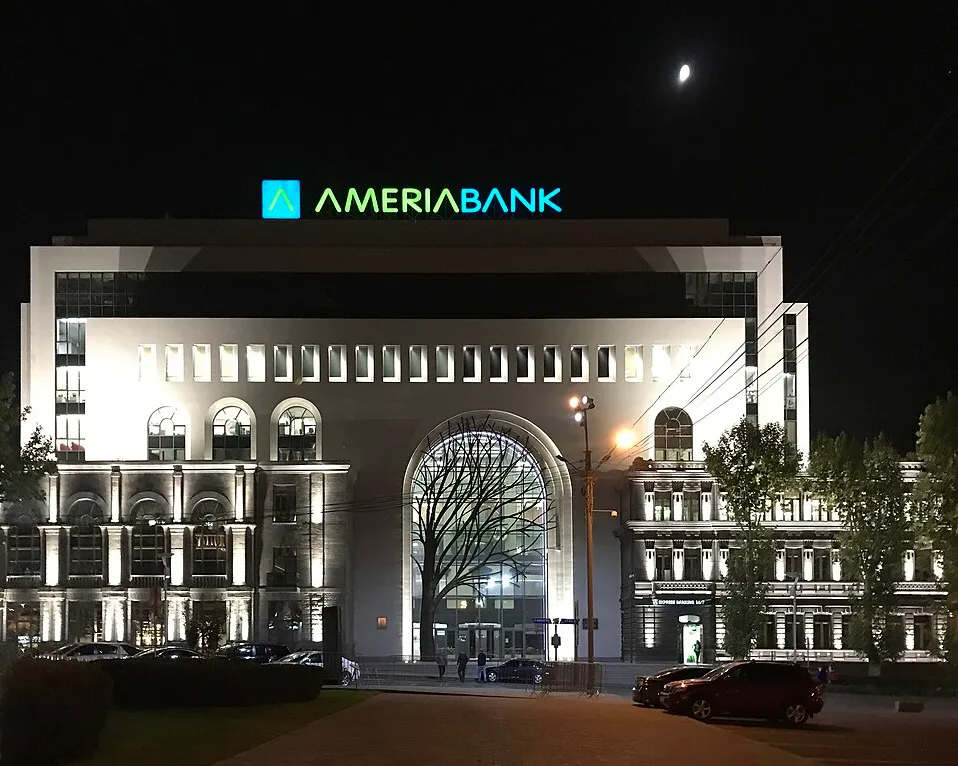
- The Ameriabank building in Yerevan at night.: IM3847, CC BY-SA 4.0, via Wikimedia Commons
- Northern Avenue, a pedestrian street of shops and cafes in central Yerevan.: 23artashes, CC BY-SA 4.0, via Wikimedia Commons
Get new jobs in Armenia by email
One email a week with the jobs added since the last one. Free, with no account.
Nothing is sent until you open the link we email you. Choose a role, a pay level or daily emails
We use your address only to send the alerts you ask for, and every email has a one-click unsubscribe link. The privacy notice says how long we keep it, and the terms of use cover the alerts.
We check this guide again by February 2, 2027. Rules change, so confirm visa steps with the embassy and your school before you go. First published November 4, 2026. Spotted something out of date? Tell us. How we write these guides.