Opening a bank account in Cambodia
Get your teaching salary into a Cambodian account in your first weeks, with the right papers in hand. Here's which banks take foreign teachers, what they charge, and how to pay with a QR code.
AbroadPin team7 min read
Contents
Opening an account in Cambodia is quick once you qualify. The hard part is qualifying, because banks want to see that you live here, not that you're passing through. For a new teacher that usually means a longer visa, a lease or a letter from your school. Plan the bank visit for the point where you have one of those, and carry enough money to cover the gap. For the visa and work permit steps, what schools pay and what a month costs, read the main guide to teaching in Cambodia.
Which banks foreign teachers use
Cambodia has a long list of commercial banks, and most of them serve foreigners. IPS Cambodia's 2023 guide names ABA, ACLEDA, Canadia, Foreign Trade Bank, Union Commercial Bank, J Trust Royal, Vattanac and Campu among the top commercial banks [4].
- ABA Bank is the one you'll hear about first. Move to Cambodia calls it the bank of choice for most expats and locals [6]. Its savings account comes in US dollars and riel, and you can open it in the ABA Mobile app or at a branch [1].
- ACLEDA Bank is one of the largest, with more than 230 branches according to Move to Cambodia [6]. That reach helps if you teach outside Phnom Penh or Siem Reap.
- Canadia Bank and J Trust Royal Bank are older expat favourites, the second once known as ANZ Royal [5] [6].
- Shinhan Bank Cambodia spells out its foreigner rules on its own product page, which makes it easy to prepare for [2].
The most useful question is which bank your school pays salaries through. Same-bank transfers are usually simplest for payroll, and HR may have a contact at that branch who knows their paperwork.
What papers banks ask for
Every bank starts with your passport. LOLC, for example, lists only a valid national ID card or a valid passport for a savings account [3]. Beyond that, foreigners need proof that they're staying, and the banks word it differently.
ABA's own page is the most detailed. A foreign customer must be 18 or older and bring [1]:
- an original passport that is valid and unexpired [1]
- a valid, unexpired Cambodian visa of any type [1]
- one proof of residency, from this list: a visa of 6 months or more, back-to-back visas adding up to at least 182 days, a lease or residential address certificate covering 6 months or more, or proof of employment of at least 6 months [1]
Shinhan asks non-residents for a valid passport and visa, a work permit or a lease agreement, and their occupation, address and contact number in Cambodia [2]. So get a local SIM before you go, and have your address written down the way it appears on your lease.
Older guides fill in the rest. IPS Cambodia wrote in 2023 that a passport with at least six months left was expected, and that a one-year visa extension used to be the norm while some banks now accept shorter ones [4]. Expat.com's 2021 guide said most banks wanted your passport, your business visa and a letter of employment from your employer, often with a copy of your lease [7]. Some branches also ask for a passport photo on a white background [4] [5].
Pack this folder for the visit:
- Your passport, plus a photocopy of the photo page and your visa.
- Your visa extension, if you have it.
- Your employment contract and a short letter from the school confirming your job.
- Your lease, or a letter from the school if you live in school housing.
- Your Cambodian phone number.
- A passport photo, just in case.
A tourist visa won't get you far. Move to Cambodia says it's no longer possible to open an account as a tourist, though some people have managed it [6].
How long it takes
At the counter, not long. IPS Cambodia says that once you have the documents, opening an account takes only a couple of minutes [4]. The wait comes before that, while you collect the papers.
Here's how ABA's rules line up with a teacher's first months. Your arrival visa won't count as proof of residency by itself, but a work contract or a lease covering 6 months or more can [1]. That means you may be able to open an account in your first weeks, before your visa is extended. If your school only gives you a contract on your first day, ask for a letter confirming your start date and contract length before then.
Deposits and fees
ABA charges no monthly fee, but read the small print on dormant and early closing charges.
ABA's savings account [1]:
- Opening deposit of US$10 for residents and US$50 for non-residents [1].
- No monthly service fee, and mobile banking is free [1].
- The ATM card is free; a replacement costs US$5 or KHR 20,000 [1].
- An account with no activity for 12 months or more is charged US$10 or KHR 40,000 a year [1].
- Closing within 3 months of opening costs US$20 or KHR 80,000 [1].
- A balance certificate costs US$10 or KHR 40,000 [1].
Interest is small on dollars. ABA pays 0.00% a year on USD balances up to 1,000, and up to 1.50% on riel [1]. Shinhan lists 1.00% a year on USD and 1.50% on KHR [2].
Other banks, from the guides:
- Shinhan's savings account has an initial deposit of 0.00 USD and no annual fee [2].
- IPS Cambodia reported in 2023 that ACLEDA's savings account had no initial deposit, minimum balance or service charge [4].
- Realestate.com.kh put Sathapana's savings account at a US$10 opening deposit and a US$5 balance to keep, in 2022 [5].
IPS Cambodia also notes a withholding tax on interest: 4% on savings interest for residents and 14% on bank interest for non-residents [4]. It's worth knowing if you keep savings here.
Cards, apps and paying with KHQR
Your debit card usually comes with the account. ABA issues an ATM card free with its savings account [1]. Withdrawals at your own bank's machines carry no convenience fee, according to IPS Cambodia [4].
Much of daily spending runs through phone apps. The National Bank of Cambodia launched KHQR in July 2022 as a universal QR code for retail payments: one code at a shop takes payment from any participating app, including the central bank's Bakong app [8]. At launch, 37 banks and financial institutions had joined, and payments work in riel and US dollars [8]. In August 2024, Tourism Cambodia reported about 3.3 million KHQR merchants nationwide [9].
In practice this means you can scan a KHQR code at a cafe, a market stall or a petrol station with a participating bank's app. Move to Cambodia mentions paying for things like petrol through ABA's QR payments [6]. Set up the app at the branch while staff can help, and register it with your Cambodian number.
Getting paid before the account is open
Your first payday can come before your account exists, so plan for the gap.
- Ask HR in your first week how they'll pay your first salary, which bank they use, and whether they can wait until your account is ready.
- Give payroll your account details in writing, with your name exactly as it appears in your passport.
- Bring savings and a home card for rent, food, a SIM and transport. Cambodian ATMs charge foreign cards US$4 to US$5 or more, according to IPS Cambodia [4], and Move to Cambodia reports US$6 or US$7, sometimes up to US$8 a withdrawal [6]. Take out larger amounts less often.
- Expect big notes. Foreign cards get US dollars at Cambodian ATMs, often in US$50 and US$100 notes that small shops can't change [6] [7]. Break them at supermarkets or hotels.
- Count any cash salary in front of the person paying you, and ask for a signed receipt to keep with your contract.
If you're still on an arrival visa and want to pay by QR code, the central bank's Bakong Tourists app is aimed at visitors. You register with an email address and top up through the app's partners, with spending up to US$1,000 a day, or US$3,000 once verified [9]. Visitors with Alipay+ partner wallets from home can also scan KHQR codes; the central bank said more than 10 such apps joined in October 2024 [10].
With kids
Children won't get their own ABA account: the bank's savings page sets 18 as the minimum age for foreign customers [1]. If your kids go to an international school, ask its finance office early how it takes fees, whether by bank transfer, KHQR or cash, and which bank it uses.
When your banking plan is clear, browse teaching jobs in Cambodia and contact schools directly.
See jobs in Cambodia
- Primary Learning Facilitator, class teacher (iCAN British International School, Phnom Penh)Phnom Penh
- English Lecturer (University of Puthisastra, Phnom Penh)Phnom Penh
- Teacher of English, 2027 terms (ACE Phnom Penh and Siem Reap)Phnom Penh
- PYP Primary Teacher (Northbridge International School Cambodia, Phnom Penh)Phnom Penh
By city: Teaching jobs in Phnom Penh
Sources and photo credits
- 1.ABA Bank, Savings Account (undated, read 5 November 2026)
- 2.Shinhan Bank Cambodia, Saving Account (undated, read 5 November 2026)
- 3.LOLC (Cambodia), required documents to open a savings account for individual customers (undated, read 5 November 2026)
- 4.IPS Cambodia, Opening a bank account in Cambodia as an expat (6 February 2023)
- 5.Realestate.com.kh, banking in Cambodia for expats (18 May 2022, updated 7 June 2022)
- 6.Move to Cambodia, Banking in Cambodia (undated, read 5 November 2026)
- 7.Expat.com, The banking system in Cambodia (updated 20 July 2021)
- 8.The Star (Xinhua), Cambodia's central bank launches KHQR code payment service (5 July 2022)
- 9.Tourism Cambodia, Bakong app launched for tourists (22 August 2024)
- 10.Bank for International Settlements, remarks by Dr Serey Chea, Governor of the National Bank of Cambodia, at the launch of cross-border QR payments between Bakong and Alipay+ (17 October 2024)
Photos
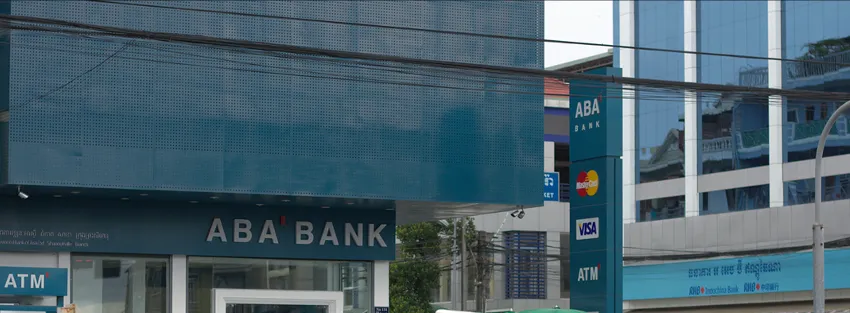
- An ABA Bank branch and cash machine sign in Sihanoukville.: Dmitry Makeev, CC BY 3.0, via Wikimedia Commons
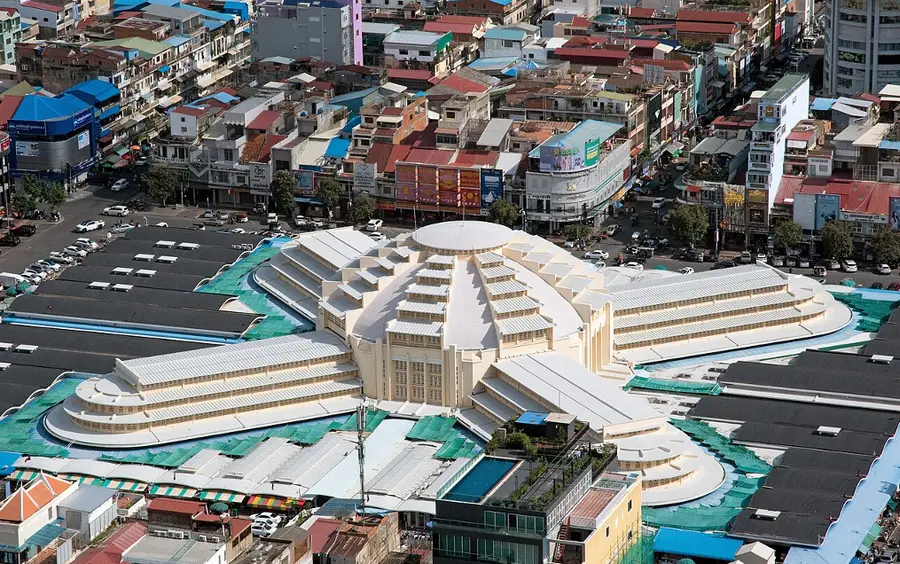
- Phnom Penh's Central Market from above.: Rik Schuiling / TropCrop-TCS, CC BY-SA 4.0, via Wikimedia Commons
Get new jobs in Cambodia by email
One email a week with the jobs added since the last one. Free, with no account.
Nothing is sent until you open the link we email you. Choose a role, a pay level or daily emails
We use your address only to send the alerts you ask for, and every email has a one-click unsubscribe link. The privacy notice says how long we keep it, and the terms of use cover the alerts.
We check this guide again by February 3, 2027. Rules change, so confirm visa steps with the embassy and your school before you go. First published November 5, 2026. Spotted something out of date? Tell us. How we write these guides.