Opening a bank account in Hungary
Have a forint account ready for your first Hungarian payday, without trailing from branch to branch. Here's what to bring, which banks to try, what it costs and how to cope until the account is open.
AbroadPin team7 min read
Contents
A forint account is one of the first things to sort out after you land. Rent, phone bills and your salary all run more smoothly through a Hungarian account, and a university that pays grants to foreign students puts it bluntly: some payments can only go to an account held with a Hungarian bank [2]. Banks here do take foreign customers, but each one decides for itself, so a little preparation saves you repeat visits. This page covers which banks to try, the papers they ask for, how long it takes, the fees, cards and phone payments, and what to do about pay that arrives before the account does. For contracts, permits and pay rates, read the main guide to teaching in Hungary.
Which banks to try
The big domestic banks are where most newcomers start. The international office at the Budapest University of Technology and Economics (BME) points its foreign students to OTP, MBH and Erste, as large banks with many branches and plenty of international clients [1]. The University of Szeged lists OTP, Erste, K&H, UniCredit, Raiffeisen and CIB among the banks in that city [2]. Daily News Hungary names OTP, K&H and Erste as popular with expats and says some Budapest branches have staff who speak English [4].
Older guides may send you to MKB or Takarék. MBH's own app list now shows apps "previously MKB" and "previously Takarék", so look for the MBH name instead [7].
Banks are free to turn an application down. BME says so in as many words, adds that some banks have a policy of not taking non-residents, and notes that some of its students only succeeded after trying several banks [1]. If the first branch says no, try another bank rather than giving up.
Digital accounts
Wise and Revolut are the other route. BME says both give you a local Hungarian IBAN and can be set up online [1]. Monito's 2022 comparison said Wise could take you on without proof of Hungarian residence [10]. Before you rely on one for your salary, ask the school's payroll office whether it will pay into it, because the University of Szeged tells its own students to check that first [2].
Papers to bring
The exact list changes from bank to bank, so check the bank's site or phone the branch before you go [2]. Most lists look like this [1][2][3]:
- Your passport. Some banks also want a second ID [1].
- Your residence permit card. BME says it's not needed in most cases for its students, but other universities list it as standard, so bring it once you have it [1][3].
- Your address card (lakcímkártya) or another paper that shows where you're registered to live [2].
- Your Hungarian tax number (adóazonosító jel), if the bank asks for it [2].
- Proof of why you're here. Universities ask for a student status certificate [3]. For a teacher, the matching paper is your work contract, and Wise notes that some banks ask for proof of employment or earnings [9].
- Your lease. BME suggests bringing your rental contract too [1].
Two Hungarian quirks catch people out. Some banks want two Hungarian witnesses to sign your papers, and a few may ask you to bring a translator [1][3]. Ask about both when you book, and ask a colleague from school if you need a witness.
Address card and tax number
The address card and tax number are often what slow a new teacher down, because you don't have them on day one. Ask the school office early which of the two it is arranging for you and when, then book the bank for the week after they arrive.
Your phone number
None of the bank or university pages read for this article lists a phone number among the papers. You'll still want a local number soon, because banking apps run on your phone, and Hungary's instant transfers let you link a mobile number to your account, Hungarian or foreign, so friends can pay you without your account number [7].
How long it takes
At a branch that says yes on the spot, Daily News Hungary puts the appointment at 30 minutes to an hour, with the account number given straight away and the debit card often arriving within a few days [4]. Not every bank decides at the counter. BME says banks usually decide within two weeks whether they'll open your account [1].
Branch hours are short by some countries' standards. Banks generally open on weekdays from 8:00 to 16:00 and close on Saturdays, apart from some branches in shopping centres [1]. In Dunaújváros, branches close at 15:00 on Fridays [3]. Plan the visit for a free morning or a lunch break.
The basic account if banks say no
Hungary has a legal fallback, the basic account (alapszámla), which banks offer under Government Decree 262/2016 [5]. UniCredit's information sheet sets out how it works [6]:
- It's for a private customer entitled to reside in an EEA state [6].
- You can't already hold another forint payment account in Hungary, unless you declare that it has been closed [6].
- It's a forint account with one holder, one contactless card and no overdraft [6].
- The bank must decide within 10 working days of a complete application [6].
- A refusal comes with reasons, unless the law forbids giving them, and you can complain to the bank or take it to the Financial Arbitration Board [6].
UniCredit's current page lists a monthly fee of HUF 1,745 for its basic account (read 5 November 2026) [5]. It includes 4 occasional domestic forint transfers a month and free cash withdrawals twice a month at any Hungarian cash machine, up to HUF 150,000 in total [5]. Other banks set their own terms, so ask for the basic account by name if a normal account is refused.
Fees to ask about
Hungarian current accounts usually come as packages with a monthly fee, and the costs add up in small ways. The University of Szeged lists the fees to expect: an opening fee, which is often waived, a debit card fee, a monthly account fee and charges per transaction [2]. Daily News Hungary says some banks have cheaper packages for customers whose salary is paid in [4]. Monito's comparison from February 2022 put the monthly fee at local banks at about HUF 200 to 600, but that's an old figure, so check the bank's current list of conditions [10].
Before you sign, ask about:
- Cash machines. Withdrawals at your own bank's machines are usually free, while other networks are likely to charge [9]. BME warns that private machines in the city centre add extra fees for foreign cards [1].
- Paper statements. Banks charge for notices sent by post, while online notices are free [3].
- Payments from abroad. Local banks charge for nearly all foreign transactions [10].
- Closing the account. BME warns that an OTP account left open after you leave keeps charging its monthly fee, and closing one usually has to be done in person [1]. Close yours before you fly home.
Cards, Apple Pay and instant transfers

Visa and Mastercard are widely accepted at cash machines, so a card from home works while you wait for your own [1].
Paying by phone is common. Apple's list of Apple Pay banks in Hungary includes OTP, K&H, Erste, MBH, Raiffeisen, UniCredit, CIB, Gránit and MagNet, as well as Revolut and Wise (updated 27 October 2026) [8]. Apple adds that some cards from those banks may not work with it, so check before you count on it [8].
Transfers between Hungarian forint accounts are fast. Under the instant payment system, a transfer arrives within 5 seconds, 24 hours a day, 365 days a year, and since 1 September 2023 a single transfer can be up to HUF 20 million [7]. It covers forint accounts in Hungary only, not foreign currency or transfers to banks abroad [7]. To be paid by phone number, email or tax number instead of an account number, you register it as a secondary identifier, which lasts one year and has to be renewed [7].
You'll also meet qvik, the name for instant payments started from a payment request, a QR code, a tap or a payment link; the QR, tap and link service went live on 1 September 2024 [7]. MBH says private customers pay no fee on the payer side for these [7].
Getting paid before the account is open
Your first salary may be due before your account exists, so plan for that gap.
- Ask the school how it pays, and when the first payday is. Tell the office the date of your bank appointment.
- Ask whether a Wise or Revolut Hungarian IBAN is acceptable for the first month. Both can be opened online before you have a branch account [1].
- Give payroll your account number in writing as soon as you have it, since the account number comes at the appointment [4].
- Carry a home card that works abroad. Visa and Mastercard work at Hungarian cash machines, but avoid the private machines in the city centre [1].
When your paperwork is lined up, look at English teaching jobs in Hungary.
See jobs in Hungary
No live jobs in Hungary right now. New pins go up every day.
Sources and photo credits
- 1.Budapest University of Technology and Economics, International Mentor Team, opening a bank account (last modified 18 August 2026)
- 2.University of Szeged, open a bank account (1 July 2021, read 5 November 2026)
- 3.University of Dunaújváros, Hungarian bank account (updated 26 July 2024)
- 4.Daily News Hungary, opening a bank account in Hungary (updated 2 July 2026)
- 5.UniCredit Bank Hungary, basic account (read 5 November 2026)
- 6.UniCredit Bank Hungary, preliminary information on the basic account (undated, read 5 November 2026)
- 7.MBH Bank, instant payment system (read 5 November 2026)
- 8.Apple, Apple Pay participating banks in Europe (27 October 2026)
- 9.Wise, how to open a bank account in Hungary as an American (last modified 23 November 2023)
- 10.Monito, how to open a bank account in Hungary (26 February 2022)
Photos
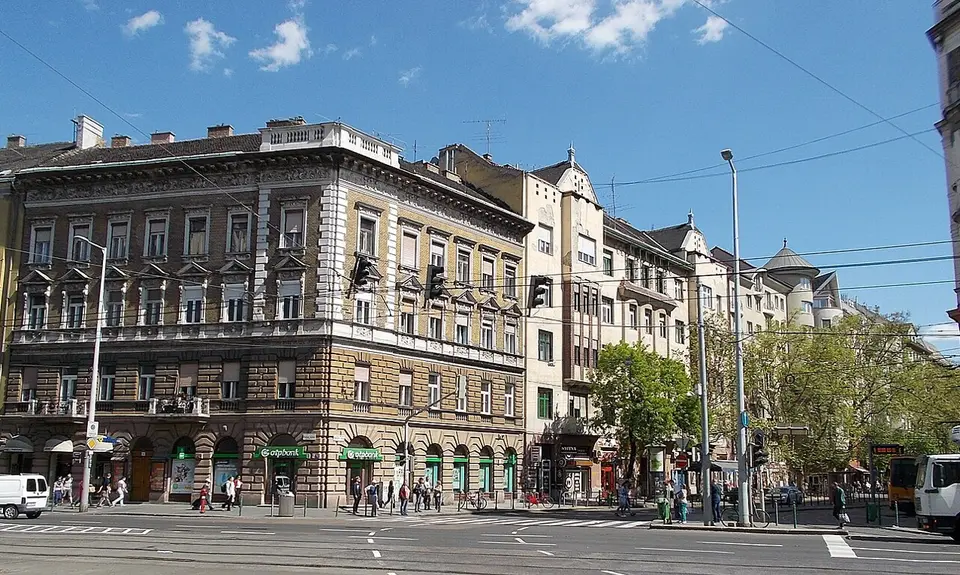
- An OTP Bank branch on Ferenc körút, Budapest.: Globetrotter19, CC BY-SA 3.0, via Wikimedia Commons
- An OTP Bank building in Budapest.: Boubloub, CC BY-SA 4.0, via Wikimedia Commons
Get new jobs in Hungary by email
One email a week with the jobs added since the last one. Free, with no account.
Nothing is sent until you open the link we email you. Choose a role, a pay level or daily emails
We use your address only to send the alerts you ask for, and every email has a one-click unsubscribe link. The privacy notice says how long we keep it, and the terms of use cover the alerts.
We check this guide again by February 3, 2027. Rules change, so confirm visa steps with the embassy and your school before you go. First published November 5, 2026. Spotted something out of date? Tell us. How we write these guides.