Opening a bank account in Kuwait
Get your Kuwait salary paid smoothly by opening the right account soon after your Civil ID arrives. Here's the order of steps, what banks want to see, and how money moves day to day.
AbroadPin team7 min read
Contents
Private schools in Kuwait pay salaries into a local bank account, so setting one up is among the first real jobs of your new life there. You can't do it on day one, though. Banks want your residence and Civil ID card first, and those take a few weeks after you land. This article walks through what to do in the meantime, what to bring to the bank, and how cards and phone payments work once you're set up. For the permit steps, pay and the school market, see the main guide to teaching in Kuwait.
Why your salary goes through a bank
Kuwait's private sector labour law expects wages to be paid through approved financial institutions [1]. When the Public Authority for Manpower (PAM) gave some farming and fishing businesses extra time to comply in November 2025, it said the rule rests on Article 57 of Law No. 6 of 2010 [1]. That grace period applied only to those businesses and ran to the end of January 2026 [1].
In September 2026 the Central Bank of Kuwait (CBK) launched the Kuwait Wage Payment System, which processes and monitors private sector salary transfers through local banks [2]. CBK runs the system itself, while PAM checks that employers follow it [2]. Gulf News reports that it lets regulators spot cases of non-compliance at an early stage [3].
For a teacher, the practical point is simple. Your school will want your account details on file before payroll day, so ask HR in your first week what they need and by when.
The order to do things in
Expat.com's guide to banking in Kuwait says your residency visa and Civil ID have to be issued before you can open an account [4]. Your school handles the residence steps, so most of this is waiting rather than doing.
- Residence. Your employer files for your residence after your arrival medical and fingerprints. The main guide sets out these steps.
- Civil ID. Once residence is issued, you apply for the Civil ID card at the Public Authority for Civil Information (PACI). It's the ID every bank asks for [4].
- The Kuwait Mobile ID app. This is the official digital ID on your phone. Gulf Bank lets you link it instead of scanning your card when you open an account online [6]. Arab Times reports that the central bank has told exchange companies to verify customers through it for all online transfers abroad [8].
- A salary letter. Ask HR for a salary certificate or salary transfer letter as soon as your Civil ID is ready [4][5].
- The bank. With those in hand, you can open an account in a branch or, at some banks, on your phone.
What banks ask for
Expat.com lists the usual set of papers for an expat account [4]:
- A valid passport, your Civil ID and a valid residency visa [4].
- Proof of address, such as your rental agreement [4].
- Proof of work: a salary certificate and your work contract [4].
- A no objection letter (NOC) from your sponsor, which for you is the school [4].
- Passport-sized photos [4].
The same guide says banks generally expect you to be 21 or older [4]. Not every bank asks for all of these, but bringing the full set saves a second trip.
The salary letter matters most. NBK, for example, says a salary certificate or salary transfer letter is required to open its Express Account [5]. A salary transfer letter is your school's promise to pay your salary into that bank, so ask HR which banks it will write one for.
Choosing a bank
Expat.com counts 11 local banks and 12 foreign banks in Kuwait [4]. Among the local ones it profiles are National Bank of Kuwait (NBK), Burgan Bank, Gulf Bank and Commercial Bank of Kuwait [4]. Kuwait Finance House (KFH) is the large Islamic bank, and it merged with Ahli United Bank [4].
Expat.com suggests banking with the same bank as your employer, since most companies deposit pay straight into staff accounts on their own schedule [4]. Ask HR which bank the school uses. If it's one you're happy with, that's usually the shortest path to your first payday.
Opening on your phone
Some banks let you do the whole thing in an app. Gulf Bank's digital onboarding asks for these, and says the account opens in about a minute once you're through [6]:
- Your Civil ID, scanned front and back, or a link to your Kuwait Mobile ID app [6].
- A mobile number for a one-time code [6].
- A Kuwaiti home address [6].
- A selfie that's checked against your Civil ID [6].
- A digital signature, then funding the account through K-net [6].
The card can be delivered to your home or picked up at a branch [6]. The page doesn't say whether every account type is open to expats, so check the options it shows you. You'll still need a Kuwaiti number and an address, so sort out your phone and housing first.
Opening balances and fees
Opening amounts differ a lot, so look before you choose. The figures below are what Expat.com gives for current accounts, plus NBK's own page for its Express Account [4][5]:
| Bank and account | Minimum to open | Source |
|---|---|---|
| NBK current account | KD 500 | [4] |
| Gulf Bank current account | KD 200 | [4] |
| Burgan Bank current account | KD 100 | [4] |
| Commercial Bank of Kuwait current account | KD 100 | [4] |
| NBK Express Account | KD 10, no ongoing minimum balance | [5] |
NBK's Express Account needs a monthly salary of at least KD 400 for expats, and it comes with a free Visa debit card [5]. Some accounts also need a balance kept at all times to avoid fees or closure, so ask about that as well as the opening amount [4].
Two other costs are worth knowing. Most ATMs charge for foreign bank cards, usually 1% to 3% of the amount you take out, which adds up if you live on your home card for weeks [4]. Some accounts also cap how much you can send out each month without a penalty [4]. Ask each bank for its schedule of charges before you sign.
Cards, K-net and WAMD
Your account will come with a debit card, and people in Kuwait often call debit and credit cards K-net [4]. K-net is also the payment gateway Gulf Bank uses to fund a new account opened online [6].
Credit cards come later. Banks set the limit by your monthly income and ask for your Civil ID and salary slips [4].
The phone payment you'll use most is WAMD, run by K-net. It lets you send and receive money instantly using a mobile number, to and from customers of any local bank [7]. KFH's launch note gives these rules for its customers [7]:
- Sender and receiver both register the phone number linked to their account [7].
- Each transfer is KD 1 to KD 1,000 [7].
- The daily limit is KD 3,000 and the monthly sending limit KD 20,000 [7].
- A request stays open for 24 hours, and KFH says the service is free [7].
These are KFH's figures, so check your own bank's WAMD limits in its app. It's handy for splitting rent with a flatmate or paying back a colleague.
Getting paid before your account is open
Because the Civil ID comes first, your first payday may arrive before your account does. Expat.com's guide says many employers pay at least the first month's salary in cash for this reason [4]. That guide predates the 2026 wage payment system, which routes private sector pay through local banks, so ask how your school handles new arrivals now [2][4].
A few steps help:
- Ask HR at your first meeting how and when your first month will be paid.
- Bring enough savings to cover food, transport and any deposits until then, and remember the ATM fees on your home card [4].
- Ask for your salary letter the day your Civil ID is ready, so the account can open the same week [4][5].
- Give HR your new account details in writing, then check your first payslip against your contract.
A short checklist
- Passport, Civil ID and residency visa [4].
- A salary certificate or salary transfer letter from your school [4][5].
- Your contract and your rental agreement [4].
- A Kuwaiti mobile number and the Kuwait Mobile ID app on your phone [6][8].
- Money for the opening deposit, from KD 10 at NBK Express to KD 500 for an NBK current account [4][5].
Ready to look for a post? Browse teaching jobs in Kuwait and write to the school directly.
See jobs in Kuwait
No live jobs in Kuwait right now. New pins go up every day.
Sources and photo credits
- 1.Arab Times, Kuwait grants three-month grace period for salary transfer compliance (12 November 2025)
- 2.Kuwait Times, Wage payment system launched (28 September 2026)
- 3.Gulf News, Kuwait launches centralised wage payment system to protect private sector workers (updated 28 September 2026)
- 4.Expat.com, Banking and finances in Kuwait (updated 4 August 2024)
- 5.National Bank of Kuwait, NBK Express Account (read 5 November 2026)
- 6.Gulf Bank, Digital onboarding (read 5 November 2026)
- 7.Kuwait Finance House, KFH launches WAMD for sending and receiving money via mobile number (29 June 2024)
- 8.Arab Times, Mobile ID app now mandatory for online money transfers in Kuwait (22 April 2026)
Photos
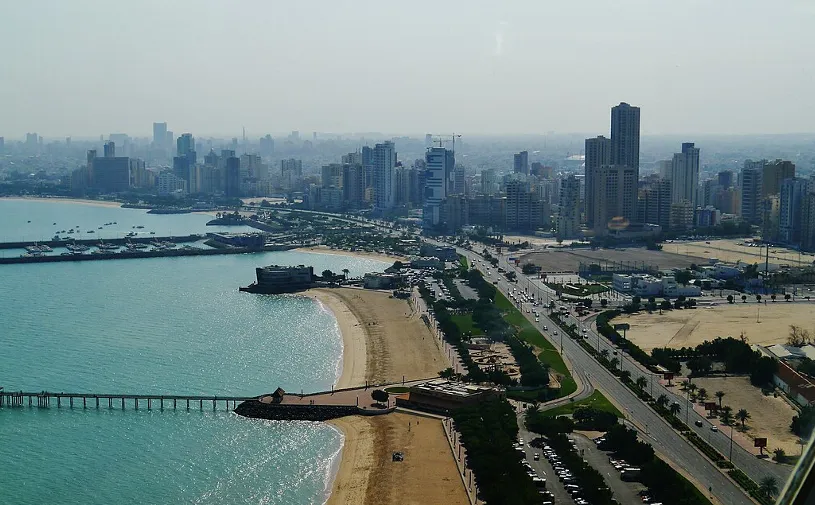
- Kuwait City's towers and Arabian Gulf Street, seen from Kuwait Towers.: Zairon, CC BY 4.0, via Wikimedia Commons
- Shopfronts at Souq al-Mubarakiya, Kuwait City's old market.: Zairon, CC BY 4.0, via Wikimedia Commons
Get new jobs in Kuwait by email
One email a week with the jobs added since the last one. Free, with no account.
Nothing is sent until you open the link we email you. Choose a role, a pay level or daily emails
We use your address only to send the alerts you ask for, and every email has a one-click unsubscribe link. The privacy notice says how long we keep it, and the terms of use cover the alerts.
We check this guide again by February 3, 2027. Rules change, so confirm visa steps with the embassy and your school before you go. First published November 5, 2026. Spotted something out of date? Tell us. How we write these guides.