Opening a bank account in Malaysia
Get your salary into a Malaysian account in your first weeks, with every paper the bank wants. Here's which banks take foreign teachers, what they charge to open, and how to pay by phone once you're set up.
AbroadPin team7 min read
Contents
Opening an account in Malaysia is mostly a paperwork job. Banks want to see that you live and work here legally, and for a teacher that means the Employment Pass your school applies for. Once the pass is in your passport and you have an employer letter, the branch visit itself is usually short. For the job market, the pass categories and what schools pay, read the main guide to teaching in Malaysia.
Your pass comes first
The banks and guides below all ask foreigners for proof of legal stay as well as a passport. Wise, the money transfer firm, lists a passport, a work permit or pass with a letter from your employer, and proof of a Malaysian address as the usual papers [1]. Wise also says foreigners who are legal residents shouldn't have trouble opening an account if they bring the right documents [1].
The pass also needs some life left in it. CIMB asks for a passport valid for at least 6 months from the day you open the account, and an Employment Pass or work visa with at least 6 months of validity [2]. If your pass is close to renewal, sort the renewal first or pick a bank that doesn't set that rule.
Basic accounts, the stripped-down kind with low fees, are usually only for Malaysian citizens and permanent residents, according to Wise [1]. Expect to open a regular savings or current account instead.
Which banks open accounts for foreign teachers
The big local banks are the usual choice. The MSC Malaysia expatriate living guide names Maybank, CIMB, Public Bank, RHB and AmBank, plus HSBC and Standard Chartered for international banking [3]. Here's what the banks' own pages and Wise's comparison say about a few of them.
- Maybank. Its Savings Account-i is open to residents and non-residents aged 18 and over, and the first deposit is RM50.00 [4]. You can start the application online, but foreigners then have to visit a branch within 10 working days to verify their identity [4].
- CIMB. Its identity page lists what working foreigners bring: passport, Employment Pass, an employment letter and proof of income, which it describes as "at least RM10,000 salary" [2]. That income proof isn't needed for customers of CIMB@Work, its payroll service [2]. If your offer is under that figure, ask HR whether the school pays salaries through CIMB.
- Public Bank. Wise says you'll probably need an introducer who has banked with Public Bank for 12 months or more [1]. The current account Wise lists for it, PBE Plus, needs at least RM3,000 to open [1].
- RHB. Online opening needs a Malaysian mobile number, among other conditions [5].
- Hong Leong. Wise notes you need to already be in Malaysia to open an account [5].
The most useful question to ask at interview is which bank your school pays salaries through. A same-bank transfer is simpler for payroll, and some banks, like CIMB above, relax their rules for payroll customers [2].
What to bring to the branch
Put originals and a copy of each in one folder. Combining the pages above, expect to be asked for:
- your passport, with at least 6 months left at CIMB [2]
- your Employment Pass, with at least 6 months left at CIMB [2]
- a letter from your school confirming your job [1] [4]
- proof of a Malaysian address, such as a stamped tenancy agreement or a utility bill [2]
- a Malaysian mobile number, which RHB needs for online opening [5]
- proof of income, if the bank asks for it [2]
Maybank's terms ask foreigners for a passport, a valid work permit, a valid visa and a letter of confirmation from the employer [4]. The address proof is the paper new arrivals most often lack. If you're in a hotel or school housing at first, ask the school or your landlord early for a tenancy agreement or a letter.
How long it takes
The branch visit is the main step. The MSC Malaysia guide says most banks want foreign nationals to open accounts in person, and that fully online opening generally isn't available to them [3]. Wise also says you'll usually need to visit a bank in person [1].
At Maybank you can start online, but foreigners still finish the job at a branch [4]. If you don't do that within 10 working days, the bank may close the account after giving you 14 calendar days' notice [4]. So start the online form only when your papers are ready and you can get to a branch that week.
Deposits, fees and cards
Opening deposits vary a lot by account type. The MSC Malaysia guide puts most standard savings or current accounts at RM 250 to 1,000 to open [3]. Wise's comparison gives these figures for current accounts [1]:
| Bank and account | Minimum to open |
|---|---|
| Maybank, Personal Current Account | RM1,000 |
| CIMB, Regular current account | RM1,000 |
| Public Bank, PBE Plus Current Account | RM3,000 |
A savings account is cheaper to start: Maybank's Savings Account-i needs RM50.00 [4].
Ongoing fees are modest but they add up if you forget an account. Wise lists Public Bank's annual fee as nil, with RM10 charged on inactive accounts [1]. For sending money abroad, Wise lists RM10 to RM30 per transfer at CIMB and Maybank, and RM15 to RM30 in cable charges at Public Bank [1].
For cards, ask at the branch on the day you open the account. Maybank's terms tell you to ask a branch officer for your debit or ATM card and phone banking PIN [4]. The MSC Malaysia guide says most accounts come with internet banking and a Visa or Mastercard debit card [3]. Public Bank makes you collect the debit card at a branch, while RHB may post it to your home in some areas [5].
Paying by phone: DuitNow and e-wallets
A lot of daily spending in Malaysia goes through QR codes and phone transfers. DuitNow is one of the services of PayNet, Malaysia's national payments network, and lets you send money with a mobile number or DuitNow ID, or pay with a QR code [6]. Once your bank app is set up, ask the bank how to link your Malaysian number to DuitNow, so people can send you money by number.
The Touch 'n Go eWallet is the other app you'll see everywhere, with payment and toll features [7]. Since 20 December 2024 new users must finish eKYC, an identity check with a selfie, to use it [7]. RinggitPlus, a Malaysian comparison site, says eligible foreign residents can register and verify with a passport and a live selfie [8]. It lists these limits and fees [8]:
- unverified Lite wallet: RM200 maximum balance [8]
- eKYC-verified wallet: RM20,000 maximum balance and RM9,999 per transaction [8]
- opening the wallet: RM0 [8]
- reloading with a credit card: 1% [8]
- an inactive wallet: RM2.50 for every 365 days without use [8]
You can top it up by DuitNow Transfer or a debit card, so it works best once your Malaysian account is open [8].
Getting paid before your account is open
Payroll may run before the bank has finished with you. A little planning keeps that from hurting.
- Raise it with HR early. Find out the payroll cut-off date and what happens to your first month's salary if you don't have an account by then.
- Ask for the employer letter on day one. The bank needs it [1], and HR may take a few days to write it.
- Send payroll the account number by email the day the bank gives it to you, and check the account name matches your passport spelling.
- Arrive with a cushion. Bring enough savings, and a card from home that works abroad, for the rental deposit, a SIM and a few weeks of food. Ask your home bank about its foreign card fees before you leave.
- Look at a transfer account as a backup. Wise says its account opens online with your passport, proof of address and your pass, with no minimum deposit [1]. It's a way to hold money while you wait, not a replacement for a local salary account.
- Read the first payslip line by line and compare it with your contract, allowances included.
If the first month is paid some other way, get a written record of it from the school.
If your spouse comes too
CIMB opens accounts for spouses on a dependant pass. It asks for a valid dependant pass or spouse permit with at least 6 months of validity [2]. A spouse who isn't working also brings a marriage certificate, or other proof of the relationship, and a bank statement showing where the money comes from [2]. Bring copies of those along with your own papers, so you can open both accounts in one visit.
When you're ready to look at schools, see the teaching jobs in Malaysia and write to the ones you like.
See jobs in Malaysia
- Secondary English Teacher, IGCSE and A Level (BSKL Kuala Lumpur)Kuala Lumpur
- Prep School Key Stage 2 Class Teacher, August 2027 (Marlborough College Malaysia, Johor)Johor Bahru
- Primary Class Teacher (Straits International School Rawang, Selangor)Kuala Lumpur
- Secondary EAL Teacher (Tenby International School Setia Eco Park, Shah Alam)Kuala Lumpur
- Secondary English Literature and Language Teacher (Tenby International School Setia EcoHill, Semenyih)Kuala Lumpur
By city: Teaching jobs in Kuala Lumpur · Teaching jobs in Johor Bahru
Sources and photo credits
- 1.Wise, Can a foreigner open a bank account in Malaysia? (updated 19 January 2026)
- 2.CIMB Bank, Documents for identity verification (undated, read 5 November 2026)
- 3.MSC Malaysia, Expatriate living guide: banking (undated, read 5 November 2026)
- 4.Maybank, Terms and conditions for Savings Account-i, individual account (undated, read 5 November 2026)
- 5.Wise, Open a bank account online in Malaysia: fees and requirements (undated, read 5 November 2026)
- 6.PayNet, DuitNow (read 5 November 2026)
- 7.The Star, All Touch 'n Go eWallet users must complete eKYC verification by Dec 20 (20 November 2024)
- 8.RinggitPlus, Touch 'n Go eWallet (undated, read 5 November 2026)
Photos
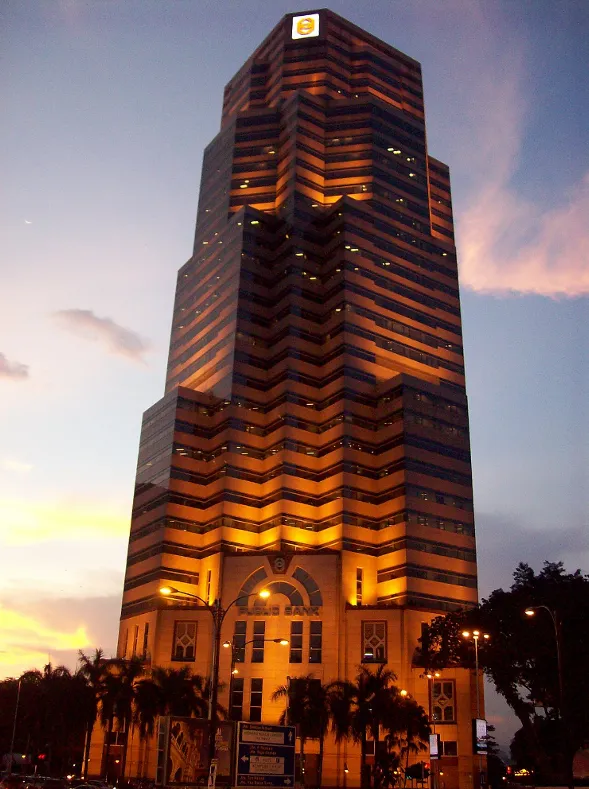
- Menara Public Bank, Public Bank's head office tower in Kuala Lumpur.: Philip Nalangan, CC BY 4.0, via Wikimedia Commons
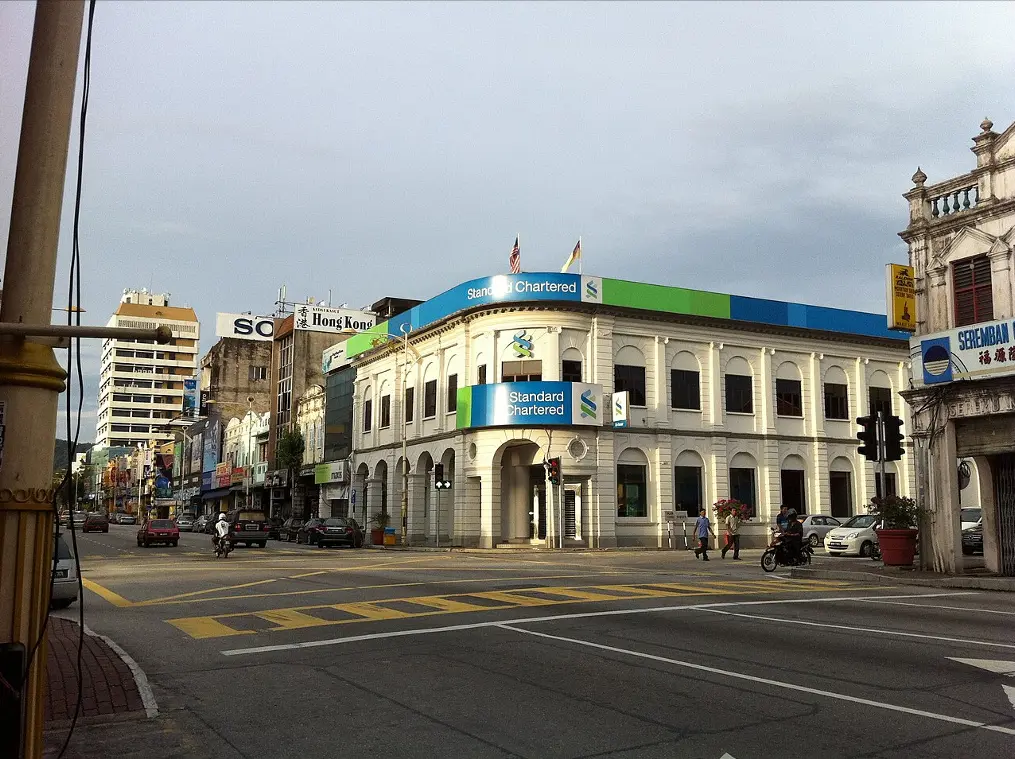
- A Standard Chartered branch on the main street of Seremban.: hermitaurous, CC BY-SA 3.0, via Wikimedia Commons
Get new jobs in Malaysia by email
One email a week with the jobs added since the last one. Free, with no account.
Nothing is sent until you open the link we email you. Choose a role, a pay level or daily emails
We use your address only to send the alerts you ask for, and every email has a one-click unsubscribe link. The privacy notice says how long we keep it, and the terms of use cover the alerts.
We check this guide again by February 3, 2027. Rules change, so confirm visa steps with the embassy and your school before you go. First published November 5, 2026. Spotted something out of date? Tell us. How we write these guides.