Opening a bank account in Oman
Have your Oman salary land safely by sorting out a bank account in your first month. Here's what each bank asks for, how the apps work, and what to do while you wait.
AbroadPin team7 min read
Contents
Schools in Oman's private sector pay salaries into a local account, so a bank account is one of the first things to set up after you arrive. It's a short job once your resident card is in your hand, and several banks now let you do most of it on your phone. Below is the order to work in, what to bring, what it costs, and how to manage until your first payday. For the work visa, pay bands and who hires, see the main guide to teaching in Oman.
How your salary reaches you
Oman's Ministry of Labour runs a Wage Protection System (WPS) that tracks how private sector workers are paid [5]. Under Ministerial Decision 729/2024, in force from 16 December 2024, private sector wages have to be paid into the worker's account at a bank or financial institution regulated by the Central Bank, through the WPS [5]. The employer has to pay within three days of the end of each pay period [5].
The same decision lets an employer leave out workers who haven't yet completed 30 days in the job [5]. So your first part month may be handled differently. Ask HR in your first week how and when that first payment arrives, and which account details they need from you.
The order to do things in
- Your resident card. Bank Muscat and Bank Dhofar both ask expatriates for a resident ID [1] [2]. The Royal Oman Police issues it, and under Decision 78/2025 expatriate cards can run for 1, 2 or 3 years, at 5, 10 or 15 riyals [7]. Ask HR who books your appointment and when you can expect the card.
- A local phone number. Bank Dhofar's app checks a valid mobile number by one-time code before it lets you start [3], and every banking app you use will text you codes.
- A letter from your school. Bank Muscat asks for proof of employment [1], and Expat.com says a salary certificate is generally needed for salary transfers or a credit card [8].
- Proof of address. Bank Dhofar asks expatriates for address proof [2], and Expat.com says banks may ask for a tenancy agreement [8]. If your school houses you, ask it for a letter or a copy of the lease.
- The bank itself. Take your passport too: both Bank Muscat and Bank Dhofar list it next to the resident card [1] [2].
Which bank to pick
Expat.com names Bank Muscat as the largest bank by assets and market share, and lists Bank Dhofar, National Bank of Oman (NBO), Oman Arab Bank, Ahli Bank and Sohar International among the local banks [8]. Foreign banks there include First Abu Dhabi Bank, Standard Chartered, Bank of Beirut and Bank of Baroda, and Bank Nizwa and Alizz Islamic Bank are the Islamic banks it lists [8].
Two things narrow the field quickly:
- Where your school pays. Some expatriate accounts are tied to having your salary paid in. Bank Muscat's current account is open to residents with a minimum salary of OMR 500 transferred to Bank Muscat [1]. Bank Dhofar's expatriate account lists a salary account with the bank as a condition [2]. If your school already pays staff through one bank, start there.
- Branch or phone. If you'd rather avoid a branch, look at the app options below. Expat.com notes that front line staff speak English and forms are in English, and that branches generally open from 8am to 2pm, Sunday to Thursday [8].
Opening in an app
Bank Dhofar's Intilaqa app takes non-Omanis with a valid resident ID, the main page of the passport, address proof and a mobile number, and asks for employment details [3]. After you submit, someone from the bank calls to set up a video call to confirm who you are, and your account limits go up once that's done [3]. The bank's expatriate page describes app opening as taking under 1 minute [2].
NBO lets people open savings and current accounts in its app by scanning identity documents, passing a face check and adding a digital signature, with the account number issued straight away [4]. Its announcement doesn't say whether expatriates qualify, so check in the app or at a branch [4].
Americans: one extra form
Bank Muscat asks US nationals, US tax residents and green card holders for a FATCA W-9 form, and people with a US address or phone number for a W-8BEN [1]. Have your US tax number ready if this applies to you.
Balances and fees
| Bank and account | What the page says | Source |
|---|---|---|
| Bank Muscat current account | Minimum balance OMR 200; a fee applies if the balance falls below it on any day of the month | [1] |
| Bank Muscat current account | Eligibility: salary of at least OMR 500 paid to the bank | [1] |
| Bank Dhofar expatriate account | No minimum balance stated; "fees and charges may apply" | [2] |
Neither bank prints its fee amounts on the account page [1] [2]. Bank Muscat points to its tariff book for the below-balance fee, dormancy fees after 1 year without transactions, and closing fees [1]. Ask for the charges list before you sign, and keep an eye on that daily minimum in the weeks before your first salary.
Cards, transfers and apps
A Bank Dhofar debit card comes with the new account automatically [2]. Bank Muscat's international debit card is linked to the current account and works for purchases worldwide wherever Visa Electron is taken [1]. NBO says it delivers debit cards to your door [4].
Credit cards come later. Expat.com says banks want a salary of OMR 250 to OMR 500 depending on the card, and applicants usually need to be 21 with proof of at least 6 months in a job [8]. Approval takes 3 to 7 business days [8].
For everyday payments:
- Instant transfers. Since 1 July 2026, person to person payments on the Central Bank's Instant Payment System are free for all customers, whether you send to a mobile number or an alias and whatever bank the other person uses [6]. Local transfers through RTGS and ACH on digital channels are free for individuals too [6].
- Maal cards. The Central Bank also waived issuance and annual fees on Maal, the domestic card scheme [6].
- Phone wallets. Expat.com lists Thawani, a local wallet for QR payments, bills and transfers between people, alongside Apple Pay, Google Pay and Samsung Pay at contactless terminals [8].
- Cash. Cards are common in big shops, hotels and supermarkets, but cash is still used in small shops, souqs and some taxis [8].
Sending money home
Bank transfers abroad go by SWIFT and take 1 to 5 business days, says Expat.com, and the bank should show you the fee and exchange rate before you send [8]. Exchange houses such as Lulu Exchange, Al Jadeed Exchange and Musandam Exchange, and services such as Western Union and MoneyGram, are the other route [8]. Bank Dhofar's app offers transfers to India, Bangladesh and Pakistan, and instant Western Union transfers [2]. Compare the rate you actually get, not only the fee.
Getting by before the account is open
You'll probably land, wait for the resident card, then open an account, so plan for a gap.
- Bring enough money from home, on a card that works abroad, to cover food, transport and deposits for your first weeks. Visa, Mastercard and American Express are widely taken, and ATMs accept most international cards, but check your home bank's foreign fees [8].
- Ask HR whether your first part month is paid through the WPS or another way, given the 30 day exemption for new hires [5].
- As soon as the account is open, give HR the account number and IBAN in writing.
- Check your first payslip against your contract, and raise a missing or late salary with HR straight away, since the WPS expects payment within three days of the pay period ending [5].
With kids
If your children are with you, the account set up is the same, but your family's residence papers come through you, so keep copies of everyone's resident cards in one place. NBO lists children's and youth accounts among those you can open in its app [4]. Bank Dhofar said in February 2024 that residents as well as Omanis can open a children's account in its Intilaqa app [9]. Either can make pocket money simpler once your own account is running.
Before you leave Oman
Expat.com advises closing your accounts before you leave the country for good [8]. Bank Muscat says closing a current account needs a branch visit and that you return your debit card [1]. Leave time for this in your last weeks, after your final salary and end of service payment have arrived.
Ready to look? Browse teaching jobs in Oman and write to the school directly.
Sources and photo credits
- 1.Bank Muscat, Current account (read 5 November 2026)
- 2.Bank Dhofar, Expatriate account (read 5 November 2026)
- 3.Bank Dhofar, Intilaqa app (read 5 November 2026)
- 4.National Bank of Oman, NBO simplifies digital account opening experience, press release on Zawya (read 5 November 2026)
- 5.KPMG Oman, Ministry of Labour updates to the Wage Protection System in Oman (January 2025, read 5 November 2026)
- 6.Oman Observer, CBO waives digital transfer fees for individuals and SMEs (17 June 2026)
- 7.Gulf News, Oman introduces flexible 1 to 3 year expat residence cards (updated 11 August 2025)
- 8.Expat.com, Banking and finances in Oman (updated 13 September 2024)
- 9.Bank Dhofar, BankDhofar enhances Intilaqa app for instant account opening of children and savings accounts (13 February 2024)
Photos
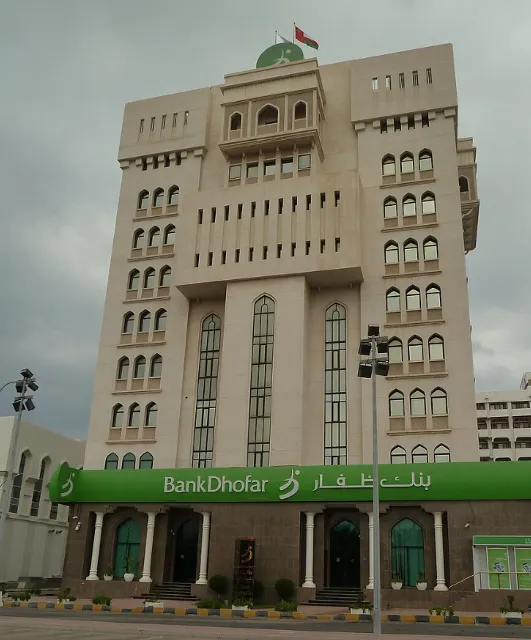
- BankDhofar's head office in Muscat.: A1000, CC0, via Wikimedia Commons
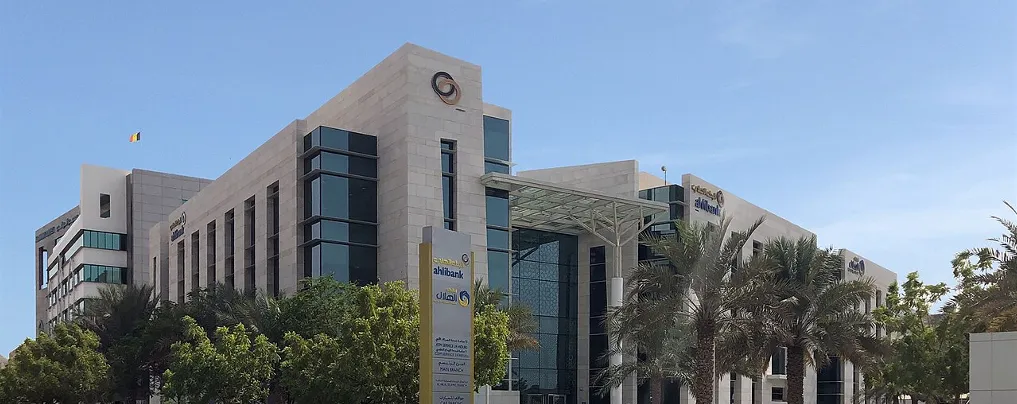
- Ahlibank's head office in Muscat.: Wael Mohammed Al-Masri, CC BY-SA 4.0, via Wikimedia Commons
Get new jobs in Oman by email
One email a week with the jobs added since the last one. Free, with no account.
Nothing is sent until you open the link we email you. Choose a role, a pay level or daily emails
We use your address only to send the alerts you ask for, and every email has a one-click unsubscribe link. The privacy notice says how long we keep it, and the terms of use cover the alerts.
We check this guide again by February 3, 2027. Rules change, so confirm visa steps with the embassy and your school before you go. First published November 5, 2026. Spotted something out of date? Tell us. How we write these guides.