Getting a phone number and SIM in Austria
Get an Austrian number working in your first days, so bank codes, deliveries and school messages reach you. Here's how registration works, which brands to try and what plans cost.
AbroadPin team8 min read

Contents
Getting a phone sorted is one of the quicker jobs after a move to Austria, and it makes the slower ones easier. Prepaid plans are cheap and common, so most teachers can be online in their first days and keep the same number for as long as they stay. The one step that surprises newcomers is registration: a new SIM has to be linked to your identity before it works, and not every brand accepts every passport online. This page covers registration, the networks and budget brands, what plans cost, eSIM, roaming and your number from home. For pay, permits and employers, see the main guide to teaching in Austria.
Registration comes first
Since 2019, every SIM card in Austria, prepaid ones included, has to be registered to a named person before it can be used [5]. So you can't pick up a card at the supermarket checkout and start calling straight away. There are three usual ways to register:
- In a shop. Carriers' own stores register cards, often for free or a small fee, while partner shops and post offices may charge up to €10, according to a crowd-edited prepaid SIM wiki [5].
- Online with a photo or video check. Most brands offer this, with a photo ID check at A1, Drei, Georg and yesss! and a video call at Magenta [5]. You'll need a phone camera and a steady connection for it [5].
- On the brand's activation page. HoT, the mobile brand of the Hofer supermarket chain, lets you register and activate a new number online with the PUK1 code printed on the SIM card [3].
Online checks don't suit every foreign document. The wiki warns that not all brands accept passports from outside Europe for online registration, and says Drei's online check needs an Austrian address [5]. It reports that HoT's online registration takes a passport from any country, though it still suggests registering in a Hofer store with your passport [5]. If you're coming from outside the EU, a branded store with your passport in hand is the route least likely to fail [5].
What to bring:
- Your passport, or a national ID card if you're an EU citizen.
- Your Austrian address, if you already have one, since some online checks ask for it [5].
- An unlocked phone, so it will accept an Austrian card.
Getting online the day you land
What you do first depends on where your current SIM comes from.
- A SIM from another EU or EEA country. Under the EU's roam-like-at-home rules you pay no extra charges to use it in another EU country, so it can carry you through your first weeks [4]. Your operator may still cap how much data you get at your home price under a fair use policy [4].
- A SIM from outside the EU and EEA. Those rules don't cover it. Look up your carrier's roaming prices before you fly, or switch mobile data off and rely on Wi-Fi until you have an Austrian card.
- An Austrian eSIM bought online. HoT sells eSIMs online around the clock and says they're ready on your phone within a few minutes [1]. Registration still applies, so check the ID rules for your passport before you count on this [5].
An EU SIM isn't a long-term answer once you live here. Roaming rules are built around the country where you live, work, study or have other stable links [4]. Your operator can look at your use over a 4-month period, and if you're mostly abroad it can ask you to explain, give you 14 days to reply and then add roaming charges [4].
The networks and the budget brands
Austria has three mobile networks: A1, Magenta (formerly T-Mobile) and Drei [5]. Each runs its own shops and also carries cheaper brands that sell online or through supermarkets and electronics chains. The wiki lists these among them [5]:
| Brand | Network it runs on |
|---|---|
| A1, yesss! and Georg | A1 |
| Magenta, HoT and S-Budget Mobile | Magenta |
| Drei, spusu and Lidl Connect | Drei |
A few notes on who sells what:
- Supermarket brands. HoT is sold by Hofer, S-Budget Mobile by Spar and Lidl Connect by Lidl, so you'll often see starter packs near the checkout [5].
- Georg is sold through MediaMarkt, and yesss! is a brand of A1 itself [5].
- Coverage follows the host network, but a budget brand may not offer every feature on every plan; the wiki says S-Budget Mobile has 5G on select plans only [5].
Branded shops are the easiest place to get help in English or slow German. The budget brands mostly handle sign-up and support through their websites and apps.
What plans cost
Prepaid plans in Austria usually run in blocks of 30 or 28 days rather than calendar months [2] [5]. HoT says it has no contract commitment and no annual service fee, so you can change plans as your needs settle [1]. Here are HoT's prices as its tariff page showed them, last updated on 6 October 2026 [2]:
| HoT plan | Price | What you get |
|---|---|---|
| HoT smart MINI | €1.90 every 30 days | 550 MB, Austria only, calls and texts at 3.9 cents each |
| HoT smart | €5.90 every 30 days | 10,000 MB, calls and texts at 3.9 cents each |
| HoT fix | €9.90 every 30 days | 70,000 MB on 4G, 1,000 minutes or texts |
| HoT fix, 5G version | €14.90 every 30 days | 100,000 MB on 5G, 1,000 minutes or texts |
| HoT fix MEGA | €17.90 every 30 days | 150,000 MB on 5G, 1,000 minutes or texts |
Some things to watch:
- Where your data works. Some HoT plans and packs are marked for use in Austria only, which matters if you travel at weekends [2]. Its data top-ups of 5,000 MB for €6.90 and 10,000 MB for €8.90 can also be used in the EU [2].
- Trips outside the EU. HoT sells roaming packs for more than 45 countries outside the EU, for example 1,000 MB for €5.90, valid 30 days [2].
- The big brands. The wiki lists A1's prepaid welcome package at €9.90 for the first 28 days and Magenta's Klax Unlimited at €29.90 per 28 days [5]. It gives yesss! Unlimited as €19.99 per 30 days [5]. These figures come from the wiki rather than the carriers' own pages, so check the price at the counter.
- Cards left unused. The wiki says A1 charges €0.90 a month after 12 weeks without use and Magenta €0.50 a month after three months [5]. Keep that in mind if you leave a card in a drawer over the summer.
If you're a language assistant, your first salary can take a while to arrive, so a cheap plan you top up month by month is a sensible start.
eSIM or a physical card
An eSIM saves a trip to a shop, and HoT says you can buy one online and have it running in minutes [1]. The wiki lists prepaid eSIMs at most brands, including A1, yesss!, Georg, HoT, spusu and Lidl Connect [5]. At Magenta and Drei it says prepaid customers move to an eSIM through a SIM swap, which at Drei is done in a shop for €20 [5].
Two things to confirm on your phone first:
- It isn't locked to the network you bought it from. A locked phone will reject an Austrian SIM or eSIM.
- It has eSIM support. Newer handsets generally do, but if yours is an older or cheaper model, look in its settings or the maker's spec page.
If either answer is no, a physical card from a shop or supermarket is simpler.
Why an Austrian number helps
Roaming keeps you online, but daily life runs more smoothly with a local number:
- Banking. Banks and online services often send security codes by text, and an Austrian number means those arrive without roaming delays or charges.
- Your school. Colleagues and the school office will want a number for timetable changes and sick days.
- Deliveries and appointments. Parcel services, doctors' practices and offices often text or call about times.
- Flat hunting. Landlords and agents expect to call you back, and an Austrian number makes you easier to reach.
- Cheap local calls. Plans like HoT fix include 1,000 minutes or texts, so calling Austrian numbers costs little [2].
Keeping your home number
Services back home, from your bank to tax and student loan accounts, may send sign-in codes to the number they have on file. Losing it can lock you out when you least expect it.
- Use both numbers on one phone. A dual-SIM phone, or one SIM plus an eSIM, lets you keep the home line for codes and use the Austrian line for everything else.
- Ask your home carrier about a cheap plan. Before you leave, find out what it costs to keep the number active and what you'll pay when a text arrives abroad. EU numbers fall under the fair use limits described above [4].
- Move your sign-in codes. Where a service lets you switch from text codes to an authenticator app, do it before you fly.
Inside Austria, you can usually take your number with you if you change brands later. HoT, for example, says you can bring your current number over free of charge [1]. Ask your new brand to arrange the move before you cancel anything.
Your first month, step by step
- Before you fly, check that your phone is unlocked and supports eSIM, and sort out your home number.
- On arrival, use your EU SIM or Wi-Fi for the first days.
- Take your passport to a carrier's own shop, or register online if the brand accepts your passport [5].
- Pick a 30-day prepaid plan that fits how much data you use, and change it later if you need to [1] [2].
- Give the new number to your school, your bank and your landlord.
Once you're connected, browse the open jobs in Austria.
See jobs in Austria
- English Teaching Assistant in Austria (USTA 2027 to 2028)Vienna · $2,239 a month
Sources and photo credits
- 1.Hofer Telekom (HoT), home page on eSIM, contract terms and bringing your number (updated 6 October 2026)
- 2.Hofer Telekom (HoT), mobile tariffs and add-on packs (updated 6 October 2026)
- 3.Hofer Telekom (HoT), registering and activating a SIM (updated 14 May 2025)
- 4.European Commission, Your Europe, mobile roaming costs in the EU (read 5 November 2026)
- 5.Prepaid Data SIM Card Wiki, Austria, crowd-edited (read 5 November 2026)
Photos
- An A1 Telekom Austria building in Judenburg, Styria.: Naturpuur, CC BY-SA 4.0, via Wikimedia Commons
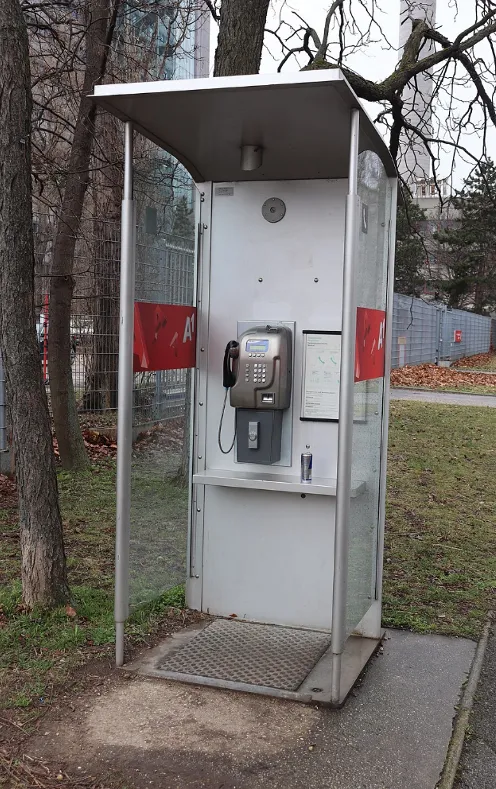
- An A1 phone box on a street in Vienna.: Andrzej Otrębski, CC BY-SA 4.0, via Wikimedia Commons
Get new jobs in Austria by email
One email a week with the jobs added since the last one. Free, with no account.
Nothing is sent until you open the link we email you. Choose a role, a pay level or daily emails
We use your address only to send the alerts you ask for, and every email has a one-click unsubscribe link. The privacy notice says how long we keep it, and the terms of use cover the alerts.
We check this guide again by February 3, 2027. Rules change, so confirm visa steps with the embassy and your school before you go. First published November 5, 2026. Spotted something out of date? Tell us. How we write these guides.