Getting a phone number and SIM in Brunei
Get a Brunei phone line in your own name and keep your home number working too. Here's what each carrier asks for, what plans cost and how to stay connected before your papers are ready.
AbroadPin team7 min read
Contents
AITI, the telecoms regulator, names three providers selling 5G plans to the public: DST, imagine and Progresif [8]. New prepaid lines have to be registered to a person with ID [3], so the order you do things in matters more than which carrier you pick. This page covers the papers each carrier wants, what plans cost, the gap before your work pass is ready, eSIM, and your number from home. For pay, schools and the work pass itself, see the main guide to teaching in Brunei.
Why sort out a local number early
A Brunei number is the one your school, your landlord and your new colleagues will use. Banking and delivery apps generally confirm a sign-up with a code sent by text, so it helps to have a number that works here. It's also what the carrier's own app uses to show your balance and let you add data.
Most of all, the line you open in your first weeks tends to stay with you for the whole contract. Put it in your own name from the start, so it matches your other records.
The ID rules for registering a number
Registration isn't optional. DST says registering a new prepaid (Easi) number at the time of purchase is a regulatory control in Brunei [3]. If an Easi number isn't registered within 7 days of activation, it's blocked until you complete the registration [3].
What you need to show depends on who you are:
- Foreign workers. DST asks foreigners for a valid original passport and employment pass [1]. AITI lists a Brunei identity card, passport and work pass for foreign workers [8].
- Visitors. AITI lists a passport for tourists buying a starter pack [8]. DST tells Easi Tourist buyers to bring their passport and travel documents [3].
The identity card for foreign workers is the green IC, which you get once your work pass is approved (the main guide has the steps). So the full set of papers only comes together after your medical and work pass are done. That's the gap the next section is about.
You can self-register a DST Easi line in the MyDST app with an internet connection, or have DST staff do it at a branch, a dealer or with a sales agent [1]. Services stay off until registration is complete [1].
Your first days, before the work pass
You have a few ways to stay connected while your papers come through.
- A tourist SIM. DST's Easi Tourist SIM costs $15, with 3GB of local data and $3 of credit for local calls and texts, valid for 7 days from activation [2]. The SIM itself expires after 30 days, and it can't be turned into a normal Easi or Mobi line later [1]. DST says it's only for international visitors [2], so ask at the counter whether it suits someone who has just arrived to work. imagine also sells a Smart 5G Tourist SIM, but its page didn't show a price [5].
- Roaming on your home plan. Ask your home carrier what Brunei costs before you fly. Prices vary a lot, so check rather than guess.
- Wi-Fi. Messaging apps on hotel or school Wi-Fi will cover you for a few days.
Once your employment pass is in your passport, go back and open your long-term line. With DST, a visitor staying longer than 30 days is pointed to the regular Easi SIM pack instead of the tourist one [1].
The carriers and what plans cost

The carriers' pages show prices with a plain dollar sign. These are Brunei dollars; imagine writes them as B$ in its FAQ [5].
DST
DST's prepaid line is called Easi and its postpaid line Mobi.
- Easi SIM pack. The SIM is $0, and you buy a $10 Easi Recharge to activate it [3]. A banner on the same page says $10 gets you 8GB of data to start [1]. You need to make that first recharge within 30 days of buying the SIM [1].
- Easi add-ons. DST lists data add-ons such as Combo and Edu packs, and you check current prices by dialling *133# or in the MyDST app [1].
- Mobi postpaid. All Mobi plans include unlimited calls and texts for personal use, and they come on a 24-month contract only [4]. On Mobi 80, speed drops to 512Kbps after 70GB, with no extra charge [4]. Downgrading a Mobi plan costs a one-time $10 [4].
Plan prices on DST's Mobi page were only in images, so we couldn't read them. For phone bundles, DST's FAQ lists a $30 deposit for foreign personal customers on Mobi 30, plus a $300 contract guarantee deposit that applies to non-Bruneians only [3].
imagine
imagine's postpaid plans are called WISH, and the mobile page listed these monthly prices [5]:
| Plan | Data | Monthly price |
|---|---|---|
| WISH 2 | 2 GB | $10 |
| WISH 6 | 6 GB | $18 |
| WISH 15 | 15 GB | $28 |
| WISH 25 | 25 GB | $45 |
| WISH 50 | 50 GB | $75 |
The page offers these on a 6, 12 or 24-month contract, and its FAQ says there's a no-contract plan too [5]. On prepaid pay-as-you-go, daily spending is capped at B$15, and after you hit it you get unlimited data for the rest of the day [5]. To transfer credit to someone else, you need at least B$5 on the balance before and after [5]. Its home page asks you to sign up at an imagine Centre [10].
Progresif
Progresif's prepaid plan costs $10 and comes with $10 of preloaded credit, no contract and 5G speed [7]. You manage add-ons in the Progresif CARE+ app, and you can buy online or at a Progresif store [6]. Its postpaid prices weren't shown as text on the pages we read.
None of the three carriers listed a plan just for foreign workers. Teachers on a work pass go on the same plans as everyone else.
eSIM
imagine has activation steps for iPhone and Android on its eSIM page [9], and Progresif has a Mobile eSIM page linked from its home page [7]. DST's FAQ says a lost or stolen phone can get a new SIM card or eSIM, depending on the device [3].
None of the pages we read said whether a foreigner can get an eSIM without visiting a store first. The safe plan is to open your first line in person with your passport and pass, then ask about moving it to eSIM. Check that your phone supports eSIM and isn't locked to your home carrier.
Keeping the line in good shape
- Pay or top up on time. Put your renewal or top-up day in your calendar. On DST, three failed recharge attempts bar an Easi number, and you then call 151 to sort it out [3].
- Moving from prepaid to postpaid. DST charges $10 to move an Easi line to Mobi [3].
- Changing carrier. DST's Switch to DST service takes numbers from other providers, as long as the line is active, all bills are paid and the account holder makes the request [3]. Settle your last bill before you switch.
- Problems with the service. Raise billing or coverage problems with your carrier first. If it doesn't acknowledge your complaint within 48 hours, or you're unhappy with the outcome, you can take it to AITI [8].
- Scam calls and texts. AITI says its officers will never call or text to ask for money, bank log-in details or personal information, and it lists an Anti-Scam Helpline on 16993 [11].
Keeping your home number
Your home bank and email probably still send codes to your old number, so plan this before you fly.
- Keep the home line on its cheapest plan that still receives texts abroad. Ask your home carrier what receiving SMS in Brunei costs.
- Use a dual-SIM phone if you have one, with the home line in one slot and the Brunei line in the other.
- Move logins to an authenticator app where you can, so fewer codes depend on a text reaching you.
- Tell your home bank you'll be living abroad, and update your contact details.
With kids
AITI says that for a child under 12, a parent or legal guardian buys the SIM and it's registered in the parent's name, with the child listed as the user [8]. Older children follow the carrier's own rules, so ask at the counter what they need to bring. A spouse on a dependant pass should ask the carrier which papers it accepts, since the pages we read only listed the employment pass for foreigners [1].
What we couldn't confirm
- DST Mobi and Progresif postpaid prices, which were shown only as images.
- Whether SIMs are sold at Brunei International Airport.
- Whether a new teacher on a temporary visa can buy a tourist SIM.
- Whether foreigners can set up an eSIM without a store visit.
Your first weeks, in order
- Before you fly: check roaming with your home carrier and move what codes you can to an app.
- First days: use Wi-Fi or roaming, and ask a carrier whether a tourist SIM fits your situation.
- Once your employment pass is issued: take your original passport and pass to a carrier and open a line in your own name.
- When the green IC arrives: ask the carrier whether it wants the card on your record too.
- Then: give the number to your school, bank and landlord.
Once you're connected, browse the teaching jobs in Brunei.
See jobs in Brunei
- Primary English Teacher, Expression of Interest for Next Academic Year (CfBT Brunei)Bandar Seri Begawan · $3,125 to $4,492 a month
Sources and photo credits
- 1.DST, Easi prepaid plans, SIM pack and registration (read 5 November 2026)
- 2.DST, Easi Tourist SIM (read 5 November 2026)
- 3.DST, frequently asked questions (read 5 November 2026)
- 4.DST, Mobi postpaid plans (read 5 November 2026)
- 5.imagine, mobile plans and FAQ (read 5 November 2026)
- 6.Progresif, prepaid mobile (read 5 November 2026)
- 7.Progresif, home page with the prepaid plan (read 5 November 2026)
- 8.AITI, Authority for Info-communications Technology Industry, frequently asked questions (read 5 November 2026)
- 9.imagine, eSIM activation (read 5 November 2026)
- 10.imagine, home page with mobile sign-up and imagine Centres (read 5 November 2026)
- 11.AITI, home page with scam warning and Anti-Scam Helpline (read 5 November 2026)
Photos
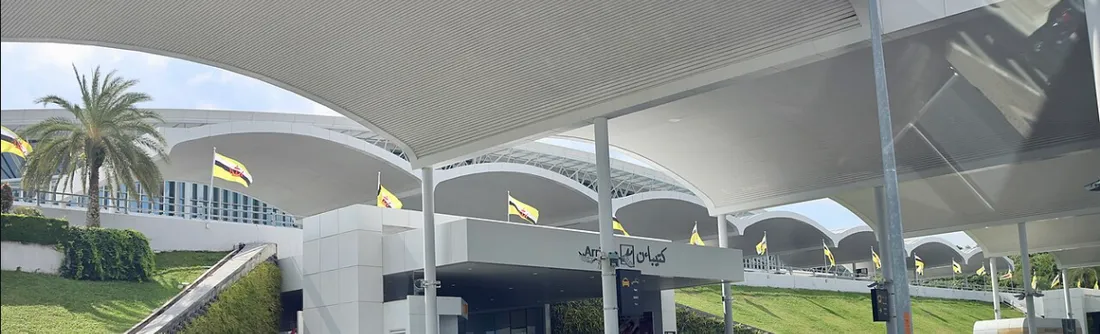
- The arrivals entrance at Brunei International Airport.: Pangalau, CC BY-SA 4.0, via Wikimedia Commons
- Shops and offices in Gadong, Bandar Seri Begawan.: DeltaSquad833, CC BY-SA 4.0, via Wikimedia Commons
Get new jobs in Brunei by email
One email a week with the jobs added since the last one. Free, with no account.
Nothing is sent until you open the link we email you. Choose a role, a pay level or daily emails
We use your address only to send the alerts you ask for, and every email has a one-click unsubscribe link. The privacy notice says how long we keep it, and the terms of use cover the alerts.
We check this guide again by February 3, 2027. Rules change, so confirm visa steps with the embassy and your school before you go. First published November 5, 2026. Spotted something out of date? Tell us. How we write these guides.