Finding an apartment in Colombia
Rent a flat in Bogotá or Medellín on terms you understand. Here's what rent costs, why landlords ask for a co-signer instead of a deposit, how estratos change your bills and what the lease law says.
AbroadPin team8 min read
Contents
Renting in Colombia works a little differently from most countries. Landlords and agencies usually want a Colombian co-signer or an insurance policy rather than a cash deposit, utility bills depend on the official stratum of the building, and the lease follows a national housing law with its own rules on notice and rent rises. None of it is hard once you know it's coming. This page takes you through it in the order you'll meet it. For pay, the M visa and your cédula de extranjería, start with the main guide to teaching in Colombia.
School housing or renting yourself
Most teachers in Colombia find their own place, so ask about housing before you accept an offer.
- Private schools. Go Overseas says private school jobs typically include a housing stipend, along with airfare and health insurance [4]. Ask for the amount and whether it's paid with your salary.
- Language institutes. The same source says institutes may pay less and leave out those benefits [4]. Plan on finding and paying for your own flat.
- International schools and some private institutions. Teast says some may help teachers find an affordable apartment, though it marks this as occasional [2].
- Public school roles. Teast says housing support is rare [2].
- Volunteer programs. Go Overseas says most public school volunteers get a stipend of about USD 500 a month, which it says should cover basic living costs, especially if volunteers share a flat [4].
Whatever the offer, get the housing part written into your contract. A short let for your first weeks gives you time to learn your commute and see places in person.
Where to look
Search in Spanish and on foot as well as online. A flat for rent is advertised as se arrienda, and walking the neighbourhood you want and calling the numbers on those signs is a common way in, since some private landlords never list online [3] [4].
- Local property sites. Expat Arrivals says local sites carry more listings at lower prices than English-language ones, which mainly target tourists [3].
- Shared flats and whole flats. Go Overseas points to Comparto Apto for shared housing and Encuentra24 for whole apartments [4].
- Owners and agencies. Many places are rented directly by individuals rather than agencies, and agencies ask for more paperwork and references [3].
- Rooms. A room in a private home or a shared flat suits a tight budget, and an informal room rental is usually simpler than an agency lease [3].
- Colleagues and expat groups. Teast names expat Facebook groups in Medellín as a good place for advice [2]. Colleagues at your school know which buildings and landlords are easy to deal with.
Expat Arrivals describes the market as competitive and fast moving, so have your papers ready before you start viewing [3].
What rent costs in Bogotá and Medellín
These are Numbeo's crowd-sourced monthly averages. The Bogotá page was updated on 3 November 2026 from 1,047 entries by 94 contributors over 12 months, and the Medellín page on 4 November 2026 from 713 entries by 48 contributors [1] [7].
| Monthly rent | Bogotá | Medellín |
|---|---|---|
| One bedroom, city centre | About 2,360,769 COP | About 4,264,053 COP |
| One bedroom, outside the centre | About 1,632,500 COP | About 2,115,000 COP |
| Three bedrooms, city centre | About 4,601,818 COP | About 6,385,914 COP |
| Three bedrooms, outside the centre | About 3,140,000 COP | About 3,243,333 COP |
The spread behind each average is wide: entries for a central one-bedroom ran from 1,750,000 to 3,640,000 COP a month in Bogotá and from 3,200,000 to 4,680,000 COP in Medellín [1] [7]. By neighbourhood, Teast's 2025 guide puts a one-bedroom in El Poblado at 1,500,000 to 3,500,000 COP and in Laureles or Envigado at 900,000 to 2,000,000 COP [2].
Set these next to your offer. If a central one-bedroom would take most of your pay, the usual answers are a shared flat, a room in a family home or a neighbourhood further out on a bus or metro line to your school.
Furnished, unfurnished and short lets
Expat Arrivals describes three broad choices [3]:
- Unfurnished flats. These often come without a fridge, washing machine or microwave. If you're staying a year or more, buying your own may pay off.
- Furnished flats. Easy to find in the big cities, but usually much more expensive.
- Short lets. Furnished, flexible on length and usually with utilities included, which makes them a good base for your first weeks.
Newer complexes often have good security and sometimes a pool or a small gym, while older blocks tend to be roomier and quieter [3]. Ask whether the monthly building fee (administración) is in the rent or on top of it.
Co-signers, insurance and deposits
This is the part that surprises most foreign tenants.
No cash deposit on a housing lease
Colombia's housing lease law, Ley 820 de 2003, says landlords can't demand cash deposits or other real guarantees for urban housing leases (article 16) [5]. Instead, Expat Arrivals says, the landlord takes out an insurance policy covering 36 months' rent plus a fixed amount for damage, and the tenant pays for it either monthly with the rent or as a yearly lump sum, with the cost written into the lease [3].
The co-signer (codeudor)
Expats usually need one or sometimes two Colombians to co-sign the lease, and they generally need to own property, since they're liable if you don't pay [3]. Agencies are strict about this [3]. Expat Arrivals says it may be possible to agree something else with a landlord directly, such as paying a large share of the rent up front, and that employers often help expats find a co-signer [3]. Ask your school early.
Papers you'll be asked for
Agencies run credit checks, and without a local credit history you can usually offer a payslip or bank statement instead [3]. Have these ready as scans:
- your passport and visa, and your cédula de extranjería once you have it
- your signed contract or a letter from your school confirming your post and pay
- a recent payslip or bank statement
- details of a co-signer, if you have one
What the lease says
Expat Arrivals says leases usually run 12 months [3]. Ley 820 sets the main rules [5]:
- Written or verbal. A housing lease can be either [5]. Ask for a written one, so every term is on paper.
- Length and renewal. The term is what you agree; with no term stated, it's one year, and at the end it renews on the same terms if both sides kept to it [5].
- Rent rises. Rent can go up once every 12 months, by no more than the previous calendar year's rise in the consumer price index [5].
- Leaving early. A tenant can end the lease early with at least three months' notice and compensation equal to three months' rent [5].
- Leaving at the end of the term. With at least three months' notice before the end date, you can leave without compensation [5]. Notice goes by an authorised postal service, and if there's no written record of it, the lease renews automatically [5].
- Utilities. The lease has to say which side pays the utility bills [5].
Expat Arrivals also advises a signed inventory (inventario del inmueble) of the contents and any damage, attached to the contract [3]. Walk through it with the landlord and photograph every room on move-in day.
Utilities, estratos and internet
Every home in Colombia sits in one of six socioeconomic strata, or estratos, from 1 (lowest) to 6 (highest), and utility charges depend on it [6]. Homes in estratos 1, 2 and 3 get subsidies on their bills, estrato 4 pays the standard cost, and estratos 5 and 6 pay a surcharge [6]. Expat Arrivals notes that expats in the more desirable neighbourhoods pay more for utilities as a result [3].
Tenants usually pay water and electricity, though this varies, so check the lease [3]. Short lets usually include utilities [3]. Expat Arrivals names EPM, Codensa and Celsia among electricity companies, and Claro, Tigo and Movistar for internet and TV [3]. When you view a flat, check that it has hot water [3].
Numbeo's Bogotá averages put basic utilities for a 915 square foot flat at about 404,003 COP a month, home internet of 60 Mbps or more at about 97,143 COP and a mobile plan with 10 GB or more of data at about 52,667 COP [1]. In Medellín the averages are about 564,821 COP for basic utilities and 96,925 COP for internet [7]. Teast says most apartments in Medellín have high-speed internet [2].
Scams and problems to avoid
- Signing in a language you can't read. Expat Arrivals warns that expats without Spanish are more exposed to exploitative landlords and scams, and suggests a translator or a Spanish-speaking friend [3].
- Tourist prices. Listings on English-language sites mainly target tourists and tend to cost more [3].
- Paying for a place you haven't seen. Don't send money for a flat that you, or someone you trust, haven't visited.
- A cash deposit on a long lease. The housing lease law bars cash deposits [5]. If someone asks for one, ask what it's for and get the answer in writing.
- No inventory. Without a signed inventory, it's hard to show the damage was already there [3].
- Cash with no receipt. Pay by bank transfer to the person named on the lease, or get a signed receipt every time.
With kids
Families usually need two or three bedrooms. Numbeo's averages for a three-bedroom flat in Bogotá are about 4,601,818 COP a month in the centre and 3,140,000 COP outside it [1]. In Medellín they are about 6,385,914 COP in the centre and 3,243,333 COP outside it [7], and Teast says family-sized flats are reasonably priced there [2]. Choose your children's school first and then look for a flat nearby, since the daily school run matters more than an extra room. Schools, fees and dependent visas are in the main guide.
Your first months, in order
- Ask your employer about a housing stipend and help finding a co-signer [3] [4].
- Book a short let for your first weeks while you view places [3].
- Gather your passport, visa, contract and payslip or bank statement [3].
- Read the lease with a Spanish speaker: rent, insurance or co-signer, notice and who pays utilities [5].
- Sign the inventory, photograph the flat and keep every receipt [3].
When you know which city suits you, browse teaching jobs in Colombia and ask each school about housing at the interview.
Sources and photo credits
- 1.Numbeo, cost of living in Bogotá (updated 3 November 2026)
- 2.Teast, teach English in Medellín (2025, read 5 November 2026)
- 3.Expat Arrivals, accommodation in Colombia (undated, read 5 November 2026)
- 4.Go Overseas, teach abroad in Colombia (undated, read 5 November 2026)
- 5.Secretaría del Senado de Colombia, Ley 820 de 2003 on urban housing leases (read 5 November 2026)
- 6.DANE, socioeconomic stratification (undated, read 5 November 2026)
- 7.Numbeo, cost of living in Medellín (updated 4 November 2026, read 5 November 2026)
Photos
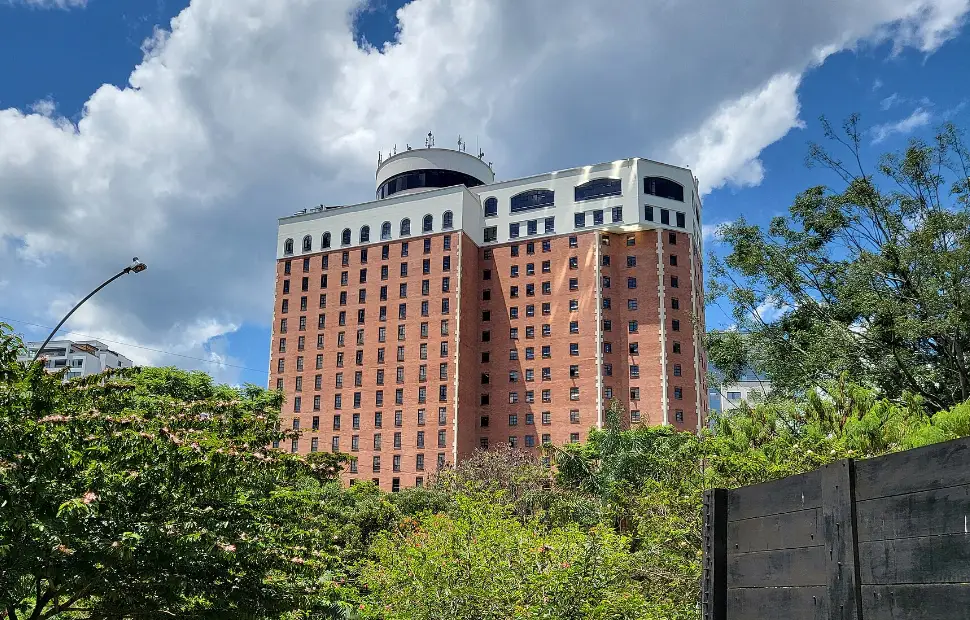
- A tall building in El Poblado, Medellín.: Xemenendura, CC BY-SA 4.0, via Wikimedia Commons
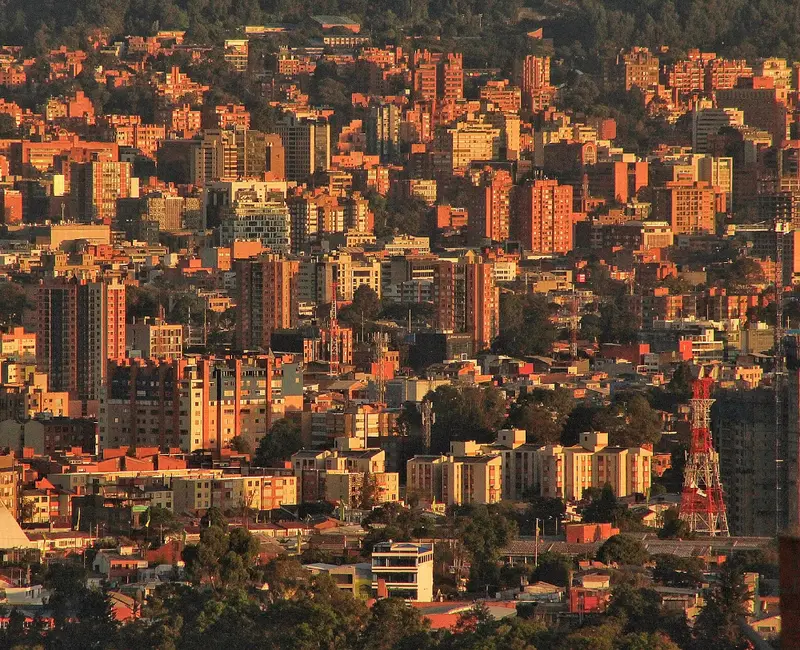
- Buildings in Chapinero, Bogotá, in evening light.: Felipeortegag, CC BY-SA 4.0, via Wikimedia Commons
Get new jobs in Colombia by email
One email a week with the jobs added since the last one. Free, with no account.
Nothing is sent until you open the link we email you. Choose a role, a pay level or daily emails
We use your address only to send the alerts you ask for, and every email has a one-click unsubscribe link. The privacy notice says how long we keep it, and the terms of use cover the alerts.
We check this guide again by February 3, 2027. Rules change, so confirm visa steps with the embassy and your school before you go. First published November 5, 2026. Spotted something out of date? Tell us. How we write these guides.