Opening a bank account in France
Get your French pay on time by opening an account in your first week. This guide covers the papers to bring, banks to try, your right to an account if one says no, fees, and the wait for payday.
AbroadPin team7 min read
Contents
Your school, university or language school will pay you by transfer into a French account, and so will the health insurance system when it repays a doctor's visit [6]. That makes the bank one of your first errands after you land. The good news is that French law is on your side: a foreign national living legally in France can open an account, and if every bank says no, the Banque de France can make one open it for you [1] [2]. For pay, visas and employers, see the main guide to teaching in France.
Before the appointment: an address on paper
Almost every bank wants proof of where you live before it opens anything, so sort your address first.
- A bill or a rent receipt in your name. Caisse d'Epargne accepts a rent receipt, an energy or water bill, a phone bill from a known operator or a home insurance certificate [4].
- A certificate from your host. If you're staying with someone, the bank can ask for an attestation d'hébergement, which is a short signed statement from them, plus their ID and their own proof of address [1] [4].
- A letter from your school. The Strasbourg education office tells its language assistants they can ask their school for a housing certificate [10].
How recent the proof must be depends on the bank. Société Générale's guide says under 12 months, while the Caisse d'Epargne checklist and the Université de Lyon both say under 3 months [4] [5] [7]. Bring the newest paper you have.
The papers to bring
Ring the branch when you book and ask for their list, because banks may ask for more than the legal minimum [7]. This pack covers what the banks and universities we read ask for:
- Your passport. A valid foreign passport is accepted as official ID [5].
- Your visa or residence permit. Société Générale's guide says people from outside the EU need a valid residence permit or visa, while EU citizens usually don't [5]. If your permit is still being processed, Université Paris-Saclay says the confirmation of your application can stand in [6].
- Proof of address, as above.
- Proof of income. Banks list a payslip, an employment contract or recent statements from your bank at home [4] [5]. For a teacher who hasn't been paid yet, the work contract or the assistant's appointment letter is the obvious one.
- A French phone number. Not on the official lists, but you'll want it for the bank's app and for Wero, which only works with a mobile number your bank has verified [8].
Which banks to try
There's no special account for foreign teachers, so the choice comes down to a branch near home or work and someone there who can explain the contract.
Branch banks. These are the safest choice if your French is still basic. Université Paris-Saclay works with Caisse d'Epargne Île-de-France, which sends an adviser who speaks French and English to its arrival days [6]. The Université de Lyon's welcome office names Crédit Mutuel Enseignant and HSBC [7]. If you work for a university, ask its welcome office which bank it partners with before you pick one yourself.
Online banks and app-only accounts. Opening online is possible, but read the conditions. Service Public says an online opening may use a certified identity check and may ask for a first transfer to or from another account in your name [1]. Société Générale's guide adds that the big online banks often keep their offers for residents, sometimes French tax residents, while some app-only providers take non-EU passports with selfie or video checks [5].
Short stays. The Université de Lyon warns that most French banks refuse accounts to people in France only for a short stay, and suggests having pay sent to your home account if you're staying under three months [7].
How long it takes
You sign the account agreement in the branch or digitally, and the bank registers the new account in the national accounts file [1]. For online applications, Société Générale's guide says the answer often comes within a few days [5]. If you ask for a chequebook, Université Paris-Saclay says it arrives within 2 weeks [6]. The debit card is sent to you with its PIN [6].
If a bank says no: the right to an account
French banks may refuse you, but the law gives you a fallback called the droit au compte [1]. It's open to anyone who lives in France, with no condition on nationality, as long as you don't already have a French current account [2].
- Get the refusal in writing. The bank must give you a written refusal with its reason [2]. If it doesn't answer within 15 days, that counts as a refusal [2].
- Send your file to the Banque de France. That's the request form, your ID, proof of address under 3 months old, the refusal and a signed statement that you have no other French account [2]. You can file online, at a Banque de France counter or by post, or ask the bank that refused you to send it [2].
- Name the bank you'd like. You can ask for a bank and branch near home or work, and the Banque de France tries to follow your choice [3].
- Wait for the designation. Within 1 working day of a complete file, the Banque de France names a bank, and that bank has 3 working days to send you its list of papers [2].
- Open the account. You have 6 months to visit the branch, and once your papers are complete it must open the account within 3 working days [2].
The basic services on this account are free: a card each payment of which the bank authorises, transfers, direct debits, a monthly statement, cash at the counter and 2 cheques a month [2] [3]. Nothing outside that list is part of the account, and charges for a payment made without enough money in it are capped at €4 each and €20 a month [2] [3].
Fees and cards
Opening an account in France is free [1]. After that, each bank sets its own account fees in its price list, and the Université de Lyon says they're usually taken from the account each month [1] [7].
- The card. Université Paris-Saclay puts yearly card fees at €15 to €40, depending on the card and the bank [6]. Ask whether it's already in the monthly fee, because it often is [7].
- Spending abroad. Some cards charge extra for payments outside France, so check before a holiday [7].
- Debit, not credit. Most accounts come with a debit card, and Université Paris-Saclay notes that credit cards are rare in France, so keep money in the account [6].
- Cheques. Still used for sports clubs and some rentals, and generally free, though a bank may charge once you pass a monthly number [7].
Your RIB and paying by phone
The RIB (relevé d'identité bancaire) is the slip with your account number that employers and the health insurance office ask for [6]. Download it from your online banking or ask for one at the branch [6] [7].
For paying friends, most French banks now offer Wero, which replaced the old Paylib service between autumn 2024 and March 2025 [8]. It sends money to a phone number or email address in under 10 seconds, and it's free for individuals [8]. Your bank sets the daily limit, and each phone number can receive money into only one account [8].
Getting paid before the account is open
Plan for a gap, because the first payday comes later than most new teachers expect.
- Assistants. The TAPIF FAQ says your first salary comes at the end of October, or even mid-November, and suggests arriving with at least 5,000 US dollars [9].
- Ask about part pay. In the Strasbourg education office's 2024 to 2025 guide, assistants who asked before 10 October could get 70% to 80% of October's pay at the end of that month, with the rest paid in November [10]. Ask your own school's office whether it does the same.
- Hand in your RIB early. The same guide tells assistants to see the school secretary in their first week with the RIB for their salary [10].
Until the first pay arrives, live on savings and a card from home that works at French cash machines. Open the French account as soon as you have your address paper, so the school isn't waiting on you.
With kids
A child can't open an account alone; parents open it on their behalf [1]. For a minor, Caisse d'Epargne lists the livret de famille, the French family record book, so ask which document it accepts from a foreign family [4]. The droit au compte can't be used for a joint account, so a couple wanting one needs an ordinary account [3]. Health insurance repayments for the family go to a French account too, which is one more reason to open yours early [6].
Once your banking is planned, browse English teaching jobs in France.
See jobs in France
- English Teaching Assistant in France (TAPIF 2027 to 2028)Paris · $1,117 a month
Sources and photo credits
- 1.Service Public, opening an individual bank account (verified 22 May 2026)
- 2.Service Public, refusal to open a bank account and the right to an account (verified 19 October 2026)
- 3.Banque de France, the right to an account: 9 misconceptions and the reality (updated 24 September 2026)
- 4.Caisse d'Epargne, documents needed to open an account (updated 8 February 2024)
- 5.Société Générale, opening an account in France with a foreign passport (29 October 2026)
- 6.Université Paris-Saclay, bank account guide for international arrivals (updated 30 September 2026)
- 7.Université de Lyon, Espace Ulys, bank account (read 5 November 2026)
- 8.Banque de France, Wero (read 5 November 2026)
- 9.Villa Albertine (Cultural Services of the French Embassy in the US), TAPIF programme FAQ for 2026 to 2027 (November 2025)
- 10.Académie de Strasbourg, administrative steps for language assistants, 2024 to 2025 school year (2024)
Photos
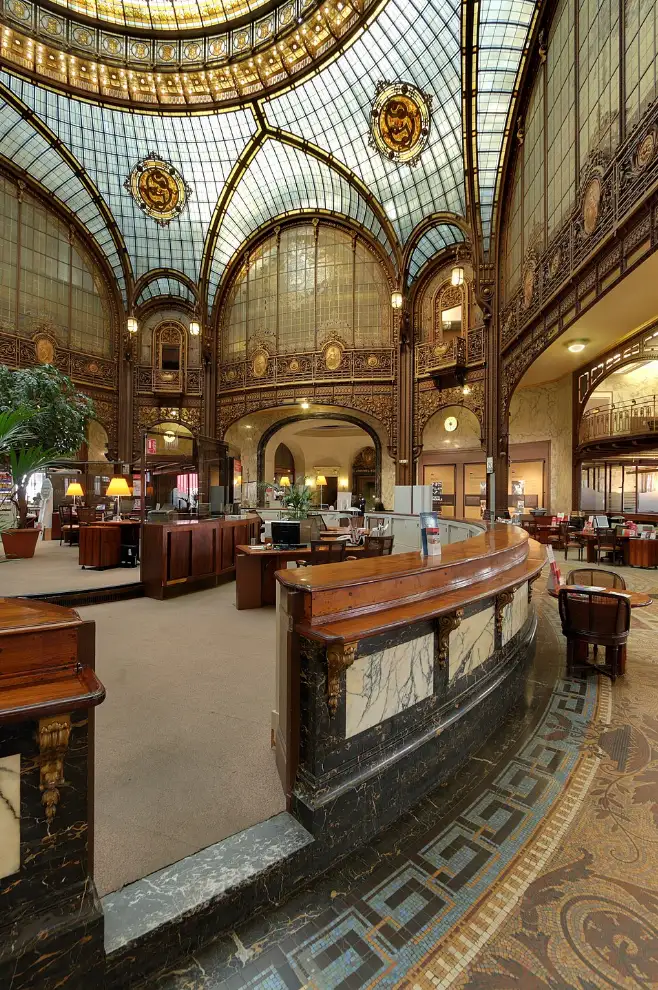
- The main hall of Société Générale's central branch in Paris.: Benh LIEU SONG, CC BY-SA 3.0, via Wikimedia Commons
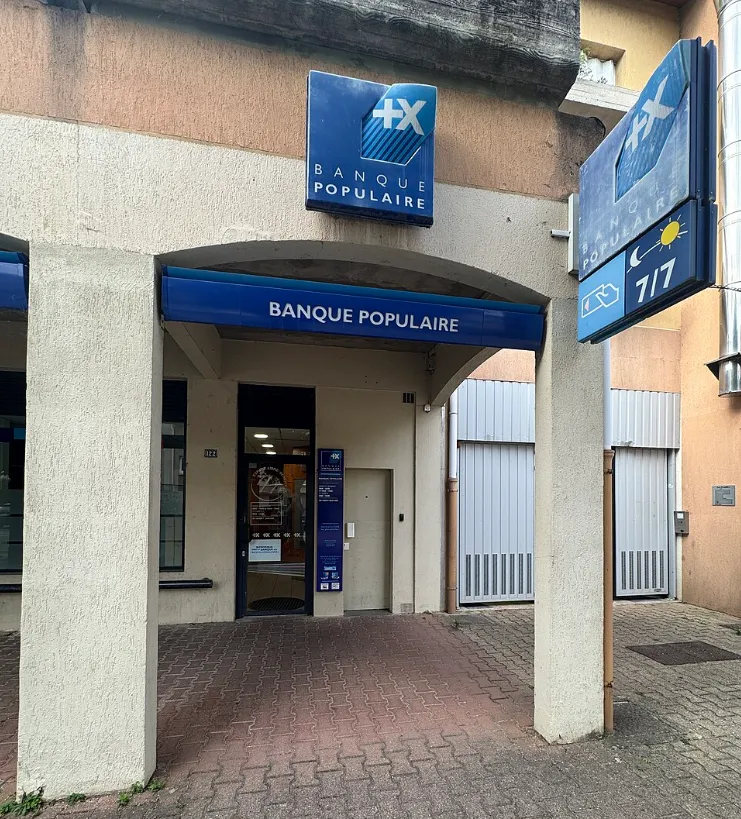
- A Banque Populaire branch in Estrablin, Isère.: Jlgay38, CC BY 4.0, via Wikimedia Commons
Get new jobs in France by email
One email a week with the jobs added since the last one. Free, with no account.
Nothing is sent until you open the link we email you. Choose a role, a pay level or daily emails
We use your address only to send the alerts you ask for, and every email has a one-click unsubscribe link. The privacy notice says how long we keep it, and the terms of use cover the alerts.
We check this guide again by February 3, 2027. Rules change, so confirm visa steps with the embassy and your school before you go. First published November 5, 2026. Spotted something out of date? Tell us. How we write these guides.