Finding an apartment in Taiwan
Find a flat in Taiwan without overpaying, from your school's offer to the lease and your ARC address. Here's where people search, what a deposit can legally be, what rent looks like outside Taipei, and the warning signs to watch for.
AbroadPin team8 min read
Contents
Renting in Taiwan is less paperwork than in many places in Asia. There's no key money, the deposit has a legal ceiling, and the government publishes a standard lease in English. The harder parts are reading Chinese-language ads, knowing which costs sit on top of the rent, and getting your address right for your residence card. For pay, work permits and the main employers, see the guide to teaching in Taiwan.
Housing from your school or a place of your own
Start by asking your employer what it does about housing, before you book a flight.
- The public school program. The Ministry of Education's Taiwan Foreign English Teacher Program lists housing reimbursement among its support for teachers and teaching assistants, next to salary, airfare and insurance [5]. It doesn't publish an amount on that page, so ask the program office or your county coordinator what you'll get and what receipts they need [5].
- Cram schools (buxibans) and private schools. Practice varies a lot. Some help you find a room, lend a staff member to phone landlords, or keep a flat that teachers pass on to each other. Others leave it all to you.
Whatever the answer, get it in your contract or an email. Ask whose name goes on the lease, whether a housing payment is added to your salary or paid against receipts, and what happens to the flat and the deposit if your job ends early.
A short stay for your first few weeks gives you time to learn the area near your school and view flats in person. The Gold Card Office suggests a serviced apartment if you'd rather not sign a lease at all [1].
Where to look
These are the routes the government's own guide for foreign professionals points to [1].
- 591. The Gold Card Office calls 591 Housing the most popular rental site [1]. You can filter by type: a whole flat (整層住家), a self-contained studio (獨立套房), a studio inside a shared flat (分租套房) or a single room with a shared bathroom (雅房) [3]. Each ad says whether an owner (屋主直租), an agent (仲介) or a representative (代理人) posted it, and you need to log in to see the full details [3].
- Agents. The Gold Card Office links a list of real estate agents with staff who speak English, Japanese or Spanish [1]. An agent's fee is usually about half a month's rent, paid when the lease starts, according to one long-term renter's guide [4].
- English-language sites and groups. The same official guide lists My Room Abroad, Rental Taiwan and several Facebook groups, plus UR House for larger units [1]. It also warns that places marketed only in English to foreigners can cost more than the going rate [1].
Ads give size in ping, and 1 ping is 3.305 square metres [1]. The figure is often the gross area including shared space, so the Gold Card Office suggests taking off about 20%, or about 30% in a building with lots of shared facilities, to estimate the space you'll actually live in [1].
What rent looks like
Your main guide's cost table has Numbeo's averages for a one-bed flat in Taipei and Taichung, so check it first. Taipei is the most expensive city by a wide margin, and many teachers there share or live further out along a metro line.
For a second city, here are Numbeo's crowd-sourced averages for Kaohsiung, in the south, last updated on 5 November 2026 and based on 500 entries from the past 12 months [6]. The range is the spread of what contributors reported.
| Monthly rent in Kaohsiung | Average | Range |
|---|---|---|
| 1-bed flat, city centre | NT$14,609.09 | NT$8,000 to NT$25,000 |
| 1-bed flat, outside the centre | NT$10,750.00 | NT$6,000 to NT$20,000 |
| 3-bed flat, city centre | NT$31,620.00 | NT$25,000 to NT$35,000 |
| 3-bed flat, outside the centre | NT$21,977.78 | NT$20,000 to NT$30,000 |
A room in a shared flat, or a studio in a converted building, usually costs well below a whole one-bed flat in the same area. Search 591 by district and type to see what's on offer near your school before you set a budget [3].
Money up front
- Deposit. By law a rental deposit can be at most 2 months' rent, and you should expect to pay it in cash [1].
- The first month's rent, paid when you sign.
- An agent's fee if you used one, usually about half a month's rent [4].
- Parking, if you need it, is extra and can reach NT$4,000 a month in Taipei [4].
So a lease found through an agent can mean up to about three and a half months' rent before you get the keys, and less if you rent straight from the owner [1] [4]. Get a receipt for the deposit, and write down in the lease when and how it comes back.
The lease and what it asks of you
The Ministry of the Interior publishes a standard residential lease in Mandarin and in English, and the Gold Card Office links both [1]. Ask to use it, or read the English one beside the contract you're given.
Before you sign, check these points:
- Your ID. Bring your passport and, once you have it, your residence card. A letter from your school confirming your job helps before the card arrives. Some landlords won't rent to foreigners at all, so if one says no, move on to the next ad [4].
- Who pays what. Utilities usually aren't included in the rent [1]. Ask about electricity, water, gas, the building's management fee and rubbish collection one by one [1]. Buildings with a guard can charge management fees that add up [4].
- How electricity is billed. If the flat has its own meter, Taipower bills you directly every two months [4]. With a shared meter, landlords often charge about NT$5 a kWh against a normal rate as low as about NT$2 [4].
- Gas. Some flats use piped gas and some use bottled gas, which costs more and can run out; one renter puts use at about one canister a month for two people [4].
- Address registration. You'll need the lease to register your address for your residence card (see below), so confirm the landlord is fine with that before you sign [2].
- Repairs and notice. Write down who fixes broken appliances and how much notice either side gives to end the lease.
If your Mandarin is limited, the Gold Card Office suggests bringing a Mandarin-speaking friend to help negotiate [1].
Your ARC address
The National Immigration Agency (NIA) wants proof of the address on your Alien Resident Certificate (ARC).
- When you apply. The NIA's residency guidelines ask for proof of your current residence, such as a lease [2]. If you live in a place someone else owns without a lease, for example with a colleague, they accept a copy of the owner's ID card with a signed consent statement, or the property deed [2].
- When you move. You must register the change with the NIA within 30 days, counted from the day after the change [2].
- Fees. The same guidelines list NT$1,000 for a one-year ARC and NT$2,000 for two years, and NT$500 for a reissued card or a change of registered details [2]. Ask your local NIA service centre which fee applies to an address change.
Other services you sign up for may ask for the same address, so keep it current.
Utilities and internet
The landlord usually has the accounts in place, and bills can be paid at convenience stores [1].
- Electricity, water and gas. See the lease checks above. Read the meter on the day you move in and photograph it.
- Internet. Home internet and TV bundles often cost about NT$1,000 a month [4]. Numbeo's average for unlimited broadband at 60 Mbps or more is NT$800 a month in Kaohsiung [6]. Chunghwa Telecom charges a NT$500 fee each time you move a line [4]. One renter's cheaper setup is an unlimited mobile SIM, at about NT$400 a month, used as home Wi-Fi [4].
- Running costs. Numbeo puts basic utilities for an 85 square metre flat at NT$2,987 a month in Kaohsiung [6].
Scams and problems to avoid
- See the flat in person. Be wary of ads with no photos of the inside, or a price that looks too good to be true [4].
- Don't pay before you've viewed and signed. Be wary of anyone who wants money sent for a flat you haven't seen. The deposit can't legally be more than 2 months' rent, so a request for more is a red flag too [1].
- Check who you're dealing with. An owner-posted ad and an agent's ad are labelled differently on 591 [3]. If you use an agent, the Gold Card Office's list of agents with foreign-language staff is a safer place to start [1].
- Watch for rooftop additions. Rooms built on top of a building (頂樓加蓋) are often cheap, but one long-term renter calls them unsafe and says utility costs can be double [4].
- Look for damp and safety risks. The same guide lists water leaks, mould, fire and carbon monoxide among the problems to check for, so look at the walls and where the gas water heater sits [4].
- Pay the going rate. Compare a foreigner-focused ad with similar Chinese-language ads on 591 before you agree on rent [1] [3].
With kids
In Kaohsiung a 3-bed flat averages NT$31,620 a month in the centre and NT$21,978 outside it [6]. Ask early whether your employer helps with a family-sized flat, and if your children will go to a local school, check which school serves an address before you sign. Remember that every family member with an ARC registers the address too [2].
Your first months, in order
- Ask your school about housing and get the terms in writing [5].
- Book a short stay and view flats in person [1].
- Search 591 and the official agent list, and compare prices [1] [3].
- Budget for up to 2 months' deposit, the first month's rent and any agent's fee [1] [4].
- Sign a lease based on the Ministry of the Interior's standard contract [1].
- Register the address for your ARC, and report any move within 30 days [2].
When you're ready to look at schools and cities, see open jobs in Taiwan.
See jobs in Taiwan
- Applied English Faculty, two posts, Assistant Professor or above, August 2027 (Taipei Tech)Taipei
- Full-time Applied English Teacher, Lecturer or above (Chaoyang University of Technology, Taichung)Taichung
- Grade 8 English Language Arts Teacher, 2027-28 (HIA Zhubei)Zhubei
- Middle School English Teacher with Grade 6 Skills for Success (TAS Taipei)Taipei
- English Teaching Flagship grant, August 2027 (Fulbright Taiwan, nationwide)Taipei · $1,656 to $1,969 a month
By city: Teaching jobs in Taipei
Sources and photo credits
- 1.Taiwan Gold Card Office, Guide to Taiwan, housing section (read 5 November 2026)
- 2.National Immigration Agency, 0902 guidelines for foreign nationals applying for residency, extensions or changes (updated 14 April 2026)
- 3.591 Rental, Taipei rentals search page (read 5 November 2026)
- 4.Foreigners in Taiwan, Taiwan apartment rental guide and FAQ (1 January 2026)
- 5.Ministry of Education, MOE to continue recruiting foreign English teaching talent in 2026 (23 February 2026)
- 6.Numbeo, cost of living in Kaohsiung (updated 5 November 2026)
Photos
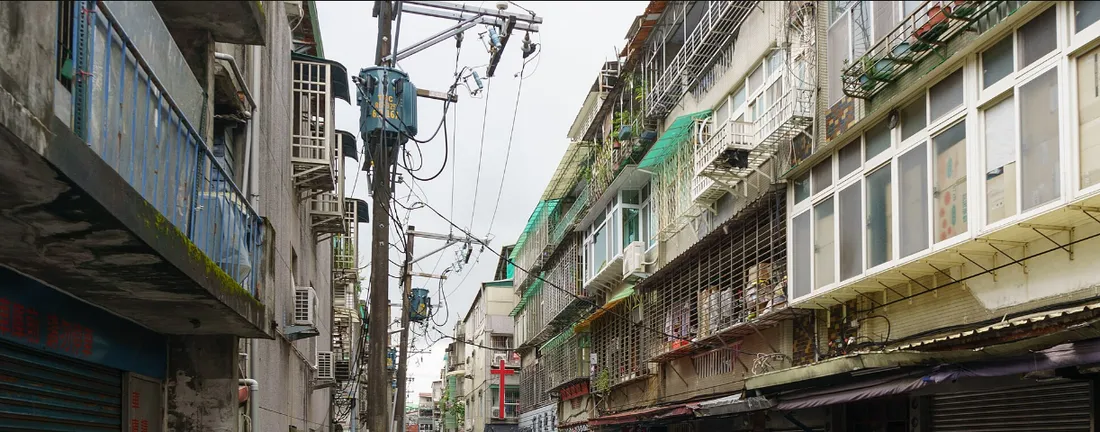
- Older walk-up apartment buildings along a residential street in Taipei, photographed in 2017.: eugene_o, CC BY 2.0, via Wikimedia Commons
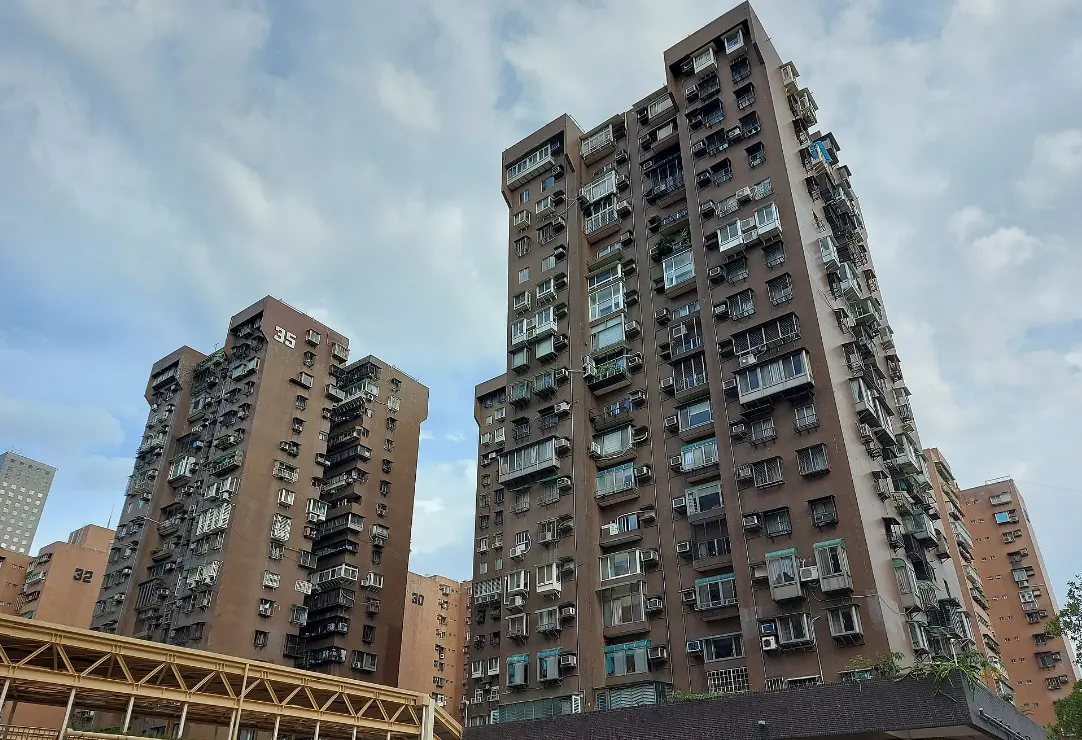
- Apartment towers in Taipei, photographed in August 2023.: Johan Jönsson (Julle), CC BY-SA 4.0, via Wikimedia Commons
Get new jobs in Taiwan by email
One email a week with the jobs added since the last one. Free, with no account.
Nothing is sent until you open the link we email you. Choose a role, a pay level or daily emails
We use your address only to send the alerts you ask for, and every email has a one-click unsubscribe link. The privacy notice says how long we keep it, and the terms of use cover the alerts.
We check this guide again by February 3, 2027. Rules change, so confirm visa steps with the embassy and your school before you go. First published November 5, 2026. Spotted something out of date? Tell us. How we write these guides.