Opening a bank account in Thailand
Walk into a Thai bank with the right papers and leave with an account, a card and an app. Here's which banks take foreign teachers, what each asks for, and how to cover your costs until the first salary lands.
AbroadPin team6 min read
Contents
Thai banks will open an account for a foreign teacher, but they want to see why you're here. For most teachers that means a work permit, or a letter from the school while the permit is on its way. The good news is that the visit itself is short once your papers are in order. This article walks through the banks, the documents, the costs and the gap before your first payday. For the visa, the work permit steps and what schools pay, read the main guide to teaching in Thailand.
Which banks foreign teachers use
The big Thai banks all take foreign customers. Expat.com's guide names Bangkok Bank, Kasikorn Bank, Siam Commercial Bank (SCB), Krungsri, Krungthai, TMB, UOB, CitiBank and HSBC among the banks expats use [7]. The government's own information page compares four of them: Bangkok Bank, Kasikorn, Krungthai and SCB [1].
There's no single right choice, but a few things help you pick:
- Your school's payroll bank. Ask HR which bank pays salaries. Many schools already have a branch that handles their foreign staff, and staff there know the paperwork.
- A branch near work or home. You open the account in person, so pick a branch you can reach easily.
- A branch used to foreigners. The Thaiger's 2026 guide suggests trying another branch if the first says no, ideally one in an area with many expats, where staff handle foreign files every week [6].
Each bank sets its own rules, and the government page says so plainly [1]. Rules can change, so call or visit your chosen branch first if you can.
What papers banks ask for
Start with your passport and your visa. A tourist visa won't work: Kasikorn's savings page says accounts are not opened for holders of a tourist visa [2]. The Thaiger reads the same policy as covering visa exemption, visa on arrival and the Destination Thailand Visa too [6]. Teachers on a Non-Immigrant B visa are in a much better position.
Here's what the banks' own pages and the government page list:
- Kasikorn (KBank): a passport, a Non-Immigrant visa of any type, an identity document from your home country, and documents that match your purpose in Thailand, such as a work permit [2].
- SCB: for a foreigner, a passport and a work permit [3].
- Bangkok Bank: its expat booklet lists a passport and work permit for work permit holders on a Non-Immigrant B visa [5]. That booklet dates from January 2017, so check the current list at the branch [5].
- Krungthai: the government page lists a passport and a copy of a house registration [1].
Some branches also ask for a certificate of residence from immigration. The Thaiger says immigration issues it against your TM30 address report, which your landlord or hotel files, and that it's good for about 30 days [6]. If your branch wants one, ask your school or landlord whether the TM30 is done before you go.
You'll also need a Thai phone number. The Thaiger says the account and its app are tied to an active Thai SIM [6]. Bangkok Bank's booklet says the number for mobile banking must be registered in Thailand [5]. Get your SIM in your first days, before the bank visit.
Pack this folder:
- Your passport, plus photocopies of the photo page, your visa and your latest entry stamp.
- Your work permit, or a letter from the school if it isn't ready (see below).
- Your employment contract.
- Your lease and your Thai address written out as it appears on it.
- A certificate of residence, if your branch asks for one.
- A home-country ID card or driving licence.
- Your Thai phone, with the SIM active.
If your work permit isn't ready yet
This is the usual situation in your first weeks. The government page says most banks ask for a work permit, but that a government document showing the date the permit will be issued can stand in for it [1]. It also says Bangkok Bank and SCB accept a certificate of work from your employer while the permit is pending [1].
So the first thing to ask HR for is an employment letter on school letterhead. It should give your name as it appears in your passport, your job title, your start date, your contract length and your salary.
How long it takes and what it costs
Once you're at the counter with the right papers, it's quick. Expat.com says opening an account should not take more than half an hour [7].
Opening deposits on the banks' own pages are small:
- Kasikorn's savings account needs at least 500 baht to open [2].
- SCB's savings account needs at least 500 baht to open [3].
- Bangkok Bank's savings account needs 500 baht, according to its 2017 booklet [5] and The Thaiger's September 2026 guide [6].
Kasikorn notes that interest is credited every June and December, and that up to 20,000 baht a year of savings interest is free of tax [2].
Expat.com suggests asking about two other costs at the counter: the yearly fee for your debit card and the fee for replacing a lost one [7]. Banks don't list these on the savings pages we read, so ask before you choose a card.
Cards, apps and PromptPay
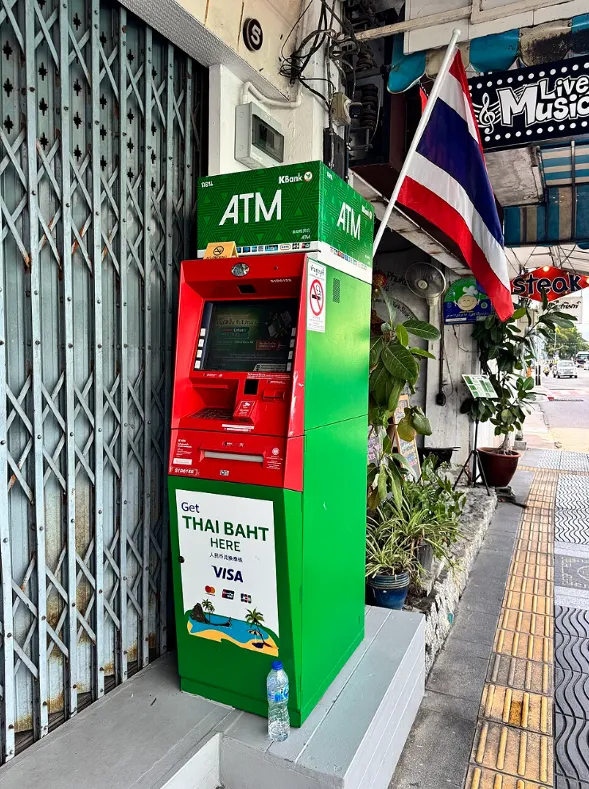
Your debit card works at your own bank's ATMs and in shops. Expat.com notes that using your bank's ATM in another province can cost 15 baht, while withdrawals in the province where you opened the account are generally free [7].
The banking app matters as much as the card. The Thaiger notes that a Thai account lets you use PromptPay properly, set up direct debits for rent and utilities, and receive your salary [6]. Once you have the app, link the account to PromptPay, the national system that lets people send money to a phone number instead of an account number [4]. Bangkok Bank says PromptPay transfers through its mobile and internet banking are free, with no limit on the number of transfers [4]. You can register at a branch, an ATM or in the app [4].
To pay a shop, open your bank app, scan its QR code, check the amount and confirm. Wise describes the transfer as instant [8]. Wise also lists standard PromptPay fees as nothing up to 5,000 baht and under 10 baht even for the largest payments, and notes that most banks waive some of these fees [8]. Check your own bank's fee list.
Getting paid before the account is open
Your first payday may come before your account is ready, so plan for the gap.
- Ask HR in your first week which bank they pay through, when the first salary is due, and whether they can pay late or another way if your account isn't open.
- Ask for the employment letter at the same time, so the bank visit doesn't wait for your work permit [1].
- Bring savings and a home card for your deposit, rent, a SIM and food. Expat.com says many Thai ATMs charge 220 baht to use a foreign card [7]. Take out larger amounts less often.
- If you're paid in cash, count it in front of the person paying you and ask for a signed receipt to keep with your contract.
- Give payroll your account number in writing as soon as you have it, with your name spelled as in your passport.
Until then, The Thaiger mentions prepaid QR products such as PAY&TOUR for daily spending [6]. Wise says you apply for that card at a Kasikorn currency exchange booth with your passport [8].
With kids
Your spouse may want their own account. Kasikorn's page accepts a Non-Immigrant visa of any type, together with documents that match your purpose in Thailand [2]. That suggests a spouse on a family visa can apply, but ask the branch which papers it wants for a dependant, such as a marriage certificate. If your children go to an international school, ask its finance office early how it takes fees, whether by bank transfer or QR code, and which bank it uses.
Once your banking is sorted, look at teaching jobs in Thailand and contact schools directly.
See jobs in Thailand
- Early Years Homeroom Teacher, 2027-2028 (BCIS Chiang Mai)Chiang Mai
- Head of English, August 2027 (Regents International School Pattaya)Pattaya
- Nursery and Kindergarten English Teacher, January 2027 (Essential partner school, Srinagarindra Bangkok)Bangkok
- Kindergarten English Teacher, start now (Essential partner school, Sathorn Bangkok)Bangkok · $1,327 to $1,415 a month
- Year 1 and Year 4 Homeroom Teacher (Sarasas Ektra School Bangkok)Bangkok
By city: Teaching jobs in Bangkok
Sources and photo credits
- 1.Thailand.go.th, what documents foreigners need to open a bank account in Thailand (17 January 2023)
- 2.Kasikornbank, savings account (undated, read 5 November 2026)
- 3.Siam Commercial Bank, savings account (undated, read 5 November 2026)
- 4.Bangkok Bank, PromptPay (updated 16 October 2026)
- 5.Bangkok Bank, expat booklet (January 2017)
- 6.The Thaiger, opening a Thai bank account as a foreigner (updated 10 September 2026)
- 7.Expat.com, opening a bank account in Thailand (updated 15 July 2024)
- 8.Wise, guide to PromptPay for foreigners (22 February 2026)
Photos
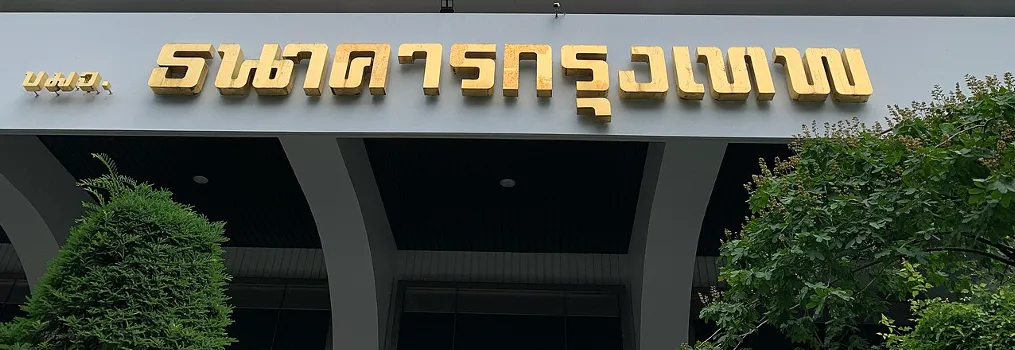
- The entrance to Bangkok Bank's head office on Silom Road, Bangkok.: Chainwit., CC BY-SA 4.0, via Wikimedia Commons
- A Kasikornbank cash machine in Phuket Old Town.: JULIANISME, CC BY-SA 4.0, via Wikimedia Commons
Get new jobs in Thailand by email
One email a week with the jobs added since the last one. Free, with no account.
Nothing is sent until you open the link we email you. Choose a role, a pay level or daily emails
We use your address only to send the alerts you ask for, and every email has a one-click unsubscribe link. The privacy notice says how long we keep it, and the terms of use cover the alerts.
We check this guide again by February 3, 2027. Rules change, so confirm visa steps with the embassy and your school before you go. First published November 5, 2026. Spotted something out of date? Tell us. How we write these guides.