Getting a phone number and SIM in Italy
Get an Italian number early so bank codes, couriers and your school can reach you. Here's the ID to carry, the networks and budget brands, what a month costs and how to hold on to your old number.
AbroadPin team7 min read

Contents
An Italian mobile line is cheap to run, but getting one takes a little more paperwork than in many countries. You'll show photo ID every time, and some brands also want your Italian tax code. This page covers what to carry to the shop, the networks and cheaper brands, current prices, eSIM, roaming and your number from home. For pay, visas and who hires, see the main guide to teaching in Italy.
The ID you'll be asked for
Every new line in Italy is registered to a named person. The prepaid SIM wiki says a photo ID such as a passport is compulsory for a prepaid card [1]. The shop copies your details and links them to the number before the card works.
The codice fiscale is the second thing that comes up. It's the 16-character personal code that Italy uses to identify you to public offices and businesses [6]. According to the wiki, the law doesn't make it a condition for buying a SIM, but some carriers ask for it in certain cases [1]:
- Vodafone's offers for foreigners and tourists officially require a foreign tax ID [1].
- Very Mobile needs an existing codice fiscale when you order online [1].
- TIM's international plans ask for proof that you were born outside Italy, and a foreign passport or ID is often enough [1].
Some sellers will offer to work a code out for you at the counter. Wikipedia's entry notes that the only official code is the one issued by the tax office, the Agenzia delle Entrate [6]. You'll need the real one soon anyway, because it's asked for when you open a bank account or sign a lease [6]. Our guide to opening a bank account in Italy explains where to get it.
Pack these for the shop:
- Your passport [1].
- Your codice fiscale, if you already have it [1].
- A phone that isn't locked to your carrier at home.
Your first days: roaming, Wi-Fi or a local card
How you get online on arrival depends on where your current SIM comes from.
- A SIM from another EU country. The EU's roam-like-at-home rules mean calls, texts and data cost what they cost at home, and incoming calls and texts carry no extra charge [5]. Your operator can still cap the data you use at home prices under its fair use policy [5].
- A SIM from outside the EU. The EU rules don't cover it, so check your carrier's daily or monthly roaming rates before you fly.
- A local card straight away. Carrier stores in most town centres sell and register SIMs on the spot.
An EU SIM won't do as your only line once you live in Italy. Roaming is meant for temporary trips, and the rules tie your line to the country where you live, work, study or have other stable links [5]. An operator can review your use over 4 months, and if you're abroad more than at home it can ask you to explain, with 14 days to answer [5]. If use abroad keeps exceeding home use, surcharges can follow [5].
The four networks and the brands that use them
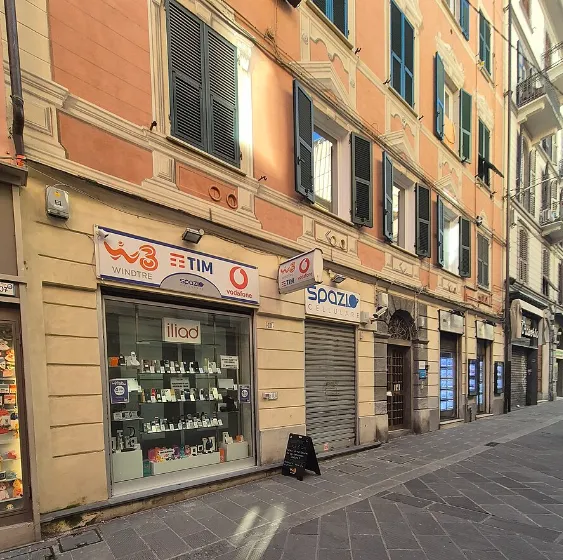
Italy has four main mobile networks: TIM, Vodafone, WindTre and iliad [1]. Fastweb runs a fifth, 5G-only network that it built with WindTre [1]. Many smaller brands (MVNOs) rent space on the big networks and usually cost less. The wiki lists these pairings [1]:
| Network | Brands that run on it |
|---|---|
| TIM | Kena Mobile, Coop Voce, Tiscali, Digi Mobil |
| Vodafone | ho. mobile, PosteMobile, Lyca Mobile, Noitel |
| WindTre | Very Mobile, Fastweb |
Where to buy:
- Carrier stores. TIM, Vodafone, WindTre, iliad, Fastweb, Kena, Tiscali, Digi Mobil and ho. mobile all have shops or sales points [1].
- Post offices and supermarkets. PosteMobile sells at post offices, Coop Voce in larger Coop stores and Lyca Mobile in outlets such as Carrefour hypermarkets [1].
- iliad's Simbox kiosks. These self-service machines sell a SIM on the spot after you scan your ID and pass a video check [1].
- Online. Most brands only ship to an Italian postal address, so this suits you once you have a home [1].
Top-up cards are sold at tobacconists, newsagents, supermarkets and many bars [1].
What a month costs
The budget brands are where prices are lowest. These are monthly prices as the brands' own pages showed them on 5 November 2026 [2] [3] [4].
Very Mobile (WindTre network) lists these plans for new numbers, with SIM and shipping free [3]:
| Very Mobile plan | Price a month | Data |
|---|---|---|
| Very 5,99 | 5.99 euros | 150 GB |
| Very 7,99 | 7.99 euros | 300 GB |
| Very 9,99 | 9.99 euros | 440 GB |
| Very Giga illimitati | 14.99 euros | Unlimited |
The 150 GB to 440 GB plans come with unlimited minutes [3]. Very sells cheaper versions of some plans to people bringing a number from iliad, PosteMobile, Coop Voce and others, such as unlimited data for 9.99 euros a month [3].
Kena Mobile (TIM network) sells a 6-month pack for 29.99 euros with 200 GB, unlimited minutes and 200 texts, renewed after 6 months, with activation, SIM and delivery free [4]. Its 4.99 euro plan with 150 GB is only for people moving a number from iliad, Coop, Sky Mobile and other operators [4]. Kena activates new SIMs through CIE, SPID or a video selfie [4]. CIE is the Italian electronic identity card and SPID the public digital identity, so if you have neither, the video selfie is your route.
iliad charges 9.99 euros to activate a SIM, and its larger plans include 5G on compatible phones where there's coverage [2].
The big three's starter cards. The wiki lists a TIM SIM at 10 euros with 5 euros of credit, a Vodafone SIM at 10 euros with 5 euros loaded and a WindTre activation at 10 euros plus the plan [1]. PosteMobile charges 15 euros with 5 euros of credit, and Coop Voce 10 euros with a 5 euro balance [1]. The wiki gives no date for these, so confirm in the shop.
Tourist plans
The large carriers also sell month-long plans aimed at visitors. The wiki lists TIM Tourist at 20 euros plus about 10 euros for the SIM, with 200 minutes and 15 GB in Italy [1]. Vodafone's Dolce Vita costs 24.99 euros a month with 30 GB in Italy and 600 minutes [1]. WindTre's Italy Tourist Pass is 24.99 euros for 20 GB over 30 days, is reserved for foreign citizens and can't be reactivated on the same SIM [1]. These are fine for a short first stay, but for a school year a regular plan from the list above costs far less [1] [3] [4].
eSIM or a plastic card
An eSIM saves a trip to the shop and leaves your home SIM in the tray. The wiki says Very Mobile offers eSIMs on all its plans and iliad offers them too [1]. Kena also promotes its own eSIM [4].
Two checks before you rely on one:
- Is your phone unlocked? A handset tied to your old carrier won't load an Italian profile.
- Does it support eSIM? The answer is in the phone's settings or on the maker's website.
International eSIM sellers such as Yesim and Airalo sell data-only packages for Italy [1]. They give you data, not an Italian number, so they don't replace a local line for long.
Why an Italian number matters
Roaming and Wi-Fi get you online, but daily life in Italy expects a local number.
- Banking. Italian banks text security codes and payment alerts, and many need a local number to set up the app.
- Your school. Timetable changes, substitutions and staff chats go to your mobile, often on WhatsApp.
- Deliveries and flat hunting. Couriers and landlords call or text, and an Italian number gets a quicker reply.
- Appointments. Health services and public offices often confirm bookings by text.
- Online sign-ups. Shops, transport apps and utility accounts often expect an Italian number.
Keeping your home number
Banks, tax offices and email accounts back home may still send codes to your old number.
- Run two lines on one phone. A dual-SIM phone, or one card plus an eSIM, lets the home line receive codes while the Italian line does everything else.
- Find the cheapest way to keep it active. Ask your home carrier about its lowest plan and what an incoming text costs abroad.
- Switch codes to an authenticator app. Where a service allows it, do this before you leave.
Inside Italy you can move your number when you change brand. Several budget brands sell lower prices only to people bringing a number from another operator [3] [4]. So start on whatever is quickest, and later ask the new brand to transfer your number before you cancel the old line.
Your first month in order
- Before you fly, check that your phone is unlocked, check eSIM support and decide what to do with your home number.
- On arrival, use an EU SIM or Wi-Fi for a day or two [5].
- Take your passport to a carrier store, a post office or an iliad kiosk and register a card [1].
- Get your official codice fiscale, which you'll need for the bank and the lease anyway [6].
- Give your number to your school, landlord and bank.
- Once you have an address, compare budget plans online and move your number if a better deal fits [3] [4].
When your phone is sorted, browse the open jobs in Italy.
Sources and photo credits
- 1.Prepaid Data SIM Card Wiki, Italy, crowd-edited (read 5 November 2026)
- 2.iliad, mobile offers page with SIM activation fee and 5G notes (read 5 November 2026)
- 3.Very Mobile, home page with mobile plans for new numbers and number transfers (read 5 November 2026)
- 4.Kena Mobile, home page with mobile plans and SIM activation methods (read 5 November 2026)
- 5.European Commission, Your Europe, mobile roaming costs in the EU (last checked 7 January 2026)
- 6.Wikipedia, Italian fiscal code (read 5 November 2026)
Photos
- Terminal 1 at Rome Fiumicino airport.: Ypsilon from Finland, CC0, via Wikimedia Commons
- A phone shop in Italy with WindTre, TIM, Vodafone and iliad signs.: ItzANormalFioko, CC BY-SA 4.0, via Wikimedia Commons
Get new jobs in Italy by email
One email a week with the jobs added since the last one. Free, with no account.
Nothing is sent until you open the link we email you. Choose a role, a pay level or daily emails
We use your address only to send the alerts you ask for, and every email has a one-click unsubscribe link. The privacy notice says how long we keep it, and the terms of use cover the alerts.
We check this guide again by February 3, 2027. Rules change, so confirm visa steps with the embassy and your school before you go. First published November 5, 2026. Spotted something out of date? Tell us. How we write these guides.