Opening a bank account in Brazil
Get your Brazilian salary into an account you control in your first few weeks. Here's how to get a CPF, which banks take foreign residents, what the basics cost and how pay reaches you before the account is ready.
AbroadPin team8 min read
Contents
In Brazil, a bank account starts with a number rather than a branch visit. That number is the CPF, the individual taxpayer registration, and without it most banks won't even start the application. Add your migration card and a Brazilian address and the rest is usually quick. This page walks through each step, what the basics cost, and how your school pays you in the meantime. For pay, work papers and employers, see the main guide to teaching in Brazil.
Start with your CPF
Serasa, Brazil's big credit bureau, says banks generally ask for a CPF, and that without one opening an account is usually blocked (July 2026) [4]. You can get it before you fly or after you land.
From abroad. Foreigners living outside Brazil apply in person at a Brazilian consulate or embassy, booked through its e-consular system [2]. Bring the completed FCPF form, an identity document and a birth or marriage certificate [2]. The service is free, and the federal page gives no processing time [2].
In Brazil. You have several routes, all listed on the federal services portal [1]:
- the online form "Inscrever Estrangeiro no CPF" on the Receita Federal site;
- the Receita Federal's email service;
- a Receita Federal office, or a virtual service point run by a partner body;
- a partner outlet: a civil registry office (cartório), Banco do Brasil, Caixa Econômica Federal or a Correios post office.
Registration is free, except at partner outlets, which charge R$ 7.00 [1]. Bring an official photo ID, plus a birth or marriage certificate if your ID doesn't show your place of birth, parents and date of birth [1]. Email requests take about 48 hours on average [1]. If the online form or a partner outlet gives you a service protocol instead of a number, you take it to the Receita Federal with your documents, which takes about 2 working days [1].
There's no plastic card. The Rio Times notes that your proof is the Comprovante de Situação Cadastral, a document with a QR code that you print or save online (September 2026) [7].
Your migration card and the other papers
Once you're in Brazil on a work residence, you register with the Federal Police and receive the CRNM, the national migration card. The Rio Times puts the deadline at 90 days from arrival [7]. Serasa says the card shows your RNM number, nationality, CPF and whether your residence is temporary or permanent, and that a passport on its own usually isn't enough to open an account [4].
The Banco Central do Brasil's guide for migrants says there's no fixed national list of documents (updated June 2023) [3]. Each bank sets its own, and any identity document recognised by Brazilian law is valid; for migrants it names the CIE, RNE and CRNM [3]. In practice, banks ask for some or all of these [7] [8]:
- your passport;
- your CPF;
- your CRNM, or at least proof that you're in Brazil legally;
- a Brazilian proof of address, such as a water, power or phone bill or a rental contract;
- a Brazilian phone number and an email address, which the bank uses for alerts and sign-in;
- for some banks, proof of income, such as your work contract or a payslip.
If you're still in temporary housing, ZS Associados, a São Paulo law firm, says a bank may accept your hotel or hostel address with a written statement that you're in transition (March 2026) [8]. Digital banks may also ask for a selfie to check your face against your ID [4].
One thing to know before you go: the central bank says no bank is obliged to open an account, even when your documents are complete, and the same is true for Brazilians [3]. If one bank says no, try another.
Which banks teachers use
The big traditional banks. The Rio Times names Itaú, Bradesco, Banco do Brasil, Caixa and Santander [7]. They have branches, so you can sit down with someone and ask questions, which helps when your Portuguese is still basic.
Digital banks. Serasa lists Banco Inter, Nubank, PicPay, C6 Bank, Mercado Pago and PagBank as digital accounts that accept the RNM [4]. A few things to check before you choose:
- The Rio Times says Nubank filters by residence status, and applicants without it are often turned down [7].
- It also says Mercado Pago and PagBank offer fewer services than a full current account [7].
- Banco Inter's help centre lists the permanent RNE or RNM among the ID it accepts from foreigners, and doesn't mention a temporary one (read 4 November 2026) [5]. If your card shows a temporary residence, ask Inter before you count on it.
Non-resident accounts are a different product, for people who live abroad. Serasa says they ask for a home-country tax number, proof of an address abroad and proof of income, and generally cost more [4]. It also says a tourist visa isn't enough for a Brazilian digital account [4]. Once you hold a work residence, you want an ordinary resident account.
How long it takes
At a traditional bank, the account itself is usually formally open within 1 to 5 working days [7] [8]. ZS Associados says a physical debit card can take 10 to 20 days to arrive [8]. Counting the CPF and the paperwork, the Rio Times puts the full setup at one to three weeks for residents [7].
Expect low limits at first. The Rio Times says new foreign customers typically start with daily withdrawals of R$ 500 to 1,000 and daily transfers of R$ 5,000 to 10,000, rising after 30 to 90 days of regular use [7]. If your rent deposit is large, plan around that.
Fees and the free basics
Brazil sets a list of essential services a current account must give free each month. The central bank's guide lists these [3]:
- 1 debit card [3];
- 4 withdrawals [3];
- 2 transfers to accounts at the same bank [3];
- 2 statements of the last 30 days [3];
- internet banking queries [3].
That list covers current accounts only. The central bank says there's no official free list for payment accounts, the kind many apps offer, and they may charge a maintenance fee if they disclose it clearly [3]. ZS Associados says current accounts are free at most banks, or up to R$ 20 a month if you don't meet the bank's minimum conditions [8]. It puts credit card annual fees at R$ 0 to 300 [8]. Ask for the bank's fee table (tabela de tarifas) before you sign anything.
Your money is protected up to R$ 250,000.00 per institution at banks and credit cooperatives [3]. Payment institutions have no guarantee fund, but the law makes them keep clients' money apart from their own [3].
Pix, cards and paying day to day
Pix is the central bank's instant payment system, and you'll use it for rent, shops, taxis and splitting bills. The Rio Times describes transfers between individuals as free, instant and available around the clock [7]. The central bank says individuals pay no fee to send or receive a Pix in ordinary cases [3]. A bank may charge if you use a branch or phone channel when an electronic one is available [3]. Fees can also apply to Pix received for commercial sales, which the guide says includes receiving more than 30 a month through a key or static QR code [3]. If you take payment from private students by Pix, read your bank's terms on this.
On cards and credit, the central bank's guide makes these points [3]:
- No bank has to give you a credit card, and paying only the minimum on the bill works as a high-interest loan [3].
- Overdraft (cheque especial) is a loan too, and its interest can't go above 8% a month [3].
- If you're defrauded by Pix, you can ask for a refund through the Special Return Mechanism (MED): report it to your bank, file a police report and contact the bank's ombudsman, and each institution has 7 days to look at the case [3].
Your home bank card works for the first weeks, but the Rio Times notes that IOF tax applies to international card spending, at rates set by decree that change over time [7].
Getting paid before your account is open
Many Brazilian employers pay through a salary account (conta-salário). The central bank says the bank opens it at the employer's request under a contract with that employer, and it takes only the employer's deposits [3]. Santander describes it as limited and meant only for receiving pay [6].
You don't have to keep your money there. Through salary portability you ask the bank you prefer to receive your pay, using your employer's CNPJ from your payslip, and the move is free [6]. Santander says the original bank has up to 10 working days to set it up, after which each payday's salary is passed on in full the same day [6]. You can cancel or switch banks later [6].
Ask your school these questions before your first payday:
- Which bank does it pay through, and will it open a salary account for you?
- Can it pay into a salary account before your CRNM arrives, or does it need the card first?
- When is the first payday, and is the first month paid in full or pro rata?
Until the money arrives, live on savings and your home card. The main guide suggests how much start-up money to bring.
Sending money home
Transfers abroad must go through institutions the central bank authorises for foreign exchange [3]. Before you send, ask for the VET (Valor Efetivo Total), the total effective cost, so you can compare offers [3]. Money arriving from abroad is always paid out in reais [3]. If you carry more than US$10 thousand in cash across the border, you must declare it through the e-DBV [3].
A first-month checklist
- Get your CPF at a consulate before you fly, or online or at a Receita Federal office after you land [1] [2].
- Register with the Federal Police and keep your CRNM paperwork with you [7].
- Get a Brazilian phone number for bank alerts [8].
- Collect a proof of address, or a statement from your landlord or hotel [8].
- Open a current account at a bank that takes your type of residence [4] [5].
- Set up Pix in your banking app.
- Ask for salary portability if your school pays through a salary account [6].
Once your paperwork is moving, have a look at English teaching jobs in Brazil.
See jobs in Brazil
Sources and photo credits
- 1.Gov.br, registering a foreigner for a CPF in Brazil (updated 8 October 2026)
- 2.Gov.br, registering for a CPF from abroad (updated 15 December 2025)
- 3.Banco Central do Brasil, financial information booklet for migrants and refugees (updated June 2023)
- 4.Serasa, digital accounts for immigrants: documents and how to open one (30 July 2026)
- 5.Banco Inter help centre, documents needed to open a personal account (read 4 November 2026)
- 6.Santander Brasil, how salary account portability works (20 January 2022, read 4 November 2026)
- 7.The Rio Times, opening a Brazilian bank account as a foreigner starts with a tax number (22 September 2026)
- 8.ZS Associados, bank accounts in Brazil for foreigners: requirements (1 March 2026)
Photos
- A Banco do Brasil branch in Jaguaré, São Paulo.: Dornicke, CC BY-SA 4.0, via Wikimedia Commons
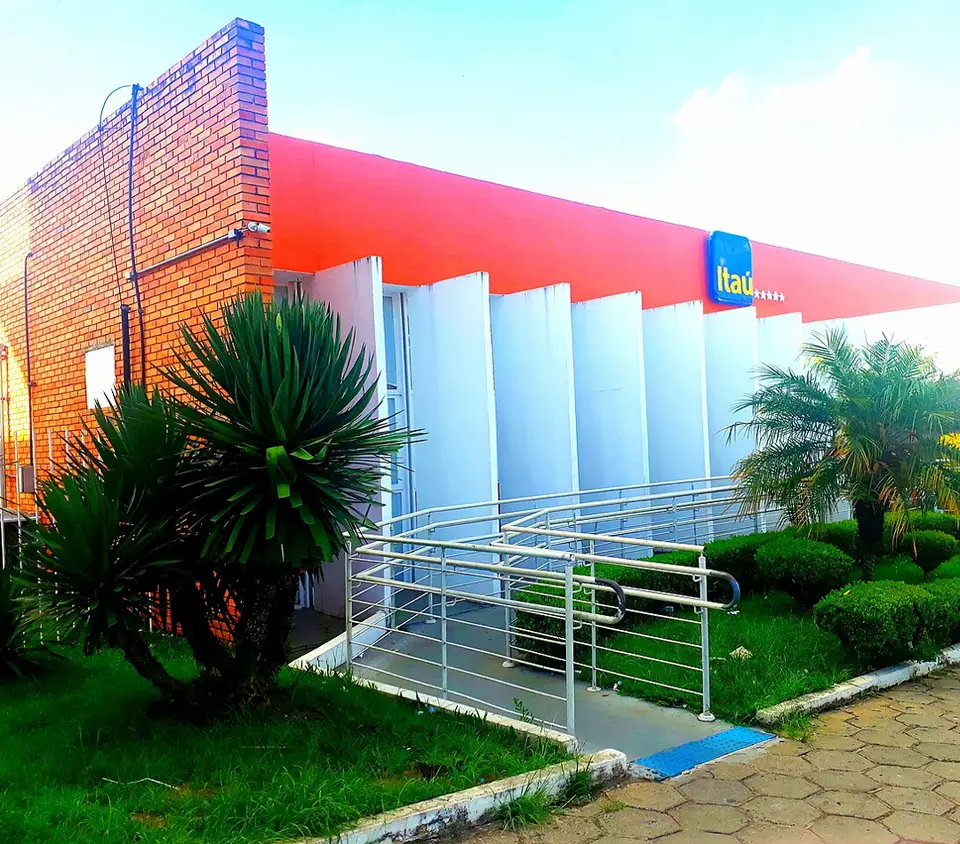
- An Itaú branch in Telêmaco Borba, Paraná.: Simplus Menegati, CC BY-SA 4.0, via Wikimedia Commons
Get new jobs in Brazil by email
One email a week with the jobs added since the last one. Free, with no account.
Nothing is sent until you open the link we email you. Choose a role, a pay level or daily emails
We use your address only to send the alerts you ask for, and every email has a one-click unsubscribe link. The privacy notice says how long we keep it, and the terms of use cover the alerts.
We check this guide again by February 2, 2027. Rules change, so confirm visa steps with the embassy and your school before you go. First published November 4, 2026. Spotted something out of date? Tell us. How we write these guides.