Finding an apartment in China
Find a home in China that fits your budget and keeps your paperwork in order. Here's how school housing, agents, deposits and registration work.
AbroadPin team8 min read
Contents
Housing is a big part of any China teaching offer, and it shapes how much of your salary you actually keep. Some teachers never sign a lease because the school hands them a key. Others get an allowance and go flat hunting in their first week. Either way, there's one legal step you can't skip: registering where you live with the police.
This article is about finding and renting a home. For pay, the work visa and who hires, see the main guide to teaching in China.
School housing or your own place
Free housing or a housing allowance is a normal part of a China teaching package. eslbase, which reviewed its China figures in October 2026, says standard contracts offer "free housing or a monthly housing allowance" [5]. By employer, it says [5]:
- Public schools typically include free housing or an allowance, alongside flights and health insurance [5].
- Training centres commonly provide or subsidise housing, though the overall package may be thinner [5].
- International schools usually include housing in the benefits [5].
TEFL.org's August 2026 guide agrees that most teachers get free accommodation or an allowance [6]. It puts living costs in Shanghai or Beijing at about ¥4,000 a month, not counting rent [6].
Neither source gives a typical allowance amount, so compare any figure you're offered with local rents (below). Before you sign, eslbase suggests making sure the contract spells out the housing arrangement, and asking for anything vague or verbal in writing [5]. Good questions to ask the school:
- Is the flat shared, and with whom?
- Who pays the utility bills and the internet?
- How far is it from the school, and what's the commute like?
- If it's an allowance, is it paid with your salary or straight to a landlord?
- Can you see photos or a video of the actual flat?
A school flat saves you the deposit, the agent's fee and the search. Your own place gives you a choice of area and flatmates.
What rent costs: Shanghai and Chengdu
Rents vary hugely between the biggest cities and everywhere else. Numbeo's crowd-sourced figures, last updated on 3 November 2026 for Shanghai and 4 November 2026 for Chengdu, are monthly rents in yuan [3][4]:
| Monthly rent (Numbeo, November 2026) | Shanghai | Chengdu |
|---|---|---|
| 1 bedroom, centre | ¥7,103.81 | ¥2,855.38 |
| 1 bedroom, further out | ¥3,829.41 | ¥1,556.15 |
| 3 bedrooms, centre | ¥18,000.00 | ¥4,991.54 |
| 3 bedrooms, further out | ¥7,882.50 | ¥3,096.67 |
eslbase gives broader ranges for a studio or one-bedroom: ¥3,000 to 7,000 a month in tier-one cities, and ¥1,500 to 3,500 in smaller ones [5]. Short-term rentals usually cost more per month than a yearly lease [8].
Agents, websites and viewings

If you don't speak Mandarin, you'll probably end up working with a Chinese real estate agent [7]. Some agencies in big cities offer service in English, but you may still need someone to translate when you negotiate [7]. Agents often work with particular buildings, so be clear from the start about your budget, the area and how you'll get to work [8].
Online portals exist too. Expat Arrivals names FlatInChina among them [7]. It also points out that some of the best deals in Shanghai never reach the internet, and come through friends and colleagues instead [8]. Your school's Chinese staff and the teachers already there are worth asking first.
A few things that help on viewings:
- Try more than one agency, and don't panic if the first week turns up nothing [8].
- Ask whether the flat is furnished, because that should show in the price [8].
- Bargaining is normal, and a good negotiator may get roughly 1 to 10 percent off the asking rent [8].
Deposits, rent in advance and agent fees
Plan for a big payment on the day you sign. Expat Arrivals describes the usual pattern [7][8]:
- A deposit of at least one month's rent, which is refundable [7].
- Rent in advance of one or two months, paid when you sign [7][8].
- The agent's fee, usually around one month's rent or a share of it, paid by the tenant and open to negotiation [7].
So moving into a ¥3,000 flat could mean handing over three or four times that amount at the start, before furniture or bills [7]. After that, rent is normally paid monthly [7]. Japan-style "key money" (a fee you never get back) isn't part of the usual pattern these guides describe; if a landlord asks for any payment beyond the deposit, advance rent and agent's fee, ask what it's for and get it in writing.
What a lease asks of foreigners
Leases usually run for one year, though some are three or six months [7]. For a Shanghai lease, Expat Arrivals lists what you should have ready [8]:
- your passport or other ID
- your residence permit
- a bank statement or proof of employment
If you need proof of employment, ask your school for a letter. Ask the landlord for two things in return: a copy of their ID and proof that they own the property [8]. You'll need both to register with the police, and the ownership proof also protects you from someone renting out a flat that isn't theirs [7].
Get a contract in both English and Chinese, and have a Chinese speaker check that the two match [7]. If there's ever a dispute, the Chinese version is often the one that counts [7]. When you move in, make a list of the furniture and its condition, with photos [8].
Registering your address with the police
Don't skip this one. If you stay anywhere other than a hotel, you or your host must register your accommodation within 24 hours of arrival, under the Exit and Entry Administration Law [1]. Hotels do this for their guests; in a rented flat it's on you and your landlord [1][2].
- In person: go to the local police station or the exit and entry office with your passport and your rental contract or the property ownership certificate [1][2].
- Online: since 20 March 2026, the National Immigration Administration has piloted online registration in seven provincial-level regions: Hebei, Liaoning, Zhejiang, Hubei, Guangxi, Chongqing and Sichuan [1]. It runs on the NIA government service website, the NIA 12367 app, the NIA 12367 WeChat mini program and an Alipay mini program, and it carries the same legal effect as registering in person [1]. The service is due to expand nationwide gradually [1].
For the first registration, the NIA says the host should help, since they know the property details best [1]. Under Article 76 of the same law, failing to register brings a warning and possibly a fine [1]. The NIA's explanation doesn't give an amount, and neither do the other sources here.
Keep the registration record. The Ministry of Commerce's guide notes that immigration officers may ask for proof of residence registration with a visa application [2]. Once you hold a residence permit, you don't need to register again each time you come back to the same long-term home while that permit is valid [1]. If you move flats, check with your local police station what's needed for the new address, because the national guidance doesn't spell it out.
Utilities and internet
Tenants usually pay the bills, and the way you pay differs by city [7][8].
- Electricity: many flats use prepaid meters that you top up [7]. In Shanghai, a post-paid account with the State Grid generally needs your passport, residence permit and lease, and the process is in Mandarin [8].
- Gas and water: you get a bill after the meter is read, or sometimes the landlord passes the bill on to you [7][8].
- Paying: bank transfer, Alipay and WeChat Pay are all accepted in Shanghai [8]. Our guide to opening a bank account in China covers getting set up for that.
- Internet: you apply to the regional telecom company or China Telecom to connect the flat, and bills usually come monthly [7].
Numbeo puts basic utilities for a flat of 915 square feet (about 85 square metres) at ¥386.27 a month in Shanghai and ¥316.58 in Chengdu, with broadband at ¥70.73 and ¥84.86 [3][4]. eslbase says electricity, gas, water and internet for a studio typically total ¥500 to 1,000 a month [5].
One more Shanghai rule: rubbish sorting is enforced, with fines if you don't follow it [8]. Ask the building manager which bins are which.
Scams and problems to watch for
- No proof of ownership. Ask for it before you sign, and walk away if it doesn't appear [7].
- Paying before seeing. Visit the flat yourself, or send someone you trust, before signing anything [7].
- Cash only. Some landlords ask for cash; an online payment leaves a record and is safer [7].
- Bait flats. Agents sometimes overcharge foreigners or push flats that turn out to be gone [8].
- Room-for-tutoring deals. Expat Arrivals reports many problems with homestays where the family expects you to tutor their children [7]. eslbase notes that homestay programmes trade English practice for accommodation, meals and a stipend, and aren't school jobs [5].
- Recruiter fees. If anyone asks you for a placement fee for a job, eslbase's advice is to walk away [5].
With kids
Families need more space, and the jump in price is steep. Numbeo's three-bedroom figures above run from ¥3,096.67 a month outside central Chengdu to ¥18,000 in central Shanghai [3][4]. Expat families in Shanghai often prefer serviced apartments or compounds, which are in high demand [8]. If your contract only covers a single teacher's flat, ask the school early whether it will pay a bigger allowance for a family. Pick the area with the school run in mind: our guide to schools for teachers' kids in China covers the options and fees.
When you've worked out what housing you need, see the current openings on the China jobs page.
See jobs in China
- Beijing, International school positionsBeijing · $4,500 to $5,250 a month
- High School teaching PositionBeijing · $3,750 to $5,000 a month
- High school drama teacherHangzhou · $3,750 to $5,000 a month
- High school Economics teacherBeijing · $3,750 to $5,000 a month
- English Teacher, English for Science and Engineering (SWJTU-Leeds Joint School, Chengdu)Chengdu · $2,252 to $3,127 a month
By city: Teaching jobs in Shanghai · Teaching jobs in Beijing · Teaching jobs in Hangzhou · Teaching jobs in Chengdu
Sources and photo credits
- 1.National Immigration Administration, Policy interpretation of the online accommodation registration service for foreigners residing or staying in domiciles other than hotels (21 March 2026)
- 2.Ministry of Commerce, Guide to Working and Living in China, 2025 edition (read 5 November 2026)
- 3.Numbeo, Cost of living in Shanghai (updated 3 November 2026)
- 4.Numbeo, Cost of living in Chengdu (updated 4 November 2026)
- 5.eslbase, Teaching English in China (updated 22 October 2026)
- 6.TEFL.org, Working in China (20 August 2026)
- 7.Expat Arrivals, Accommodation in China (undated, read 5 November 2026)
- 8.Expat Arrivals, Accommodation in Shanghai (undated, read 5 November 2026)
Photos
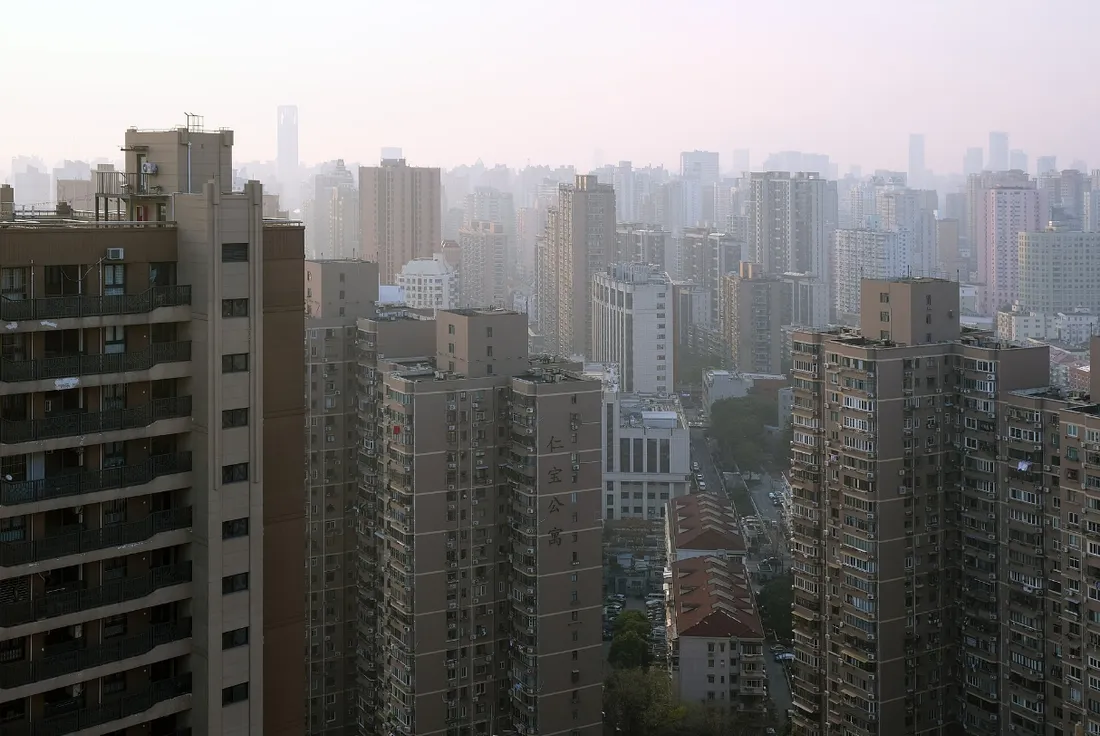
- Residential tower blocks in Shanghai.: kallerna, CC BY-SA 4.0, via Wikimedia Commons
- A Lianjia property agency in Yangpu District, Shanghai, photographed in 2016.: Shwangtianyuan, CC BY-SA 4.0, via Wikimedia Commons
Get new jobs in China by email
One email a week with the jobs added since the last one. Free, with no account.
Nothing is sent until you open the link we email you. Choose a role, a pay level or daily emails
We use your address only to send the alerts you ask for, and every email has a one-click unsubscribe link. The privacy notice says how long we keep it, and the terms of use cover the alerts.
We check this guide again by February 3, 2027. Rules change, so confirm visa steps with the embassy and your school before you go. First published November 5, 2026. Spotted something out of date? Tell us. How we write these guides.