Schools for teachers' kids in China
Find out where your children can study in China, and what it costs, before you sign a contract. Here are the school types, real fees, kindergarten steps and the visa your family needs.
AbroadPin team7 min read
Contents
If you're moving to China with children, the school question shapes almost everything else: which job you take, which city, even which side of town you rent in. The good news is that you have more than one route. The catch is that the cheapest routes need Chinese, paperwork and good timing, and the easiest route costs a lot unless your employer helps.
This article is about your own kids. For the jobs themselves, see the main guide to teaching in China.
The four kinds of school your child can attend
Families usually end up in one of these:
- International schools for foreign children. These are set up for children of foreign nationals with residence permits and follow a home-country or international curriculum [1].
- International divisions of local schools. They take students on the same terms as the international schools [2].
- Private bilingual schools. Independently run, often mixing the Chinese curriculum with international ideas [1].
- Local public schools and kindergartens. They teach the national curriculum in Chinese, and some run international classes for foreign students [1].
There's a lot of choice in the big cities. As of 2022 China had 142 schools for children of foreign nationals and 562 private schools with an international focus [1].
International schools: who gets in and what they cost
These schools take children with foreign nationality whose parents hold Chinese residence permits [1], and you apply to the school directly [2]. Most run from nursery or kindergarten up to the end of high school [2].
They're expensive. Here's one Shanghai school's published price list for the 2026 to 2027 year, in RMB a year, full day [3]:
| Year group | Tuition a year |
|---|---|
| Nursery, Pre-School, Pre-Kindergarten | RMB 140,516 |
| Kindergarten | RMB 171,518 |
| Grades 1 to 5 | RMB 213,003 |
| Grades 6 to 8 | RMB 225,740 |
| Grades 9 to 12 | RMB 232,914 |
On top of tuition the same school charges a RMB 2,500 application fee and a one-time RMB 8,000 capital fee per child [3]. There's also a RMB 2,000 technology fee each year, school bus at RMB 9,000 a semester within 15 km, and lunch at RMB 35 a day [3]. It offers discounts for siblings and for paying the year at once, so ask [3].
The most expensive Shanghai schools cost more. One 2026 fee guide puts the top foreign-passport schools at RMB 250,000 to 320,000 a year for grades 1 to 5 and RMB 320,000 to 390,000 for the last two years of high school [4]. The same guide lists a non-refundable registration fee of RMB 2,000 to 4,000 and a building fund of RMB 30,000 to 80,000, sometimes charged once and sometimes every year [4].
On a typical English teacher's salary, these fees only work if the school pays most of them. That makes the next section the one to read twice.
Will your employer pay tuition?
International school recruiter Teacher Horizons says many schools offer free places or discounts of 50 to 90 percent for teachers' children [5]. On fees like the ones above, that perk can be worth more than a pay rise.
Training centres, public schools and kindergartens hire English teachers on different terms, and a tuition benefit is not something you can assume there. Before you sign anywhere, ask:
- Is tuition for my children included, and for how many children?
- Does it cover the full fee, or tuition only? Who pays the application fee, capital fee, bus, lunch and uniforms?
- Is the place at the school where I teach, or a different school?
- What happens to the place if my contract ends or isn't renewed mid-year?
- Is all of this written in the contract, not only in an email?
If the answer is no, price the school fees into your decision before you compare salaries.
Bilingual private schools
Bilingual schools sit between local and international schools. In Shanghai, one fee guide says the bilingual joint-venture schools cost roughly 20 to 35 percent less than the top foreign-passport schools [4].
They have changed a lot in the last few years. Since 2021 they haven't been allowed to use foreign textbooks in grades 1 to 9, and many have dropped "international" from their names [5]. Packages and quality vary from group to group, so visit or talk to current parents before you commit [5].
Admission can be a lottery. In Shanghai, private primary and junior high schools admit by random selection, not by test [2].
Local public schools
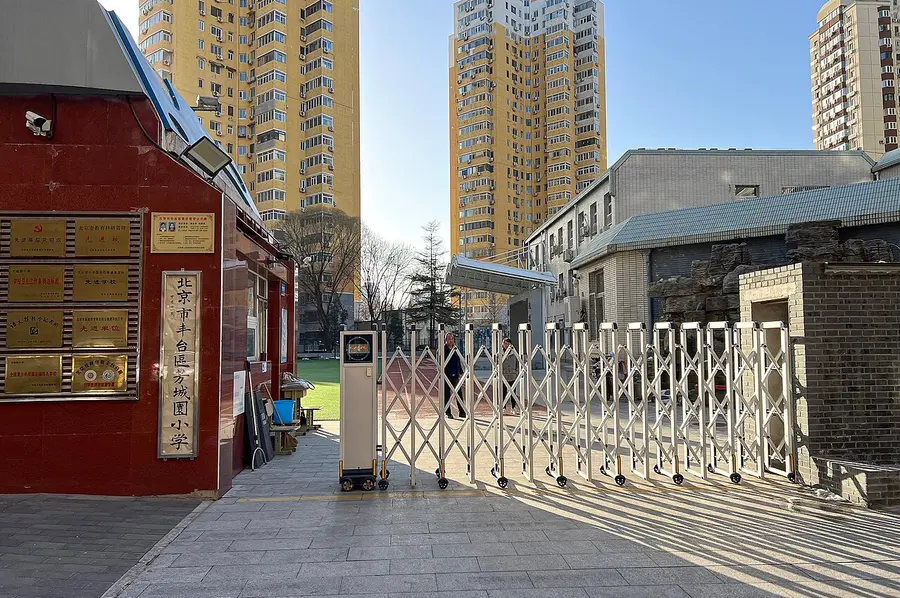
A local public school is the low-cost option, and some families like it for the Chinese their kids pick up. The trade-off is language: children who don't speak Chinese can find the lessons and the system hard at first [1].
How you get in depends on the city:
- Shanghai. Public primary and junior high schools admit by where you live, so you apply to schools in your home district [2]. For senior high you apply to the district education bureau [2].
- Beijing. If one parent holds a work-type residence permit there, the child is treated as a local resident for school places [1].
- Elsewhere. Rules differ by province and city, so start with the local education bureau's website [1].
Papers to gather before you arrive
Rules vary by district, so treat this as a starting list. Bring:
- your child's overseas birth certificate, notarized [1]
- your work-type residence permit, once you have it [1]
- your child's passport and valid visa or residence permit [1]
- a vaccination record and your child's previous school records [6]
- your rental contract, which some districts ask for as proof of address [7]
One Shanghai district also asks for a recent health check from a local hospital [6]. Shanghai lets families get an electronic vaccination certificate through the Suishenban app [8].
Kindergarten and childcare
Shanghai's public kindergartens take foreign children through the district where you live [2]. The process runs on a fixed yearly cycle. For the 2025 intake it went like this [7]:
- Children had to be born between 1 September 2021 and 31 August 2022 [7].
- Families registered online from 22 to 29 April, on the Government Online-Offline Shanghai website or the Suishenban app [7].
- Districts checked applications in May [7].
- Admission notices went out before 15 July [7].
You need passports for your child and for you, and districts such as Pudong, Baoshan and Changning also want the Temporary Accommodation Registration Form for Overseas Personnel [7]. Some ask for a birth certificate and a rental agreement or property certificate too [7]. If you arrive in August, you've missed that window, so ask the district bureau about late places or look at private kindergartens.
There's a national change worth knowing. From the autumn 2025 semester, China waives care and education fees for children in their final year of kindergarten [9]. At private kindergartens only the public standard fee is waived, and the school can charge the rest [10]. About 24 million children had benefited by August 2026 [9]. Neither announcement says whether foreign children qualify, so ask the kindergarten [9][10].
Visas for your spouse and children
Your family comes on an S1 visa, the long-stay visa for relatives of foreigners working in China [11]. It covers your spouse, parents, parents-in-law and children under 18 [11].
The usual order:
- You get your Z visa, enter China and get your work-type residence permit (the main guide walks through this).
- Your family applies for an S1 visa with a copy of your passport and residence permit, an invitation letter, and proof of relationship such as a marriage or birth certificate, or a notarized kinship certificate [11].
- Within 30 days of arriving, each family member applies for a residence permit at the local public security office [11].
Checklists can differ a little between embassies, so use the one from the Chinese visa centre in your own country. Get the birth and marriage certificates sorted at home, since they're much harder to arrange once you've left.
A first-months plan
- Before you sign. Ask whether tuition is included and get it in the contract. Shortlist two or three schools near the job and email their admissions offices about places and fees.
- Before you fly. Gather notarized birth certificates, a marriage certificate, vaccination records and school reports. Apply for international school places as soon as you have an offer.
- First weeks. Get your residence permit, then your family's [11]. Register your address, since kindergartens ask for the registration form [7].
- First months. Visit schools in person, and if you want a public kindergarten, note the next spring registration dates for your district [7].
When you're ready to look for a job that suits your family, browse open teaching jobs in China.
See jobs in China
- Beijing, International school positionsBeijing · $4,500 to $5,250 a month
- High School teaching PositionBeijing · $3,750 to $5,000 a month
- High school drama teacherHangzhou · $3,750 to $5,000 a month
- High school Economics teacherBeijing · $3,750 to $5,000 a month
- English Teacher, English for Science and Engineering (SWJTU-Leeds Joint School, Chengdu)Chengdu · $2,252 to $3,127 a month
By city: Teaching jobs in Shanghai · Teaching jobs in Beijing · Teaching jobs in Hangzhou · Teaching jobs in Chengdu
Sources and photo credits
- 1.Science and Technology Daily, education options for foreign minors in China (25 August 2023)
- 2.Shanghai government, how to enrol children in a Shanghai school (published 21 August 2026, read 4 November 2026)
- 3.Shanghai Livingston American School, 2026 to 2027 tuition and fees (read 4 November 2026)
- 4.iSchoolAdvisor, international school fees in Shanghai, 2026 cost breakdown (27 April 2026)
- 5.Teacher Horizons, teaching in China in 2026 (19 August 2026)
- 6.Jiading District education bureau, Shanghai, compulsory education enrolment rules (undated, read 4 November 2026)
- 7.Shanghai government, a guide to enrolling your children in kindergarten (21 April 2025)
- 8.Shanghai government, children's education service pages (read 4 November 2026)
- 9.Henan government, free final-year kindergarten policy benefits 24 million children (21 August 2026)
- 10.China Daily, phased free preschool policy to benefit pupils (8 August 2025)
- 11.VFS Global for the Chinese embassy in Angola, S1 and S2 visas for visiting relatives (undated, read 4 November 2026)
Photos
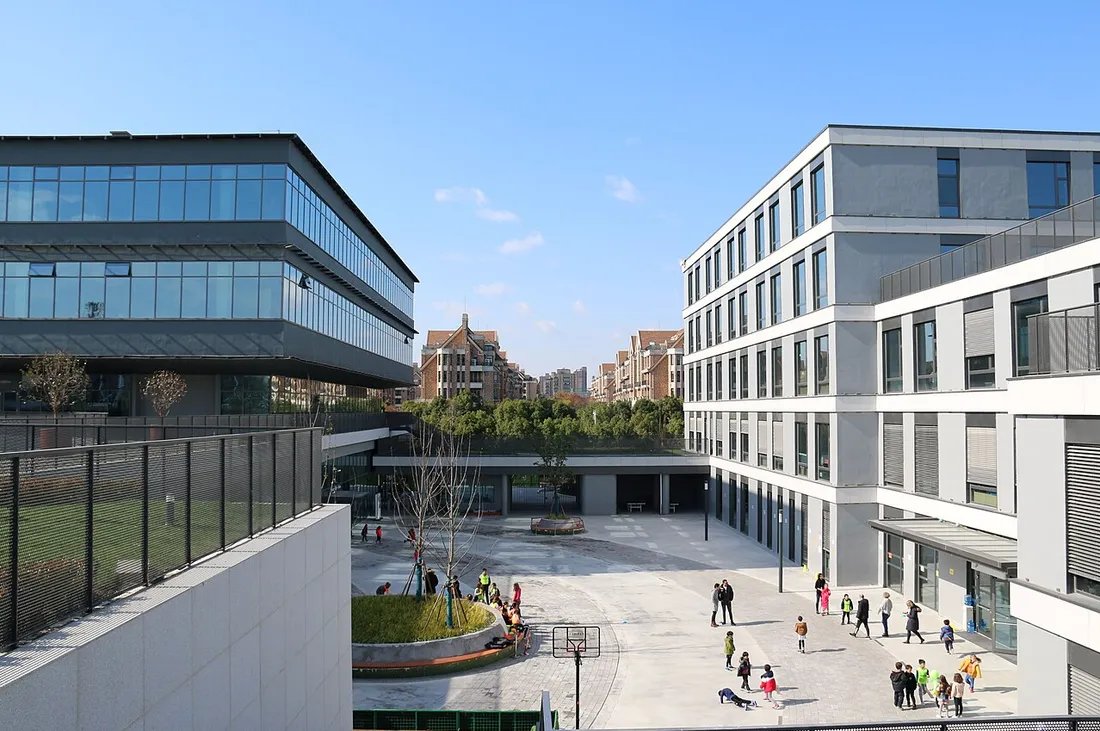
- The courtyard of the Shanghai French international school's Yangpu campus: Lyley Y, CC BY-SA 4.0, via Wikimedia Commons
- The gate of a public primary school in Fengtai, Beijing: N509FZ, CC BY-SA 4.0, via Wikimedia Commons
Get new jobs in China by email
One email a week with the jobs added since the last one. Free, with no account.
Nothing is sent until you open the link we email you. Choose a role, a pay level or daily emails
We use your address only to send the alerts you ask for, and every email has a one-click unsubscribe link. The privacy notice says how long we keep it, and the terms of use cover the alerts.
We check this guide again by February 2, 2027. Rules change, so confirm visa steps with the embassy and your school before you go. First published November 4, 2026. Spotted something out of date? Tell us. How we write these guides.