Opening a bank account in Indonesia
Get your salary into an Indonesian account soon after your KITAS arrives, with every paper the bank wants. Here's which banks take foreign teachers, what an account costs each month, and how to pay by phone.
AbroadPin team7 min read
Contents
In Indonesia the bank account is one of the last pieces of your arrival paperwork, not one of the first. Banks want proof that you're living and working here legally, and for a teacher that proof is the stay permit your employer arranges. So the smart move is to plan your first weeks around the permit and carry enough money from home to cover the wait. For the job market, the permit steps and what schools pay, read the main guide to teaching in Indonesia.
Why the KITAS comes first
Your KITAS (officially the ITAS, the temporary stay permit) is the document Indonesian banks look for. BCA's product summary for its Tahapan savings account lists an identity card plus a KITAS or KITAP as the papers for foreign adults aged 17 and over [1]. Bank Mandiri asks foreigners for a passport plus a KIMS, KITAS, KITAP or official visa, and the related foreign worker permit [2].
Some sources say a passport alone can be enough. Cekindo, a business services firm, writes that some banks open accounts on a passport for foreigners without a KITAS or KITAP, while still listing the KITAS as a common requirement [5]. An older Wise guide says that without a KITAS it's very hard, if not impossible, to open an account [4]. For a salary account, plan on having your KITAS in hand.
The wait is shorter than it sounds. Once you've done your biometrics at the immigration office, the electronic ITAS is usually ready about 2 working days later [6].
The order to do things in
- Get your KITAS. Your employer runs the work permit and visa. The main guide covers each step.
- Get a local SIM. Telkomsel registers prepaid numbers for foreigners with a passport, KITAS or KITAP at its outlets or partner shops [7]. You'll want the number before the bank visit, because mobile banking registration needs a local SIM [3].
- Ask your school for a letter. Cekindo lists a reference letter from an employer or sponsor for personal accounts [5]. Wise's list also includes your employer's tax number (NPWP) and your own [4]. Ask HR which bank they use and whether they have a standard letter.
- Sort out proof of address. Universitas Padjadjaran's international office lists proof of an Indonesian address and a domicile letter among the papers banks ask for [3]. If you're in school housing, ask the school or your landlord for one.
- Visit a branch. Wise says most banks don't let foreigners finish the process online, so expect to go in person [4].
- Collect your card and set up the app. You'll get an ATM card and, at some banks, a savings book [3].
How long the branch part takes varies. Wise says it can be done in as little as a day once your papers are in order [4], and Cekindo also says an account with an ATM card can be opened in a day [5]. Your tax number is a separate job: the NPWP is one of the local registrations that come after your KITAS [6].
Which banks open accounts for foreign teachers
The big domestic banks are the usual choice. Universitas Padjadjaran names BNI, Mandiri, BCA and BRI as examples [3], and Cekindo calls BCA, Mandiri and BNI the top three to consider [5].
- BCA (Bank Central Asia) has the Tahapan savings account, which spells out its rules for foreigners in its own product summary [1].
- Bank Mandiri opens rupiah and foreign currency savings accounts for foreigners with a stay permit [2].
- BNI and BRI complete Padjadjaran's list [3].
The most useful question is which bank your school pays salaries through. A same-bank transfer is often simpler for HR, and some schools have a branch contact who knows their paperwork already.
What to bring
Bring originals and a few copies of each. Combining the bank pages and the guides above, expect to be asked for:
- your passport [2]
- your KITAS or KITAP [1] [2]
- your work permit papers, which Mandiri lists for foreign workers [2]
- a reference letter from your school [5]
- proof of your address in Indonesia or a domicile letter [3]
- two photos sized 4 cm by 6 cm, which some branches still ask for [3] [4]
- your NPWP, if you already have one [4]
- your local phone number [3]
Wise also mentions that some banks ask for a card or a document from your bank at home [4]. Bring a recent statement just in case.
Deposits and monthly fees
Indonesian savings accounts charge a monthly fee, and the card you pick changes it.
Mandiri's rupiah savings account needs a first deposit of Rp 500,000, and its foreign currency account US$100 [2]. Wise put the usual opening deposit at around Rp 500,000 and monthly fees at around Rp 15,000 to 20,000, in a guide from January 2021 [4].
BCA's Tahapan fees depend on your debit card (called Paspor BCA) and its network, Mastercard or GPN, Indonesia's domestic network [1]:
| Paspor BCA card | Monthly fee, Mastercard | Monthly fee, GPN | Card issue fee |
|---|---|---|---|
| Blue | Rp 15,000 | Rp 14,000 | Rp 10,000 |
| Gold | Rp 17,000 | Rp 16,000 | Rp 15,000 |
| Platinum | Rp 20,000 | Rp 19,000 | Rp 20,000 |
A few more Tahapan rules worth knowing:
- Keep at least Rp 50,000 in the account and a monthly average of Rp 100,000 from the month after you open it [1].
- On a Blue card, a monthly average below the minimum costs Rp 5,000 that month [1].
- Opening has no stamp duty charge [1].
- Closing the account costs Rp 50,000 [1].
- An account left at zero for 6 months in a row is closed automatically [1].
That last point matters when you leave Indonesia. Close the account or move the balance home before your flight, rather than leaving fees to eat what's left. Wise also notes that withdrawals at your own bank's ATMs are free, but other banks' machines may charge [4].
Debit cards, mobile banking and your phone number
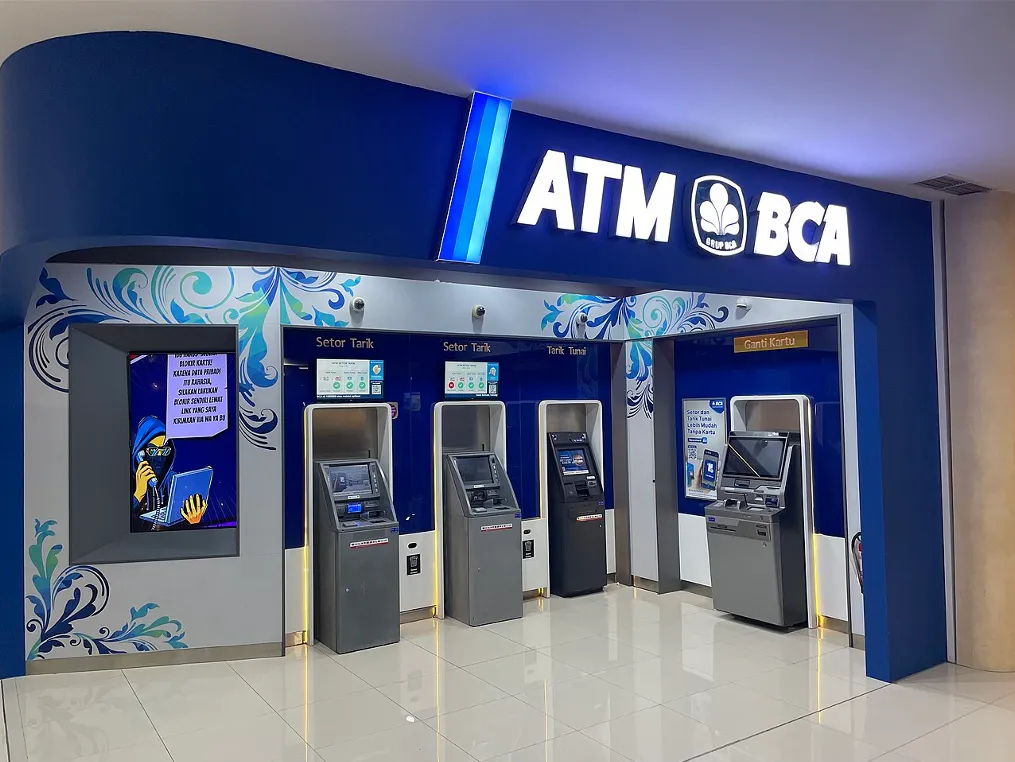
Your debit card comes with the account, often the same day [3] [5]. BCA offers its card on Mastercard or GPN [1]. GPN is the domestic network, so if you want to pay shops abroad online, ask for the Mastercard version.
Set up mobile banking at the branch while staff can help. You'll register with your local number [3], so keep that SIM topped up and the number in use. Mandiri and BNI both offer phone and internet banking, according to Wise's overview [4].
Paying with QR codes and e-wallets
Much of daily life in Indonesia runs on phone payments. QRIS is the national QR code standard, set up by Bank Indonesia and the payment system association ASPI and launched in August 2019 [10]. Banks and fintech firms both use it [10], so one code at a warung or shop works with your bank app or an e-wallet.
The main e-wallets are GoPay, OVO and DANA [3]. Universitas Padjadjaran notes that some of them, such as GoPay and OVO, need a bank account to use fully [3]. To upgrade to GoPay Plus, foreigners photograph their passport and take a selfie in the app, then wait for approval [8]. Upgrading matters because Bank Indonesia sets higher limits for registered e-money accounts: it raised the registered limit from Rp 10 million to Rp 20 million, and the monthly transaction limit from Rp 20 million to Rp 40 million, from 1 July 2022 [9].
Getting paid before your account is open
Your first payday can come before your account exists, so plan for the gap.
- Ask HR in your first week how the first salary will be paid and whether it can wait until your account is ready.
- Give payroll your details in writing as soon as you have them, with your name spelled exactly as on your passport.
- Bring savings and a home card that works abroad for food, transport, a SIM and any housing deposit until payday. Check your home bank's foreign ATM fees before you fly.
- Check your first payslip against your contract, including any housing allowance.
If your school pays in cash for the first month, ask for a signed receipt, and keep it with your contract.
With kids
BCA lets a parent open a Tahapan account for a child under 12 with the parent's identity card and NPWP, plus the child's birth certificate, family card or child identity card [1]. For a foreign child aged 12 to under 17 without a parent as representative, BCA asks for the child's passport or child identity card, the child's own identity card, the parent's identity card and NPWP, and a parental statement letter [1]. Both routes need your NPWP, so get your tax number early if your children want their own accounts [1] [6].
Once your banking plan is clear, browse teaching jobs in Indonesia and contact the school directly.
See jobs in Indonesia
- Lower Elementary Homeroom Teacher, K to Grade 2, July 2027 (Jakarta Intercultural School)Jakarta
- Early Years Homeroom Teacher, July 2027 (Jakarta Intercultural School)Jakarta
- International English Teacher (English 1 Swara Group, Jakarta)Jakarta
- Early Years Teacher, IB PYP, 2027-28 (Global Jaya School Jakarta)Jakarta
- IB PYP Classroom Teachers, 2027-28 (Global Jaya School Jakarta)Jakarta
By city: Teaching jobs in Jakarta
Sources and photo credits
- 1.Bank Central Asia (BCA), Tahapan product and service summary (read 5 November 2026)
- 2.Bank Mandiri, Mandiri savings accounts (read 5 November 2026)
- 3.Universitas Padjadjaran International Office, Opening a bank account (undated, read 5 November 2026)
- 4.Wise, How to open a bank account in Indonesia (25 January 2021)
- 5.Cekindo, Opening a bank account in Indonesia (updated 12 March 2024)
- 6.Aniday, Indonesia work permit 2026: RPTKA, E23 visa and KITAS steps (verified 7 September 2026)
- 7.Telkomsel, How to do prepaid registration for foreign citizens (undated, read 5 November 2026)
- 8.Gojek, How to upgrade your GoPay account (undated, read 5 November 2026)
- 9.Infobank News, Bank Indonesia raises the registered e-money limit to Rp20 million (19 April 2022)
- 10.Katadata, Bank Indonesia raises the QRIS transaction limit again (11 February 2022)
Photos
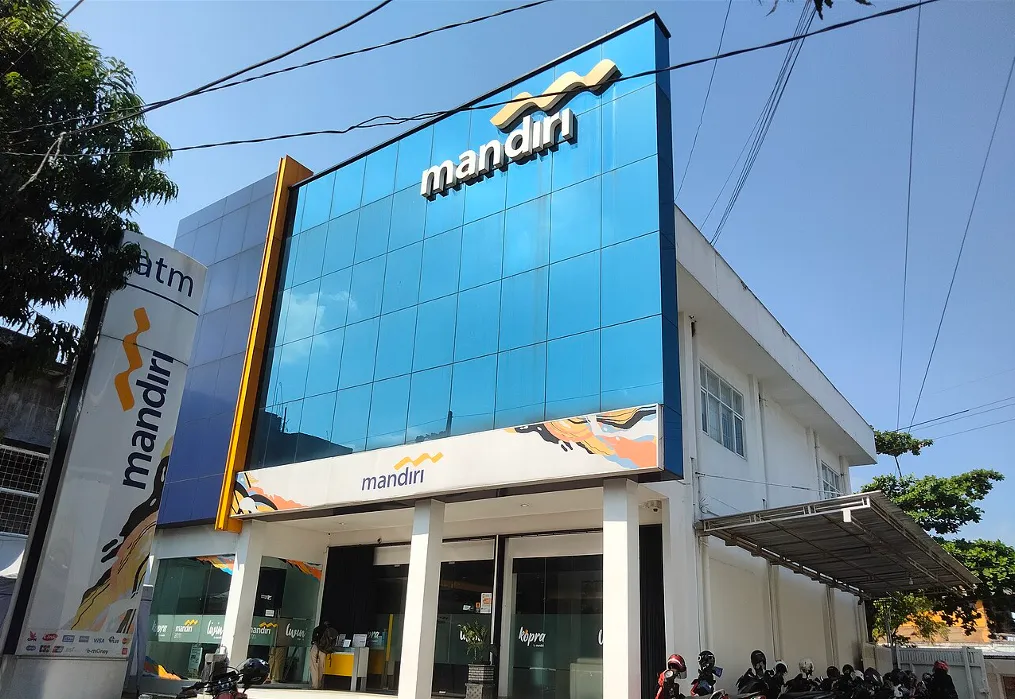
- A Bank Mandiri branch with its cash machine sign in Ngawi, East Java.: YT Arty, CC BY-SA 4.0, via Wikimedia Commons
- A row of BCA cash machines in Indonesia.: SunDawn, CC BY-SA 4.0, via Wikimedia Commons
Get new jobs in Indonesia by email
One email a week with the jobs added since the last one. Free, with no account.
Nothing is sent until you open the link we email you. Choose a role, a pay level or daily emails
We use your address only to send the alerts you ask for, and every email has a one-click unsubscribe link. The privacy notice says how long we keep it, and the terms of use cover the alerts.
We check this guide again by February 3, 2027. Rules change, so confirm visa steps with the embassy and your school before you go. First published November 5, 2026. Spotted something out of date? Tell us. How we write these guides.