Teaching English in Peru
Teach English in Peru knowing what institutes pay, how the worker visa works and what Lima costs. Most jobs follow a school year that starts in March, and this also covers schools and family visas if your kids come with you.
AbroadPin team9 min read
Contents
Peru at a glance
| Language school pay | USD 500 to 1,000 a month, more in Lima (International TEFL Academy, October 2026) [1] |
|---|---|
| Institute hourly rate in Lima | About 13 soles (about USD 5) an hour (Go Overseas) [2] |
| Contract | Written, fixed term, up to 3 years and renewable, registered in SIVICE [3] |
| Worker status fee | S/ 161.40, Migraciones code 07568 [4] |
| School year | March to December [1] |
| Rent, one-bed central | About S/ 2,449 in Lima vs S/ 1,218 in Arequipa (Numbeo) [7] [8] |
Who's hiring in Peru
Most new teachers in Peru start at a language institute, then add private students or move to a school once they know the city. These are the main places that hire.
- Language institutes. The biggest employer of new teachers. Classes for children, teens and adults, often early mornings, evenings and Saturdays. Binational cultural centres such as ICPNA and the Británico sit alongside many smaller private academies, in Lima and in cities like Arequipa and Cusco.
- Business English. Classes for company staff, taught at the client's workplace [1].
- Private and international schools. Full-time classroom jobs with a school calendar. These want more than a TEFL certificate: a bachelor's degree, often a master's, plus teaching experience [2]. The American School of Lima (Colegio Franklin Delano Roosevelt) is one of the best known [9].
- Private tutoring and online classes. ITA says you're unlikely to save without one of these on the side [1].
- Volunteer programs. Some charge you a fee that covers housing, food and local support, so read what you're paying for before you sign [2].
Pay by type of job
Pay in Peru is quoted in a mix of soles and US dollars, and few employers publish it. The table uses the figures that International TEFL Academy and Go Overseas give [1] [2].
| Type of job | What it pays | Source and date |
|---|---|---|
| Language schools | USD 500 to 1,000 a month, more in Lima than in smaller towns | International TEFL Academy, October 2026 [1] |
| Institutes and private academies in Lima | About 13 soles (about USD 5) an hour | Go Overseas, read 4 Nov 2026 [2] |
| Business English at the client's office | USD 500 to 1,000 a month | International TEFL Academy, October 2026 [1] |
| Private tutoring for adults | USD 10 to 20 an hour | International TEFL Academy, October 2026 [1] |
| Online teaching | USD 5 to 20 an hour | International TEFL Academy, October 2026 [1] |
| Teaching in general | USD 500 to 700 a month on average | Go Overseas, read 4 Nov 2026 [2] |
What the numbers don't tell you:
- One-to-one lessons pay better per hour but they're less steady. The same ITA page gives USD 10 to 15 an hour in its text for one-to-one lessons, and notes that private students can stop at any time [1].
- Peru is roughly break-even. ITA puts the monthly cost of living at USD 500 to 1,000 and says you shouldn't expect to save unless you add tutoring or online work [1].
- Arrive with savings. ITA suggests USD 1,000 to 1,500 to cover your start-up costs [1].
- International school pay is set school by school. Neither source publishes a figure, so ask for the full package in writing: salary, flights, housing, health cover and tuition for your children.
What employers and the law ask for
Employers set the bar for qualifications, and the law sets it for paperwork.
What employers usually ask:
- A TEFL or TESOL certificate. Go Overseas says most teaching jobs in Peru want one [2].
- A degree. For most institute jobs a degree is preferred rather than required, but business English clients often want a bachelor's and a TEFL [2].
- More for schools. International schools want a bachelor's degree, often a master's, and classroom experience [2].
- An in-person interview. ITA says most schools interview after you arrive, though some do it by phone or email first [1].
What the law asks:
- A worker status. Peru's labour ministry says a foreigner working as a trabajador does so under a contract approved beforehand by the Ministerio de Trabajo y Promoción del Empleo [6].
- A written, fixed-term contract. Under Legislative Decree 689 the contract runs for up to 3 years and can be renewed for the same length, and it must be registered, with any change or extension, in the online SIVICE system [3].
- Space in the employer's quota. The same law caps foreign staff at 20% of an employer's workforce and 30% of its payroll [3]. Some posts can be exempted from those limits, and the Lima Chamber of Commerce lists certain teachers among them [3].
- Clean records. A criminal record certificate from your home country, or from where you lived legally in the 5 years before Peru, plus an Interpol clearance dated within 6 months [4].
Getting the worker visa, step by step
The status you need is trabajador residente, the worker resident status, which Migraciones grants once your contract is approved. LimaEasy, a long-running expat guide in Lima, sets out the order like this (page read 4 November 2026) [4].
- Sign a contract that fits the visa. LimaEasy says the contract should run 12 months or more with no probation period [4]. If you're in Peru as a tourist, you need a permit to sign contracts before you sign [4]. A contract signed abroad has to be legalised by the Peruvian consulate [4].
- Your employer gets labour ministry approval. This happens online through SIVICE and usually takes 5 to 7 business days, though some people wait longer [4].
- Collect your documents. Passport, your criminal record certificate with an apostille or consular legalisation and a Spanish translation made in Peru, the Interpol clearance, the approved contract (approved no more than 30 days before you file), the employer's tax number (RUC) and a sworn statement from its legal representative [4].
- Pay the fee. S/ 161.40 under Migraciones code 07568, "cambio de calidad migratoria trabajador residente" [4].
- Apply online. You file on the Migraciones Agencia Digital, upload the documents and keep the file number it gives you [4].
- Give your biometrics and watch your inbox. Migraciones books a photo and fingerprint appointment and sends requests to an online mailbox, often with short deadlines [4].
- Collect your carné de extranjería. This is your foreigner ID card [4].
On timing, the official processing period is 30 business days, while LimaEasy readers report 2 to 3 months in practice [4]. The carné notice officially takes another 30 business days [4].
Who can apply from inside Peru? LimaEasy says people who can enter visa-free change status at Migraciones, while everyone else applies for residency from abroad [4].
The worker status lasts one year and is then renewed, and after 3 years of legal residence you can apply for permanent residence [4]. The carné itself is usually valid for 4 years [4].
Cost of living: Lima and Arequipa

Lima is where most jobs are. Arequipa, in the south, has a smaller job market and much cheaper rent. These are Numbeo's crowd-sourced averages, last updated on 28 January 2026 for Lima and 6 December 2025 for Arequipa [7] [8].
| Item | Lima | Arequipa |
|---|---|---|
| One-bed flat, centre, a month | S/ 2,448.96 | S/ 1,218.00 |
| One-bed flat, outside the centre, a month | S/ 1,347.32 | S/ 812.17 |
| Basic utilities, a month | S/ 215.34 | S/ 81.67 |
| Broadband internet, a month | S/ 86.03 | S/ 80.00 |
| Cheap restaurant meal | S/ 15.00 | S/ 13.50 |
| One-way local transport ticket | S/ 2.39 | S/ 1.00 |
Numbeo also puts one person's monthly costs in Lima, without rent, at S/ 1,935.70 [7]. It gives no such figure for Arequipa, and its Arequipa entries rest on fewer reports, so treat them as rough [8].
Set against institute pay of USD 500 to 1,000 a month, a central one-bed in Lima can take a big share of your wage [1] [7]. Many teachers share a flat or live outside the centre in their first year.
When schools hire
Peru's school year runs from March to December, and ITA says the busiest hiring months are February to March and July to August [1]. Schools close for the summer holiday from December to March, and Go Overseas suggests applying to schools no later than November for a March start [2]. Language institutes and non-profits hire through the year when a place opens up [2].
International schools don't all keep to the Peruvian calendar. The American School of Lima quotes its fees for a 2026 to 2027 school year, so check each school's own dates [9].
Red flags and staying legal
The biggest risk in Peru is ending up on the wrong status. Teaching sites say many teachers arrive on tourist entry and look for work after landing [1] [2]. The rules are plain, though: working as a trabajador needs a contract approved by the labour ministry [6], and a tourist needs a permit even to sign one [4].
Watch for these:
- "Come as a tourist and we'll see." Tourist time adds up to a maximum of 183 days, and ITA says you must leave by then or pay overstay fees [1]. Ask an employer, before you fly, whether it will register your contract in SIVICE and support your worker status [3] [4].
- A contract the visa can't use. LimaEasy says the contract should be for 12 months or more without a probation period [4]. A short trial contract may leave you unable to apply.
- Hourly pay with no minimum. Ask how many hours a week are guaranteed, and get it in the contract. Private students can stop at any time, and business English pay depends on how often companies book lessons [1].
- Volunteer fees. Some programs charge you, so compare the fee with what it covers [2].
- Old documents. The Interpol clearance must be dated within 6 months and the approved contract within 30 days when you file [4]. Plan the order so nothing expires.
Once your paperwork plan is clear, see open teaching jobs in Peru.
Moving with kids
Bringing children to Peru is very doable on a school salary, but much harder on institute pay. International school tuition in Lima can cost more than a year of institute wages [1] [9].
School options
International schools teach in English and suit children who'll move on to another country. The American School of Lima lists 2026 to 2027 annual tuition in US dollars from 17,470 for early childhood up to 19,790 for grades 6 to 12 [9]. On top of that come a 500 application fee, a 19,500 enrolment fee once a place is offered, and a 1,000 deposit [9].
Numbeo's averages give a wider view: about S/ 45,000.55 a year for an international primary school in Lima, and S/ 23,000.00 in Arequipa, the second based on a single entry [7] [8].
Bilingual private schools teach part of the day in English and part in Spanish. Fees vary a lot, so ask each school for its full list: entry fee, monthly fees and extras.
Local public schools teach in Spanish and follow the March to December year [1]. They work best for younger children or families staying several years.
Will your employer help with tuition?
Don't assume it. The pay figures for institutes, business English and tutoring come with no mention of tuition help [1] [2]. If an international school hires you, ask whether tuition is covered, for how many children, and whether it's full or partial, and get it in the contract.
Visas for your spouse and children
Family members of a foreign resident apply for familiar de residente, the family resident status [5]. LimaEasy lists who it covers when the sponsor is a foreign resident [5]:
- your spouse
- your children under 18 [5]
- unmarried children aged 18 to 28 who depend on you, with proof they're enrolled at a Peruvian school or college [5]
- adult children with disabilities
You'll need your own carné de extranjería, the marriage or birth certificate with an apostille or legalisation, not older than 6 months and translated into Spanish, and an Interpol clearance dated within 6 months [5]. Adults also need a criminal record certificate [5]. The fee is S/ 161.40 in 2026, code 07568 [5]. The status is usually granted for one year, official processing is 30 business days, and most approvals take 2 to 3 months in practice [5]. A spouse with family status may work as an employee or on their own account [5].
Childcare
Numbeo puts a private full-day preschool at about S/ 720.83 a month in Lima and S/ 257.50 in Arequipa [7] [8].
Healthcare and insurance
Ask each employer, in writing, whether your contract includes public health insurance and whether your spouse and children can be added as dependants. If there's no family cover through work, price private family insurance before you arrive.
See jobs in Peru
Sources and photo credits
- 1.International TEFL Academy, how much English teachers make in Peru (updated 1 October 2026)
- 2.Go Overseas, teach abroad in Peru (undated, read 4 November 2026)
- 3.Cámara de Comercio de Lima, what to know when hiring foreign workers (13 April 2026)
- 4.LimaEasy, the Peruvian work visa (undated, read 4 November 2026)
- 5.LimaEasy, the Peruvian family visa (2026 fee, read 4 November 2026)
- 6.Ministerio de Trabajo y Promoción del Empleo, information leaflet for migrant workers (undated, read 4 November 2026)
- 7.Numbeo, cost of living in Lima (updated 28 January 2026)
- 8.Numbeo, cost of living in Arequipa (updated 6 December 2025)
- 9.Schoozy, fees at Colegio Franklin Delano Roosevelt, the American School of Lima, 2026 to 2027 (read 4 November 2026)
Photos
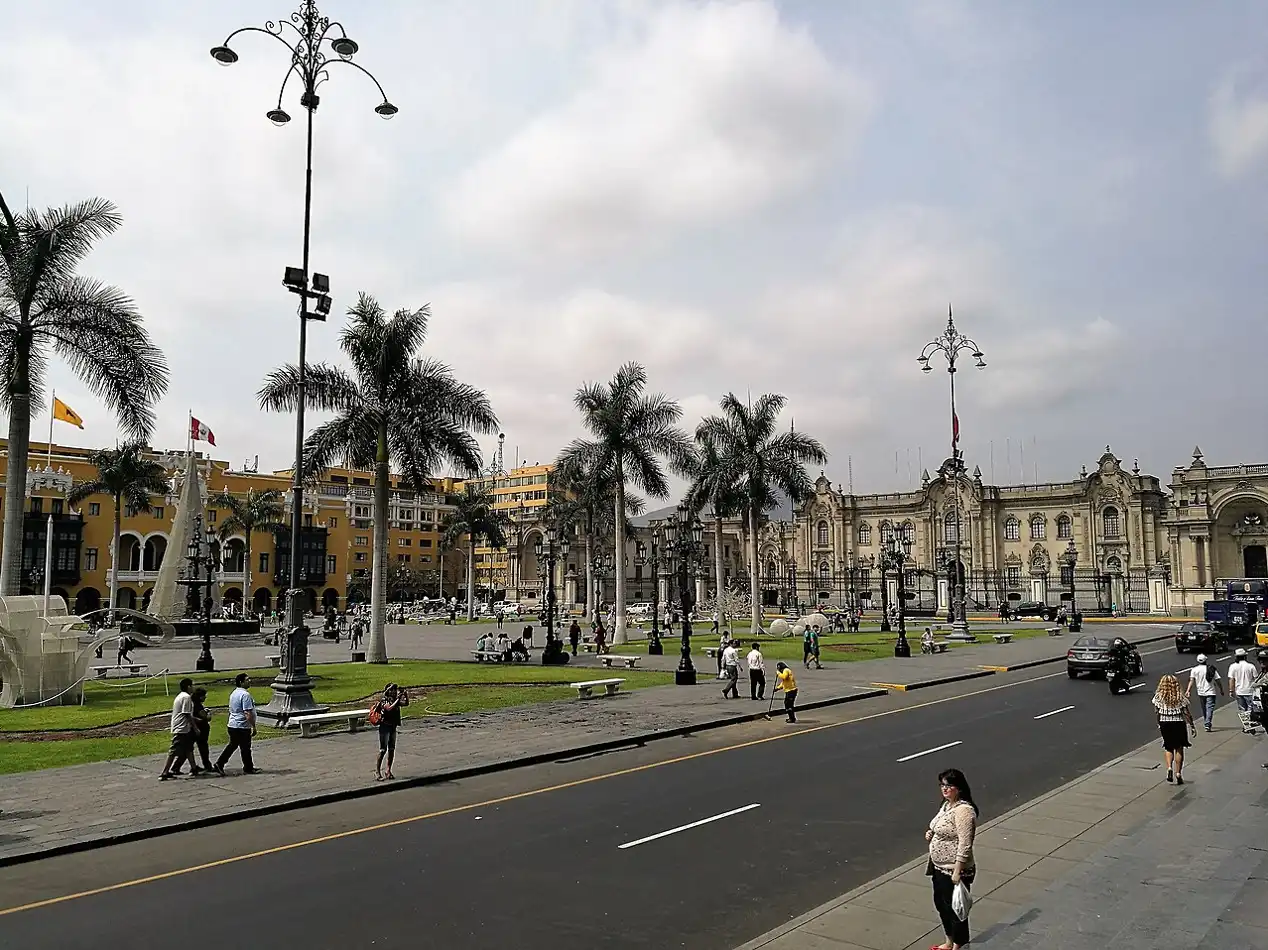
- Lima's Plaza Mayor and the Government Palace seen from the cathedral: Pitxiquin, CC BY-SA 4.0, via Wikimedia Commons
- Arequipa's Plaza de Armas and cathedral with the El Misti volcano behind: Pavel Špindler, CC BY 3.0, via Wikimedia Commons
Get new jobs in Peru by email
One email a week with the jobs added since the last one. Free, with no account.
Nothing is sent until you open the link we email you. Choose a role, a pay level or daily emails
We use your address only to send the alerts you ask for, and every email has a one-click unsubscribe link. The privacy notice says how long we keep it, and the terms of use cover the alerts.
We check this guide again by February 2, 2027. Rules change, so confirm visa steps with the embassy and your school before you go. First published November 4, 2026. Spotted something out of date? Tell us. How we write these guides.