Finding an apartment in Spain
Find a room or a flat in Spain that fits a teacher's budget. Here's what shared and whole flats cost, what landlords ask a foreign tenant for, and what Spanish tenancy law says about leases and fees.
AbroadPin team8 min read
Contents
What you have left after rent and bills matters more than the headline pay in Spain, and that's truer still on a language assistant's stipend [3]. The parts that catch newcomers out are the paperwork landlords want, the money they ask for before you get the keys, and fees that the law doesn't let them pass on to you [2] [4]. For pay, visas and the assistant program itself, start with the main guide to teaching in Spain.
School housing or renting yourself
Most teachers in Spain find their own place. What your employer offers depends on the kind of job.
- Language assistants (auxiliares de conversación). The ministry pays an allowance for housing and living costs of no less than 800 euros a month, and doesn't place you in a flat [5]. Its guide for school tutors recommends that the school support you in your search for accommodation [5]. It also lists finding housing, the NIE and a bank account among the things a tutor may help with in your first days [5].
- Language academies. Housing is rarely part of the deal, so read your offer and ask directly. If an academy does help, ask whether that means a flat it chooses, a contact, or a few nights on arrival.
- Bilingual and international schools. Ask whether the package includes a rent allowance and how much it is, and get the answer in your contract.
If you arrive with nothing arranged, book a short stay for your first week or two. Viewing in person, and learning how long the trip to your school takes, is worth more than a quick signature from abroad.
Shared flats, rooms and whole flats
You'll see three kinds of listing.
- A room in a shared flat (piso compartido). You rent one bedroom and share the kitchen, bathroom and living room with other tenants. A room costs far less than a whole flat in the same city, which is why it suits a stipend [1] [3] [5].
- A whole flat (piso). Downtown housing in the big cities is mainly furnished or unfurnished apartments, according to Expat Arrivals [4]. A furnished flat usually comes with everything from kitchen appliances to bedsheets and utensils [4].
- Houses on the edge of town. Freestanding houses and villas sit on the outskirts and in rural areas, and most come unfurnished [4]. They suit a family with a car more than a single teacher without one.
In a shared flat, ask who signed the main lease, whether your name goes on a contract, and how bills are split between flatmates.
Where to look
Expat Arrivals suggests searching online listings and local newspapers and asking on local forums [4]. On property sites, look for a filter for rooms as well as whole flats, and search in Spanish as well as English, using words such as alquiler (rent), habitación (room) and piso compartido.
Other routes that work:
- Your school. The ministry encourages tutors to support assistants in their search, so ask yours and your colleagues which areas are a short trip away [5].
- The teacher you're replacing. Their room may be available when they leave.
- Agents. Useful if your Spanish is limited. See the section on fees below before you pay one anything.
What rent costs

TEFL Ireland's 2026 salary guide lists shared rent per month by city, the figure to set beside a room in a shared flat [3].
| City | Shared rent per month |
|---|---|
| Madrid | 400 to 700 euros |
| Barcelona | 500 to 800 euros |
| Bilbao | About 400 to 650 euros |
| Málaga | 350 to 550 euros |
| Seville | 300 to 500 euros |
| Valencia | About 300 to 500 euros |
| Granada | 250 to 400 euros |
The same guide says teachers in many Spanish cities report total monthly living costs of around 850 to 1,500 euros [3]. Against a stipend of at least 800 euros, a room at the lower end of these ranges leaves the most room for food and transport [3] [5].
For a whole flat, Numbeo's crowd-sourced averages for Valencia, from its page updated on 2 November 2026, give an idea of the step up [1].
| Monthly rent in Valencia | Average | Range of entries |
|---|---|---|
| One bedroom, city centre | 1,322.07 euros | 1,000 to 1,450 euros |
| One bedroom, outside the centre | 976.19 euros | 800 to 1,200 euros |
| Three bedrooms, city centre | 2,115.26 euros | 1,800 to 2,550 euros |
| Three bedrooms, outside the centre | 1,505.00 euros | 1,300 to 1,850 euros |
Madrid costs more. Numbeo's page for Madrid, updated on 4 November 2026 from 1,710 entries, gives these averages [6].
| Monthly rent in Madrid | Average | Range of entries |
|---|---|---|
| One bedroom, city centre | 1,388.74 euros | 1,000 to 2,000 euros |
| One bedroom, outside the centre | 1,093.04 euros | 800 to 1,400 euros |
| Three bedrooms, city centre | 2,562.50 euros | 1,900 to 3,500 euros |
| Three bedrooms, outside the centre | 1,770.21 euros | 1,300 to 2,520 euros |
In both cities, even the cheapest entry for a one-bed outside the centre, 800 euros, would take a whole 800 euro stipend, so on the stipend alone a room is the realistic choice [1] [5] [6].
What landlords ask of a foreign tenant
Expat Arrivals lists what landlords usually want to see [4]:
- your NIE (foreigner's identity number) and a copy of your visa
- bank statements or payslips
- your employment contract or a letter from your employer
- references, ideally from previous landlords
New arrivals often don't have an NIE or a payslip yet. Your appointment letter from the region, or a letter from your school on its letterhead, shows a landlord that a local employer stands behind your income. If the NIE is still in progress, say so up front and offer the paperwork you do have.
Once you have an address, register it with the town hall (empadronarse). The ministry's tutor guide lists it beside opening a bank account and booking your appointment at the foreigners' office as early tasks [5]. Ask the landlord before you sign whether you can register at the flat, since you'll need the address for other paperwork.
The deposit and money up front
Expat Arrivals says landlords generally ask for a security deposit of one to six months' rent [4]. Spain's tenancy law, the Ley de Arrendamientos Urbanos, says a landlord can't require more than one month's rent to be paid in advance [2]. Ask the landlord to split what they want into the deposit, the first month's rent and anything else, and get that breakdown in writing.
The law also requires the landlord to give you a receipt for each payment of rent, unless you pay by a method that itself proves the payment, such as a bank transfer [2]. Pay by transfer where you can, to the person named in the lease.
The lease: length, leaving early and agent fees
Expat Arrivals describes a typical lease as a year with 30 days' notice [4]. The law sets out what applies to a home you rent to live in:
- Length. You and the landlord can agree any length, but a lease under five years, or seven if the landlord is a company, renews each year up to that minimum [2]. You can stop it renewing by telling the landlord at least 30 days before the end date [2].
- Leaving early. You can end the lease once at least six months have passed, giving at least 30 days' notice [2]. That matters if your assistant year ends in May or your academy contract changes.
- Agent fees. Under the law, property management and contract preparation costs can't be passed on to the tenant, directly or indirectly, under any name [2]. Some guides still say tenants pay an agent about a month's rent [4]. If you're asked for an agency fee, ask what it covers and get it in writing before paying.
Before you sign, check the rent, the day it's due, the deposit and when it comes back, who pays for repairs, and which bills are included. If your Spanish is limited, ask a colleague to read the contract with you.
Utilities and internet
Bills are usually not included in the rent of a whole flat, and the tenant pays electricity, water, gas and internet [4]. They're typically billed monthly and can be paid online, through your bank or at the post office [4]. In Valencia, Numbeo's average for basic utilities on a 915 square foot flat is 139.11 euros a month, and broadband of 60 Mbps or more averages 30.40 euros [1]. In Madrid the same averages are 161.45 euros and 31.38 euros [6].
In a shared flat, ask whether bills are included in the room price or split between tenants, and how a high winter heating bill is shared.
Scams and traps to avoid
- Paying before you've seen the place. Don't send a deposit for a room that you, or someone you trust, hasn't visited.
- The wrong person. Expat Arrivals suggests using a property registration website to check that the landlord is the legitimate owner [4]. In a shared flat, ask to see the main lease.
- Unpaid bills. Make sure earlier bills on the flat are paid before you move in [4].
- Large sums in advance. The law caps advance rent at one month [2]. Be wary of anyone who wants several months in cash.
- Cash with no receipt. The landlord has to give you a receipt unless your payment method proves it [2].
- An agency fee with no explanation. Management and contract costs can't be passed on to tenants [2].
On move-in day, photograph every room and note any damage, so the deposit conversation at the end is short.
With kids
Families usually need two or three bedrooms. In Valencia, Numbeo's average for a three-bedroom flat is 2,115.26 euros a month in the centre and 1,505.00 euros outside it, and in Madrid 2,562.50 and 1,770.21 euros [1] [6]. The assistant allowance is a single amount of at least 800 euros a month, so it won't stretch to a family flat by itself [1] [5]. Choose the area around your children's school as well as your own, and check the main guide for school options and family visas.
Your first months, in order
- Ask your employer what housing help it offers and whether a colleague can suggest an area.
- Book a short stay for your first week or two while you view places.
- Gather your visa, appointment letter or contract, and bank statements [4].
- Agree the deposit, first month's rent and bills in writing, and pay by bank transfer [2].
- Register your address with the town hall and keep a copy [5].
When you know which city suits your budget, have a look at open teaching jobs in Spain.
See jobs in Spain
- Senior School English Teacher, August 2027 (King's College School Alicante)Alicante
- Middle School English Teacher, August 2027 (King's College School Alicante)Alicante
- Secondary English Teacher, GCSE and IGCSE, August 2027 (British School of Madrid)Madrid
- Pre-Prep School Teacher, September 2027 (Runnymede College, Madrid)Madrid
- Teacher of English, senior school (from September 2027) (Runnymede College, Madrid)Madrid
By city: Teaching jobs in Madrid
Sources and photo credits
- 1.Numbeo, cost of living in Valencia, Spain, in euros (updated 2 November 2026)
- 2.Boletín Oficial del Estado, Ley 29/1994 de Arrendamientos Urbanos, consolidated text (last updated 7 October 2026)
- 3.TEFL Ireland, Spain TEFL salary guide 2026 by job type and city (updated 12 March 2026)
- 4.Expat Arrivals, accommodation in Spain (undated, read 5 November 2026)
- 5.Ministerio de Educación, Formación Profesional y Deportes, Auxiliares de conversación extranjeros en España, guía para el personal tutor 2026 to 2027 (July 2026)
- 6.Numbeo, cost of living in Madrid, Spain, in euros (updated 4 November 2026)
Photos
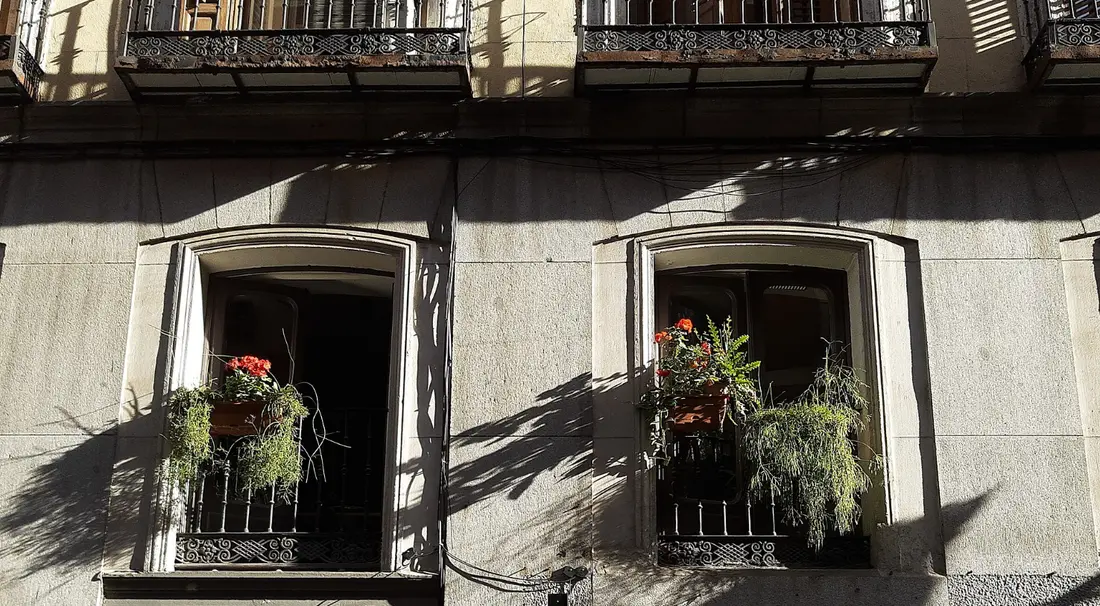
- Plants on the balconies of an older apartment building in Madrid.: Gerda Arendt, CC0, via Wikimedia Commons
- Apartment buildings on Carrer Russafa in Valencia.: Michielverbeek, CC BY-SA 4.0, via Wikimedia Commons
Get new jobs in Spain by email
One email a week with the jobs added since the last one. Free, with no account.
Nothing is sent until you open the link we email you. Choose a role, a pay level or daily emails
We use your address only to send the alerts you ask for, and every email has a one-click unsubscribe link. The privacy notice says how long we keep it, and the terms of use cover the alerts.
We check this guide again by February 3, 2027. Rules change, so confirm visa steps with the embassy and your school before you go. First published November 5, 2026. Spotted something out of date? Tell us. How we write these guides.