Getting a phone number and SIM in Spain
Get a Spanish number in your first week so bank codes, Bizum and messages from school reach you. Here's what ID to bring, which brands to look at, what plans cost and what to do about your old number.
AbroadPin team7 min read
Contents
A Spanish mobile line is cheap, quick to set up and opens the door to a lot of everyday things, from Bizum payments to texts from your landlord. Most teachers start on a prepaid card bought with a passport, then switch to a monthly plan once they have an NIE and a Spanish bank account. This page walks through the ID rules, the networks and budget brands, real prices, eSIM, roaming and your number from home. Pay, visas and employers are covered in the main guide to teaching in Spain.
Every prepaid card is tied to an ID
Spanish law makes operators keep a register of everyone who buys a prepaid SIM. Ley 25/2007 on data retention asks them to record the buyer's name, surnames and nationality, plus the type and number of the identity document shown [1]. Cards whose buyer can't be identified have to be cancelled or switched off, although any unused credit may be refunded [1].
In practice this means the shop scans your ID before handing over a working card. A crowd-edited prepaid SIM wiki reports that most operators now ask for a passport, and that national ID cards from other countries are refused more and more often [2]. It names Orange and Lebara as brands that still take a foreign national ID for prepaid [2]. If you're from outside the EU, your passport is what you'll use, so have it with you on the day.
What to bring to the shop:
- Your passport, even if you also hold an EU ID card [2].
- An unlocked phone, so it will take a Spanish card.
- Your NIE and Spanish bank details, if you already have them and want a monthly plan rather than prepaid.
Getting connected in your first days
How you get online on arrival depends on where your current SIM was issued.
- An EU or EEA SIM. Roam-like-at-home rules mean you pay no extra to use it in Spain, and incoming calls and texts cost nothing extra either [5]. Your operator can still limit the amount you use at home prices under a fair use policy [5].
- A SIM from outside the EU. Those rules don't apply. Check your carrier's roaming rates before you fly, or keep mobile internet off and use Wi-Fi until you have a Spanish card.
- Straight to a Spanish card. Carrier shops in city centres are the simplest place to register one. The wiki says airport stands tend to be overpriced [2].
A foreign EU SIM won't work as your only line for long. The roaming rules are built around the country where you live, work, study or have other stable links [5]. Your operator can look at a 4-month period, and if you've been abroad more than at home it can ask you to explain, with 14 days to reply [5].
The networks and the low-cost brands

Spain has four mobile networks: Movistar, Vodafone, MásOrange (Orange and Másmóvil together) and Digi [2]. On top of them sit many smaller brands that rent space on those networks and usually cost less. The wiki lists these pairings [2]:
| Brand | Runs on |
|---|---|
| Simyo, Hits Mobile, Llamaya | Orange |
| Digi (outside its own coverage), Lycamobile, Lobster | Movistar |
| Másmóvil, Lebara, Llamaya | Yoigo |
Where you can buy them:
- The big three sell prepaid cards in their own stores, though the wiki says many Movistar shops stopped selling prepaid products in 2024 [2].
- Digi has its own shops in a few places and kiosks that sell top-ups [2].
- Simyo cards are sold at Carrefour hypermarkets, MediaMarkt and independent phone shops, and online [2].
- Lebara is sold at kiosks, phone shops and online, and Lycamobile online and in phone shops [2].
What plans cost
Here are two low-cost brands' prices as their own pages showed them, plus what the wiki lists for the big names.
Digi lists its mobile-only plans with no minimum term and says it hasn't raised prices in 2026 [3]. These are the monthly prices for a single line without home internet [3]:
| Digi plan | Price a month | What you get |
|---|---|---|
| 5 GB | 3 euros | 5 GB, 100 national minutes |
| 25 GB | 5 euros | 25 GB, 100 national and international minutes |
| 50 GB | 7 euros | 50 GB, unlimited national calls, 100 international minutes |
| IlimiTODO | 10 euros | Unlimited data and national and international calls |
Simyo shows three main plans that it says are available both prepaid and on contract, with prices including VAT [4]:
| Simyo plan | Price | What you get |
|---|---|---|
| Móvil 100GB + ilimitadas | 10 euros | 100 GB, unlimited national calls, 200 international minutes |
| Móvil 150GB + ilimitadas | 14 euros | 150 GB, unlimited national calls, 200 international minutes |
| Móvil 300GB + ilimitadas | 20 euros | 300 GB, unlimited national calls, 200 international minutes |
Simyo says unused gigabytes carry over for 3 months, and once your allowance runs out your speed drops to 64 Kbps unless you buy an extra pack [4].
Some points to keep in mind:
- Starter cards. The wiki lists a Digi SIM at 10 euros with the same amount of credit, and a Vodafone SIM at 5 euros with 5 euros of credit [2]. Orange gives the card away free once it's registered and topped up with 10 to 20 euros [2].
- The big brands' prepaid plans. The wiki gives Vodafone's prepaid range as starting at 10 euros for 50 GB and Movistar's at 10 euros for 10 GB plus a promotional extra [2]. The wiki shows no date for these, so check the price in the shop.
- Contracts come later. A monthly contract usually waits until your Spanish account is open, and the wiki notes that Digi's unlimited plans need a contract and a Spanish bank account [2].
- Cards left unused. According to the wiki, an Orange prepaid line has stayed active for 3 months from your last top-up or use since 13 October 2024 [2]. It says Movistar removes the credit after 6 months without a top-up, and Vodafone charges 0.50 euros a month after 3 to 4 months with no outgoing use [2]. That matters if you leave Spain for the summer between contracts.
If you're an assistant, a prepaid card for the first weeks is a sensible start, because your first payment can take a while to arrive. Move to a monthly plan once your bank account and NIE are sorted.
eSIM or a physical card
Many newer phones accept an eSIM, which saves swapping cards and lets you keep your home SIM in the tray. Digi says its eSIM is free [3]. The wiki says Orange sells eSIMs online through its tuesim service, but only with an EU passport or ID and with activation inside Spain [2]. It also lists online eSIMs from Lebara and Lycamobile, again activated only in Spain [2].
Before you count on an eSIM, check two things on your phone:
- It's unlocked. A phone tied to your old carrier won't accept a Spanish profile.
- It supports eSIM. Look in the settings or on the maker's specification page.
If either answer is no, a plastic card from a shop is the easier route.
Why a Spanish number helps
Roaming will get you online, but plenty of daily life in Spain assumes a local number.
- Bizum. The instant payment service in Spanish banking apps sends money to a phone number, so flatmates and friends will ask for yours.
- Bank security codes. Spanish banks send codes and alerts by text, and a local line gets them without delay.
- School and colleagues. Staff group chats, timetable changes and sick days all run through your mobile.
- Flats and deliveries. Landlords, agencies and couriers call or text, and a Spanish number gets answered more readily.
- Appointments. Health centres and offices often confirm or change times by text.
Keeping your home number
Your bank, tax office and other accounts back home may send sign-in codes to the number they have on file, so think about it before you leave.
- Run two lines on one phone. A dual-SIM handset, or one card plus an eSIM, keeps the home number for codes and uses the Spanish one for everything else.
- Find a cheap way to keep it alive. Ask your home carrier what the lowest plan costs and what an incoming text costs while you're abroad.
- Move codes to an app. Where a service lets you swap text codes for an authenticator app, make the change before you fly.
Inside Spain, you have the right to keep your number when you change operator, whichever operator you're with [6]. So if you start on a prepaid card and later find a better deal, ask the new brand to bring your number across before cancelling anything.
Your first month, step by step
- Before you fly, make sure your phone isn't locked to your old carrier, check eSIM support and decide what to do with your home number.
- On arrival, use your EU SIM or Wi-Fi while you find a shop.
- Take your passport to a carrier's store and register a prepaid card [1] [2].
- Give the number to your school, your landlord and your bank.
- Once your NIE and bank account are ready, compare monthly plans and bring your number with you if you switch [3] [4] [6].
When you're connected, look through the open jobs in Spain.
See jobs in Spain
- Senior School English Teacher, August 2027 (King's College School Alicante)Alicante
- Middle School English Teacher, August 2027 (King's College School Alicante)Alicante
- Secondary English Teacher, GCSE and IGCSE, August 2027 (British School of Madrid)Madrid
- Pre-Prep School Teacher, September 2027 (Runnymede College, Madrid)Madrid
- Teacher of English, senior school (from September 2027) (Runnymede College, Madrid)Madrid
By city: Teaching jobs in Madrid
Sources and photo credits
- 1.Boletín Oficial del Estado, Ley 25/2007 de conservación de datos, disposición adicional única on prepaid card buyers, consolidated text (last updated 10 May 2014)
- 2.Prepaid Data SIM Card Wiki, Spain, crowd-edited (read 5 November 2026)
- 3.Digi, mobile-only tariffs (read 5 November 2026)
- 4.Simyo, home page with mobile tariffs, prices including VAT (read 5 November 2026)
- 5.European Commission, Your Europe, mobile roaming costs in the EU (read 5 November 2026)
- 6.Comisión Nacional de los Mercados y la Competencia, number portability (read 5 November 2026)
Photos
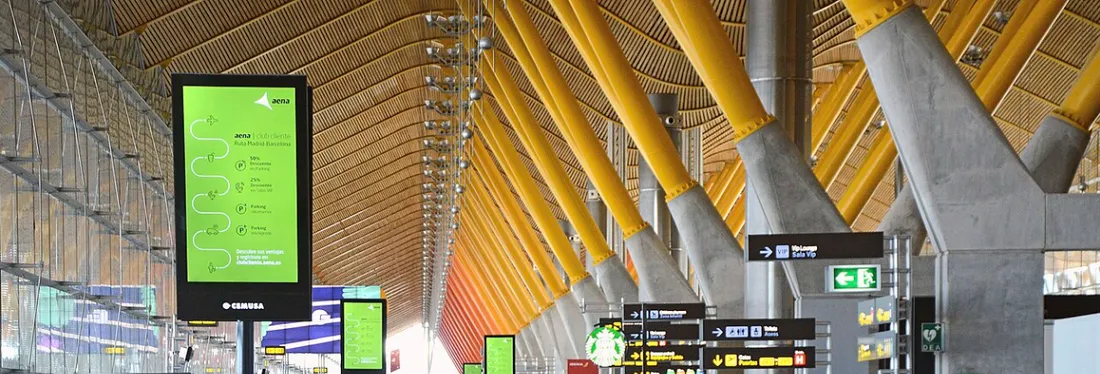
- Terminal 4 at Madrid-Barajas airport.: Pop9000, CC BY-SA 4.0, via Wikimedia Commons
- The Telefónica building on Gran Vía, Madrid. Telefónica runs the Movistar network.: Luis García (Zaqarbal), CC BY-SA 3.0, via Wikimedia Commons
Get new jobs in Spain by email
One email a week with the jobs added since the last one. Free, with no account.
Nothing is sent until you open the link we email you. Choose a role, a pay level or daily emails
We use your address only to send the alerts you ask for, and every email has a one-click unsubscribe link. The privacy notice says how long we keep it, and the terms of use cover the alerts.
We check this guide again by February 3, 2027. Rules change, so confirm visa steps with the embassy and your school before you go. First published November 5, 2026. Spotted something out of date? Tell us. How we write these guides.