Opening a bank account in Spain
Have a Spanish account ready before your first pay arrives, so nothing sits waiting. Here's the order of steps, the papers, the banks, the costs, Bizum and how to manage the first weeks.
AbroadPin team6 min read
Contents
A Spanish account makes life in Spain much simpler: rent, phone bills and Bizum transfers between friends all run through one. For language assistants it's also part of the paperwork the program expects you to sort in your first days, and the ministry asks your school tutor to help you open it [2]. This page covers the order of steps, what to bring, which banks to try, what an account costs and how to cover the weeks before the first payment lands. For pay, visas and employers, see the main guide to teaching in Spain.
Step 1: get your NIE
The NIE (Número de Identidad de Extranjero) is the foreigner's identity number, and most banks ask for it. The application form is the EX-15, and it lets you ask for the number itself or for a certificate of residence or non-residence [3]. Among the reasons you can tick are economic, professional and social interests [3].
You hand the form in at one of three places: a foreigners' office (Oficina de Extranjería), a police station (Comisaría de Policía) or a Spanish consulate abroad [3]. A few practical points:
- Ask your tutor first. Assistants have a named tutor at their school, and the ministry's guide lists help with the NIE and the bank account among the tutor's jobs [2].
- Keep copies. You'll show the NIE at the bank, for your phone contract and when you rent.
Step 2: decide whether you open as a resident or a non-resident
Spanish banks treat residents and non-residents differently. Expatica notes that some of the main banks offer non-resident accounts, mostly in euros, and that a non-resident may need a certificate of non-residency [8]. It puts the wait for that certificate at about 10 days from a police station, or about 15 euros if a bank handles the paperwork for you [8]. You must tell the bank once you become resident, which Expatica defines as 183 days or more a year in Spain or having your work or business ties there [8].
For a teacher on a full school year, the resident route is usually the one to aim for. If you arrive before your papers are ready, you can open as a non-resident first: CaixaBank's page for newcomers says you can move to a standard account once you have residency [7].
Step 3: gather your papers
Requirements vary from bank to bank, but the lists overlap a lot.
- Identity. A valid passport, or your residence card once you have it [6].
- Your NIE. CaixaBank says non-EU nationals need only their NIE to open as residents, while EU and Schengen nationals bring their national ID or passport plus their EU residence certificate [7].
- Proof of address. Expatica lists it, together with proof of what you do, such as an employment contract or a student card [8].
- A tax residence declaration. Santander asks for one if you're not yet resident in Spain [6].
- Details of your work. Santander asks for anti-money-laundering information, including what you do for a living, so bring your contract or your assistant appointment letter [6].
Bring originals and a photocopy of each. If your Spanish is basic, ask a colleague or your tutor to come with you to the branch.
Step 4: choose a bank
Expatica names BBVA, Banco Sabadell and Santander among the big Spanish banks, ING among the international ones, and N26 and Revolut as app-only options [8]. CaixaBank also runs a section of its site for new residents [7].
- A high-street bank is the safest choice for a salary or stipend, because staff can check your papers on the spot and sort problems in person.
- Online sign-up usually means a video call to check your identity, then signing the contract digitally and activating the account in the app [7].
- App-only banks are quick to open, but ask your school or program whether they can pay into a foreign IBAN before you rely on one.
Expatica says an account is usually opened within 1 to 5 days, and that the card arrives with your paperwork within two weeks [8].
The basic payment account: your fallback
If a bank turns you down for its normal account, Spanish law gives you a right to a basic payment account (cuenta de pago básica).
- Who qualifies. Anyone living legally in the European Union, plus asylum seekers and people without a residence permit who can't be expelled [5].
- What it costs. The fee is capped at 3 euros a month, and it's free for people in a situation of vulnerability [4].
- What it covers. Cash deposits and withdrawals, a debit or prepaid card, and up to 120 payments a year in euros inside the EU, such as transfers and direct debits [4] [5].
- When a bank can say no. If you already hold an account, if you don't give the information it asks for, if there's a real risk of money laundering, or on grounds of national security or public order [5].
- What to bring. The Banco de España leaflet lists a valid passport or national ID, plus papers on your household and income such as recent payslips [5].
Santander's version shows how this works in practice. It charges a single fee of 3 euros a month, the debit card is optional and free to issue and keep, and you can't hold another payment account at a Spanish bank at the same time [6]. Taking cash at Santander's own machines is free [6].
Fees and what to compare

Expatica notes that few Spanish accounts are completely free, but basic current accounts are usually low-cost [8]. Before you sign, ask about:
- the monthly maintenance fee, and whether it disappears once your pay goes in
- charges for transfers made at the counter rather than in the app
- fees for cash from other banks' machines
- the charge for card payments in other currencies, which Santander sets at 3% on its basic account [6]
Santander gives you pre-contract information, a list of fees and a draft contract before you sign its basic account [6]. Ask any bank for the same, read it, and keep a copy.
Cards, apps and Bizum
Your debit card works in shops, at cash machines and online, and most banks let you manage the account in their app. Once the account is open, set up Bizum. It's the payment service built into Spanish banking apps, used to split a dinner bill, pay a flatmate or send money to a friend using their phone number instead of an account number [9].
To use it you need an account at a member bank, your bank's app and a mobile number you can verify, and you switch it on inside the app rather than creating a new account [9]. A March 2024 guide describes it as free for users [9]. Limits can change, so check what your bank's app shows before you rely on it for rent.
A Spanish phone number makes all of this easier, so sort your SIM in the same week as the bank.
Getting paid before the account is open
Your first payment will come later than your first day, so plan for the gap.
- Assistants wait the longest. The ministry pays the allowance monthly in arrears, the first payment may not arrive until late December, and there are 7 payments across the 2026 to 2027 year [1].
- Know who pays you. Depending on your quota, the money comes straight from the ministry or from your region, and in some cases through the school, whose secretary then handles it [2].
- Help your school help you. The ministry asks schools to send the assistant's arrival paperwork early so the allowance arrives as soon as possible, so give your tutor your bank details the day you get them [2].
- Bring savings. The program's conditions ask assistants to bring enough money for their first months [1]. A card from home that works at Spanish machines covers you until your own account is running.
- Academy and school jobs. Ask on your first day when payday is and what account details the office needs, and get the start date in writing.
When your account is open, it's a good time to look at teaching jobs in Spain for next year.
See jobs in Spain
- Senior School English Teacher, August 2027 (King's College School Alicante)Alicante
- Middle School English Teacher, August 2027 (King's College School Alicante)Alicante
- Secondary English Teacher, GCSE and IGCSE, August 2027 (British School of Madrid)Madrid
- Pre-Prep School Teacher, September 2027 (Runnymede College, Madrid)Madrid
- Teacher of English, senior school (from September 2027) (Runnymede College, Madrid)Madrid
By city: Teaching jobs in Madrid
Sources and photo credits
- 1.Ministerio de Educación, Formación Profesional y Deportes, Condiciones generales del programa de auxiliares de conversación, curso 2026 to 2027 (read 5 November 2026)
- 2.Ministerio de Educación, Formación Profesional y Deportes, Auxiliares de conversación extranjeros en España, guía para el personal tutor 2026 to 2027 (July 2026)
- 3.Ministerio de Inclusión, Seguridad Social y Migraciones, form EX-15, application for a foreigner's identity number and certificates (read 5 November 2026)
- 4.Banco de España, Portal del Cliente Bancario, the basic payment account (28 February 2020)
- 5.Banco de España, leaflet on the basic payment account (read 5 November 2026)
- 6.Banco Santander, Cuenta Básica (read 5 November 2026)
- 7.CaixaBank, how to open an account as a foreigner (read 5 November 2026)
- 8.Expatica, how to open a Spanish bank account (updated 5 September 2025)
- 9.Xataka Android, how to use Bizum, first steps and common questions (3 March 2024)
Photos
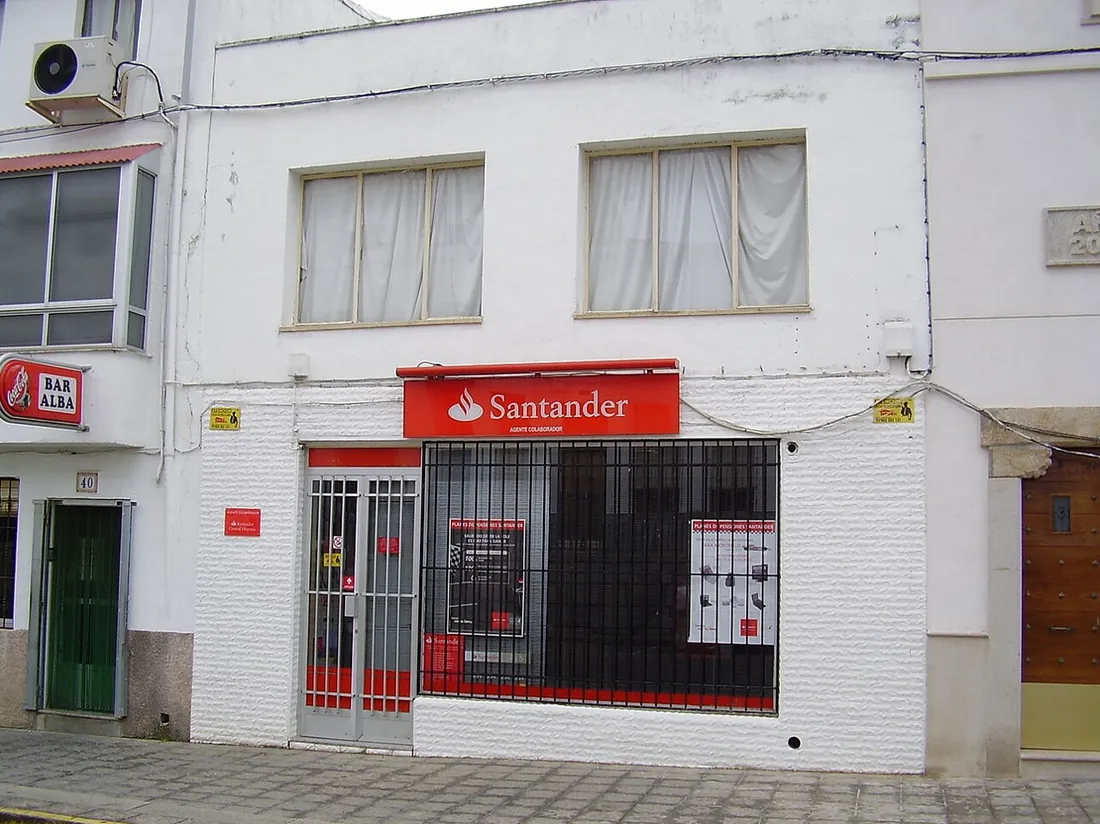
- A small Santander office in Cañaveral, Cáceres.: José Antonio Cotallo López, CC BY 2.0, via Wikimedia Commons
- A bank office on the ground floor of the Casa Bruno Cuadros on La Rambla, Barcelona.: Jordiferrer, CC BY-SA 3.0, via Wikimedia Commons
Get new jobs in Spain by email
One email a week with the jobs added since the last one. Free, with no account.
Nothing is sent until you open the link we email you. Choose a role, a pay level or daily emails
We use your address only to send the alerts you ask for, and every email has a one-click unsubscribe link. The privacy notice says how long we keep it, and the terms of use cover the alerts.
We check this guide again by February 3, 2027. Rules change, so confirm visa steps with the embassy and your school before you go. First published November 5, 2026. Spotted something out of date? Tell us. How we write these guides.