Finding an apartment in Japan
Renting your own flat in Japan takes a few weeks and several months of rent up front. Here's how the lease works, what each fee is for, what Tokyo and Osaka cost, and how to set up power, gas and internet.
AbroadPin team7 min read
Contents
Housing is often the biggest single bill you'll face in your first month in Japan. The good news is that the system is predictable once you know the vocabulary: a deposit, key money, an agent's fee, a guarantor and a two-year lease. This page walks through each one, what rent looks like in two big cities, and what to do on moving day. For pay, visas and the main employers, see the main guide to teaching in Japan.
School housing or your own lease
Before you search, ask your employer what it offers. Some ALT companies, eikaiwa chains and boards of education arrange a flat for new teachers, take over a lease from the teacher who left, or act as the guarantor. Others hand you a list of agents and leave the rest to you. Get the answer in writing, and ask these questions:
- Is the flat furnished, and who owns the furniture and appliances?
- Whose name is on the lease: yours, the school's or the company's?
- Who pays the move-in costs, and are any of them taken back out of your pay?
- What happens to the flat, and to your deposit, if you leave before the contract ends?
Taking school housing for the first year is the low-stress option. You skip the hunt while you settle in, and you can rent your own place later once you know the area and have a payslip to show.
Where to look
There are three common routes for a newcomer.
- A local agent (fudosan). Many rentals go through an agency. The Japan Property Management Association (JPM) keeps a searchable list of member agencies that offer service in foreign languages, sorted by prefecture [3].
- Rental websites. You can search online and then visit the agent who holds the flat [1]. Viewing costs nothing, and you can say no after a viewing without applying [1].
- Share houses and furnished rooms. Operators such as Oakhouse rent furnished rooms and flats in English, with stays from 1 month [7]. Oakhouse says it asks for no deposit, no key money and no guarantor, and lists a ¥50,000 contract fee as its full initial cost [7]. This suits a first few months while you look for something longer.
The Ministry of Land, Infrastructure, Transport and Tourism (MLIT) publishes an apartment search guidebook, a sample standard lease and a move-out checklist for foreign renters, most in 14 languages [2]. Reading the English lease before you see the real one makes the paperwork much less of a surprise.
What rent looks like in Tokyo and Osaka
Numbeo's crowd-sourced figures give a rough idea; the Tokyo column was last updated on 29 September 2026 and the Osaka column on 1 November 2026 [5] [6]. Treat them as averages: a small older flat further from a station can be much cheaper.
| Monthly rent | Tokyo | Osaka |
|---|---|---|
| 1-bedroom, city centre | ¥198,131.58 | ¥116,909.09 |
| 1-bedroom, outside the centre | ¥107,070.59 | ¥80,918.18 |
| 3-bedroom, city centre | ¥390,300.00 | ¥268,454.55 |
Smaller rooms cost far less. The Institute of Science Tokyo tells its students that a room with its own kitchen, bath and toilet runs about ¥70,000 a month in the middle of Tokyo [4]. Most flats come unfurnished, so budget for a fridge, a washing machine, curtains and a futon or bed [4].
Money up front: deposit, key money and the rest
This is where newcomers get caught out. JPM's English guidebook gives a rule of thumb of 4 to 7 months' rent in total to move in [1]. Here's what makes up that figure.
- Deposit (shikikin). About 2 months' rent as a guide [1]. It covers repairs when you leave, and the rest comes back to you [4].
- Key money (reikin). Usually 1 or 2 months' rent, paid to the landlord, and you don't get it back [1]. It's common in the Kanto region around Tokyo [1], and some leases don't charge it at all [4].
- Agent's fee. Up to 1 month's rent [1].
- The first month's rent, paid in advance, plus any common service fee charged on top of the rent [1].
- Insurance. A damage insurance premium, covering fire or water damage you cause [1].
- Guarantee company fee. JPM's guidebook gives figures of between 35% and 50% of one month's rent [1].
- A non-refundable cleaning or restoration fee, often charged in the Tokai, Kansai and Kyushu regions, which includes Osaka [1].
Some places also ask for a small holding payment (tetsukekin) before the contract to keep the room for you; it goes toward the later costs [4].
What a lease asks of you
Landlords screen applicants, and as a foreign renter you'll be asked for more paper than you might expect.
- Documents. Your passport, residence card, proof of income and an employment certificate, depending on your situation [1]. A letter from your school confirming your job and salary helps a lot in your first months.
- A guarantor. Most leases want one [4]. A personal guarantor must show proof of income and a seal registration certificate [1], so most newcomers use a rent guarantee company instead [1]. MLIT has run a registration system for guarantee companies since October 2017 and publishes a list of registered ones that offer foreign-language support [2]. Japan's standard lease comes in two versions, one for a personal guarantor and one for a guarantee company [3].
- Emergency contacts. The application form asks for one contact in Japan and one in your home country [1]. Your school is the usual choice for the first.
- The timeline. From application to moving in usually takes 1 to 2 weeks [1].
- Length and renewal. A regular lease normally runs 2 years and renews automatically, and the landlord can't refuse renewal without good cause [1]. Any renewal fee is written in the contract's special terms, so read that part before you sign.
- House rules. Sort your rubbish by the local schedule, keep it quiet late at night, and don't nail into walls [1]. You can't sublet, and anyone living with you must be declared to the landlord [1]. The sample pledge sheet in JPM's guidebook bans pets [1].
Before you sign, the agent goes through an explanation of the important points of the contract with you [1]. Ask for an English copy of the lease or the MLIT sample to compare it with [2].
Utilities and internet
Ask your agent for the contact details of each company before you move in [1].
- Electricity. Fill in the postcard attached to the breaker box with your name, address and start date, and post it [1].
- Gas. Call the gas company before you move in and book the start date. Someone has to be home when the gas is turned on [1].
- Water. Contact the city's waterworks section and send its postcard [1].
- Internet. Sign up with a provider yourself [1]. Some buildings come with a connection already, so ask at the viewing. Numbeo puts unlimited broadband at 60 Mbps or more at ¥4,754.55 a month in Tokyo and ¥4,840.00 in Osaka [5] [6].
- Running costs. Numbeo's monthly figure for electricity, heating, cooling, water and rubbish in an 85 m2 flat is ¥23,569.77 in Tokyo and ¥21,915.18 in Osaka [5] [6].
When you move out, tell the electricity, gas and water companies at least 1 week ahead [1].
Scams and problems to avoid
Most rentals go smoothly, but a few habits keep you safe.
- Check the agent. MLIT runs a public search of licensed real estate brokers, built from what the licensing offices register [8]. Look up the company before you hand over money.
- Don't pay before the contract stage. In the normal order you view the flat, apply, pass screening, hear the explanation of important points, and only then sign and pay [1]. Be wary of anyone who wants money for a flat you haven't seen, or asks you to send it to a personal account.
- Watch out for sublets. A tenant offering their flat to you cheaply is breaking the usual lease terms, and both of you could lose the flat [1].
- Protect your deposit. Take dated photos on move-in day and use the move-in and move-out condition checklist that MLIT and JPM publish [2] [3]. If repairs cost more than the deposit, you pay the difference [1].
- Give notice on time. Notice is usually 1 to 2 months, in writing, as your lease says [1]. The Institute of Science Tokyo warns its students that late notice means paying another month's rent [4].
With kids
Families need more space, and it costs more. A 3-bedroom flat in the city centre averages ¥390,300.00 a month in Tokyo and ¥268,454.55 in Osaka, and the same size outside central Osaka is ¥121,265.89 [5] [6]. Ask your employer early whether it can help with a family-sized flat, and if your children will go to a local public school, ask the city office which school serves an address before you sign.
Your first months, in order
- Ask your school what housing it offers and get the terms in writing.
- If you're renting yourself, find an agent with English service and read the MLIT sample lease [2] [3].
- Save for 4 to 7 months' rent to move in [1].
- Collect your residence card, proof of income and an employment letter, and pick a guarantee company [1].
- Book gas, electricity, water and internet for your move-in date [1].
Once you're settled and thinking about your next contract, browse the open jobs in Japan.
See jobs in Japan
- English Teacher, Central Japan district, based in Nagoya area (ECC Foreign Language Institute)Nagoya · $1,773 a month
- English Literature and Culture Faculty, April 2028 (Sophia University, Tokyo)Tokyo · $2,632 to $3,421 a month
- First-Year Writing Lecturer or Professor, Fall 2027 (Temple University Japan, Tokyo and Kyoto)Tokyo · $2,632 a month
- English Teacher, East Japan district, based in Tokyo area (ECC Foreign Language Institute)Tokyo · $1,773 a month
- English Teacher, West Japan district, based in Osaka area (ECC Foreign Language Institute)Osaka · $1,773 a month
By city: Teaching jobs in Tokyo · Teaching jobs in Chiba · Teaching jobs in Nagoya · Teaching jobs in Koshigaya
Sources and photo credits
- 1.Japan Property Management Association, Room Hunting Guidebook in English (read 5 November 2026)
- 2.Ministry of Land, Infrastructure, Transport and Tourism, rental housing support for foreign nationals (read 5 November 2026)
- 3.Japan Property Management Association, move-in support for foreign residents (read 5 November 2026)
- 4.Institute of Science Tokyo, renting an apartment (read 5 November 2026)
- 5.Numbeo, cost of living in Fukuoka vs Tokyo (Tokyo updated 29 September 2026)
- 6.Numbeo, cost of living in Osaka (updated 1 November 2026)
- 7.Oakhouse, share houses and apartments in Japan (read 5 November 2026)
- 8.Ministry of Land, Infrastructure, Transport and Tourism, search for construction and real estate businesses (notice of 1 April 2025, read 5 November 2026)
Photos
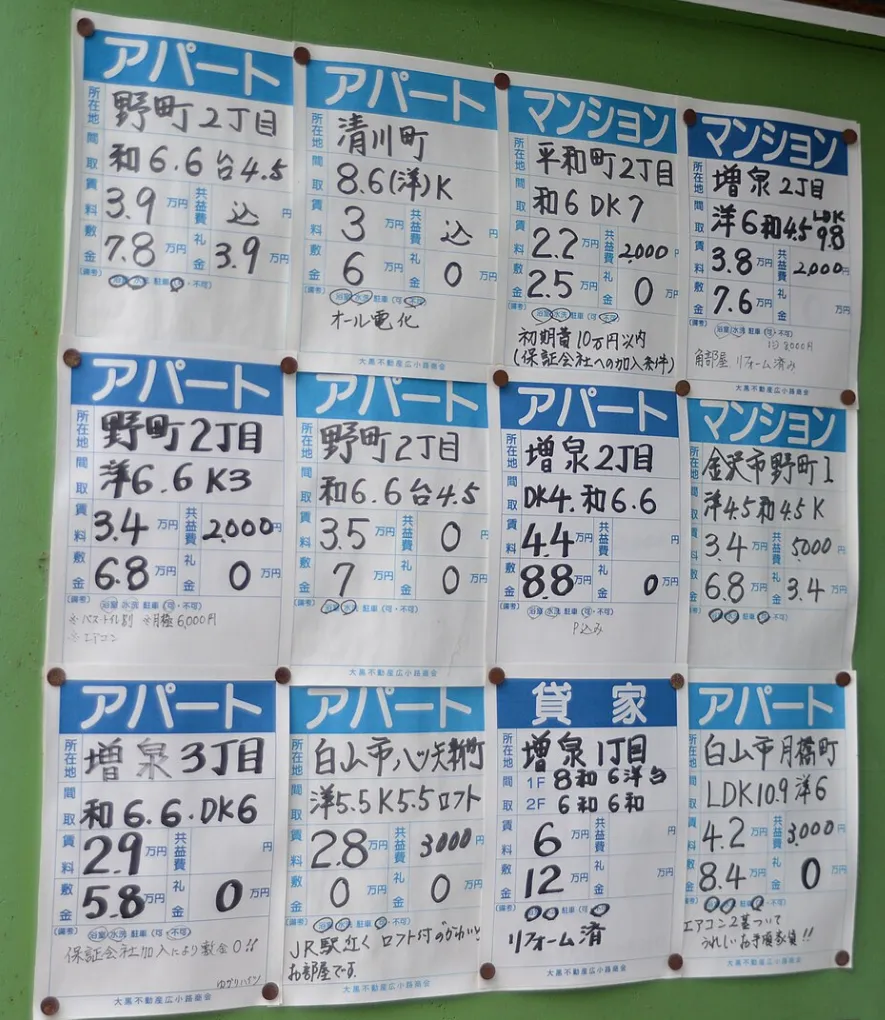
- Rental listings posted outside an estate agent in Japan, photographed in 2013. Each card gives the rent, deposit and key money in units of ¥10,000.: Kennosuke Yamaguchi, CC BY-SA 2.0, via Wikimedia Commons
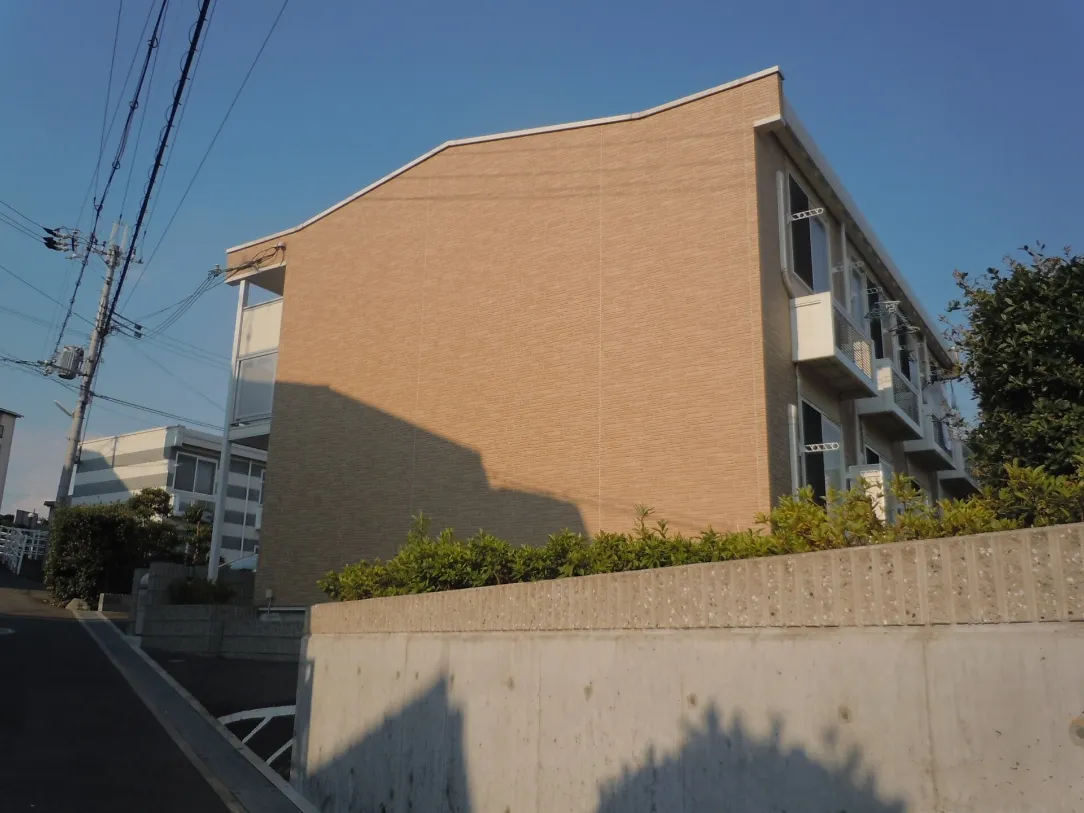
- A low-rise apartment building in Japan.: ぶーーーーーた, CC BY-SA 3.0, via Wikimedia Commons
Get new jobs in Japan by email
One email a week with the jobs added since the last one. Free, with no account.
Nothing is sent until you open the link we email you. Choose a role, a pay level or daily emails
We use your address only to send the alerts you ask for, and every email has a one-click unsubscribe link. The privacy notice says how long we keep it, and the terms of use cover the alerts.
We check this guide again by February 3, 2027. Rules change, so confirm visa steps with the embassy and your school before you go. First published November 5, 2026. Spotted something out of date? Tell us. How we write these guides.