Finding an apartment in South Korea
Find a safe, affordable flat in South Korea and keep your deposit protected. Here's how school housing, jeonse and wolse work, what Seoul and Busan cost, and the checks to make before you hand over money.
AbroadPin team7 min read
Contents
Most English teachers in Korea never sign a lease in their first year, because the school hands them the keys to a studio. That changes when you switch jobs, take a housing allowance, bring a partner or simply want more space. Korean renting runs on deposits that can be far larger than anything you'd pay at home, so it pays to understand the system before you sign anything. For pay, visas and the kinds of employer, see the main guide to teaching in South Korea.
School housing or your own place
Start by asking exactly what your employer gives you, and get it in writing.
- EPIK public schools. Your office of education provides a leased house, apartment or studio-type room [1]. EPIK says its size and location differ from region to region because housing costs differ [1]. The monthly bills and the building's maintenance fee are yours to pay [1].
- Hagwons. Private academies usually house you too. Of 24 hagwon ads on Korvia's board in early November 2026, 22 list a single studio, one offers a housing allowance and one lists no housing [2].
- Universities. Packages vary a lot, so read the offer closely and ask whether campus housing or an allowance comes with it.
If your school provides the flat, ask these before you arrive:
- Whose name is on the lease, and who paid the deposit?
- Is it furnished, and which appliances belong to the flat?
- How much is the monthly maintenance fee, and what does it cover?
- What happens to the flat if you leave the job early?
Taking school housing for the first contract is the low-risk route. You learn the neighbourhoods, finish your residence paperwork and build up savings before you put money into a deposit of your own.
Jeonse and wolse: the two kinds of lease
Korea has two main ways to rent, and both start with a deposit to the landlord.
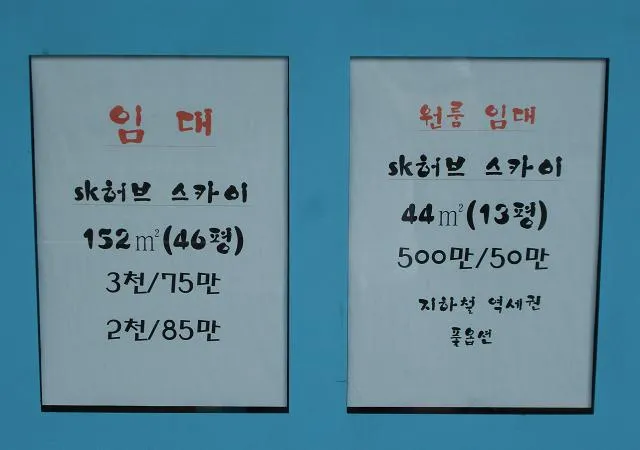
Wolse is deposit plus monthly rent, paid on a set date each month [3]. The deposit is smaller than for jeonse, and you can often offer a bigger deposit in exchange for lower rent [3]. On a wolse lease you also pay the monthly charges for electricity, water, gas, phone, internet and TV reception [3].
Jeonse, sometimes called the key money deposit, is a system found only in Korea [3]. You pay one large lump sum into the landlord's bank account and pay no monthly rent [3]. When the contract ends, the landlord returns the deposit to you [3]. Seoul Start points out that with jeonse, the money at risk can be the main savings you brought to Korea [4].
For a teacher on a one-year contract, wolse is the realistic choice. A jeonse deposit for a Seoul officetel ran to a median of 230 million KRW in August 2026, against 10 million KRW for the same kind of home on wolse [5].
What rent costs in Seoul and Busan
Two sets of numbers give a fair picture. Seoul Start's medians come from Seoul lease contracts reported in August 2026 [5]:
| Home type in Seoul | Monthly rent | Wolse deposit | Jeonse deposit | Typical size |
|---|---|---|---|---|
| Officetel | 700,000 KRW | 10 million KRW | 230 million KRW | 23.3 m2 |
| Villa or row house | 550,000 KRW | 40 million KRW | 230 million KRW | 30 m2 |
| Apartment | 1,000,000 KRW | 100 million KRW | 630 million KRW | 59.2 m2 |
Numbeo's crowd-sourced averages let you compare Seoul with Busan; the Seoul page was read on 5 November 2026 and the Busan page was updated on 1 November 2026 [6] [7]:
| Monthly rent | Seoul | Busan |
|---|---|---|
| 1 bedroom, city centre | 1,167,199 KRW | 997,500 KRW |
| 1 bedroom, further out | 704,545 KRW | 768,225 KRW |
| 3 bedrooms, city centre | 3,658,221 KRW | 2,915,048 KRW |
| 3 bedrooms, further out | 1,958,041 KRW | 1,900,320 KRW |
On top of rent there's usually a maintenance fee (gwallibi). In apartment complexes covered by the multi-family housing law it's made up of ten set monthly items, but many officetels and villas fall outside those rules, so ask the agent or landlord what the fee includes [5].
Where to look
- A goshiwon for the first weeks. These small furnished rooms work as a low-commitment first stop while you finish foreigner registration [8]. In Seoul, rooms built under the newer standard must be at least 7 m2, or 9 m2 with a toilet inside, but older rooms may not meet it [8].
- A local real estate agent. Most leases go through a licensed agency (budongsan) near the area you want. Bring a Korean-speaking colleague to your first viewings if you can.
- Price checks before you view. The government's real transaction price system at rt.molit.go.kr shows reported lease prices from June 2021 onwards, so you can see what similar homes actually rented for [9].
Seoul Start suggests treating your first viewings as research until you've learned to read the property records [10]. Foreigner registration is due within 90 days of entry if you're staying longer than that, and HiKorea says the card takes about 2 to 3 weeks to arrive [10].
The agent's fee
The fee is agreed within a legal cap that depends on the value of the lease [5]. For a wolse lease, the value is the deposit plus 100 times the monthly rent [10]. In Seoul Start's example, a small officetel with a 10 million KRW deposit and 600,000 KRW rent, charged at the 0.4% officetel rate, costs each side no more than 280,000 KRW [5]. Ask for the fee in writing before you sign [10].
Signing the lease, step by step
- Check the property register and building register. Confirm who owns the home and that the person signing is the owner or someone authorised to act for them [4]. The Seoul city government says to check that there are no unpaid loans on the property before you sign [3]. Viewing one register online at the Supreme Court registry (iros.go.kr) costs 700 KRW, and a printable copy is 1,000 KRW [9].
- Match every amount and the bank account. Before any money moves, check the deposit, the rent and the account in the contract, and never transfer to an account that has nothing to do with the landlord [10].
- Agree the length. Under the Housing Lease Protection Act, a lease shorter than 2 years counts as 2 years unless the tenant wants the shorter term [4]. You can ask to renew once, from 6 months to 2 months before the end, and the increase is capped at 5% [4] [11].
- Register your address. Registered foreigners must report a new place of stay within 15 days after moving [10]. For foreign residents, foreigner registration and that change report take the place of the move-in report Korean tenants file, and that's what starts your legal protection for the deposit [4].
- Get a confirmed date. Priority for getting your deposit back needs the confirmed date (hwakjeong ilja) on the contract as well [4]. Leases with a deposit over 60 million KRW or rent over 300,000 KRW must be reported within 30 days of signing, and that report can also give you the confirmed date [4].
If you end a renewed lease early, your notice takes effect 3 months after the landlord receives it [11].
Utilities and internet
Once the lease is signed, the bills are in your name or added to your rent. Numbeo puts basic utilities for an 85 m2 flat at about 245,000 KRW a month in Seoul and about 268,000 KRW in Busan [6] [7]. Broadband averages about 32,000 KRW a month in Seoul and 36,250 KRW in Busan [6] [7]. A studio costs less to heat and cool than the 85 m2 flat these figures assume, so treat them as an upper guide for a single teacher.
Deposit scams and warning signs
The biggest risk in Korean renting is a deposit that never comes back. Seoul Start lists these warning signs [9]:
- The deposit is close to or above 90% of the home's latest sale price [9].
- Mortgages and other claims on the register, plus your deposit, come close to the home's value [9].
- The landlord or agent won't let you see the register [9].
- Someone asks you to skip the date stamp on the contract [9].
- The landlord holds many guaranteed homes or has had a guarantor pay out on their behalf before [9].
Since 1 May 2023, HUG's deposit insurance only covers homes where the deposit is 90% of the price or less [9]. HUG's Safe Jeonse app, made with the land ministry, lets a renter see the landlord's tax arrears and the rights registered on the home [9]. On a small wolse deposit the stakes are lower, but the register check still costs only 700 KRW online [9].
With kids
School housing is built around one teacher, and most hagwon ads offer a single studio [2]. If your partner and children are coming, raise housing size at the interview and ask whether the school will pay an allowance toward a bigger place instead. A 3-bedroom flat outside the centre averages about 1,958,000 KRW a month in Seoul and 1,900,000 KRW in Busan on Numbeo [6] [7]. The median Seoul apartment rented in August 2026 was 59.2 m2 [5].
If the job and housing look right, browse open teaching jobs in South Korea.
See jobs in South Korea
- Kindergarten and Elementary English Teacher, March 2027 (English academy Munjeong Songpa Seoul)Seoul
- Kindergarten English Teacher, March 2027 (immersion kindergarten Sinsa Gangnam Seoul)Seoul
- Kindergarten English Teacher, three posts, March 2027 (English kindergarten Gangnam Seoul)Seoul
- Pre-K Homeroom English Teacher, March 2027 (Hillside Collegiate Songdo Incheon)Incheon
- Primary and Secondary English Teacher, March 2027 (private school Gangnam Seoul, 3.0M to 3.5M won)Seoul
By city: Teaching jobs in Seoul · Teaching jobs in Incheon · Teaching jobs in Seongnam · Teaching jobs in Suwon
Sources and photo credits
- 1.EPIK (English Program in Korea), salary and benefits (updated 4 May 2026 for the Fall 2026 intake)
- 2.Korvia Consulting, hagwon teacher job ads (read 5 November 2026)
- 3.Seoul Metropolitan Government, wolse and jeonse explained (read 5 November 2026)
- 4.Seoul Start, jeonse explained: how the deposit-only lease works and its risks (updated 27 October 2026)
- 5.Seoul Start, rent in Seoul 2026, medians of contracts reported in August 2026 (24 October 2026)
- 6.Numbeo, cost of living in Seoul (read 5 November 2026)
- 7.Numbeo, cost of living in Busan (updated 1 November 2026)
- 8.Seoul Start, goshiwon vs officetel vs oneroom (updated 6 June 2026)
- 9.Seoul Start, how to check real rent and sale prices and spot a risky jeonse (24 October 2026)
- 10.Seoul Start, first month in Korea: housing timeline from arrival to signed lease (updated 6 June 2026)
- 11.Korea.kr policy briefing, Q&A on the amended Housing Lease Protection Act (30 July 2020)
Photos
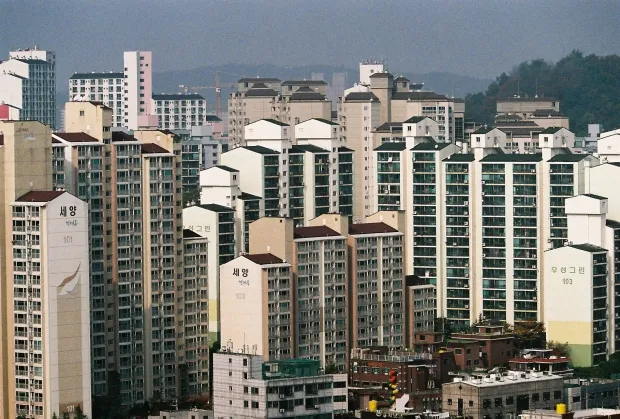
- High-rise apartment blocks in Jangan-dong, Dongdaemun-gu, Seoul.: Thomiccor, CC BY-SA 3.0, via Wikimedia Commons
- Rental listings outside an estate agency in Busan, photographed in 2008. Each card gives the deposit and then the monthly rent, in units of 10,000 won.: Remi Cormier, CC0, via Wikimedia Commons
Get new jobs in South Korea by email
One email a week with the jobs added since the last one. Free, with no account.
Nothing is sent until you open the link we email you. Choose a role, a pay level or daily emails
We use your address only to send the alerts you ask for, and every email has a one-click unsubscribe link. The privacy notice says how long we keep it, and the terms of use cover the alerts.
We check this guide again by February 3, 2027. Rules change, so confirm visa steps with the embassy and your school before you go. First published November 5, 2026. Spotted something out of date? Tell us. How we write these guides.