Opening a bank account in South Korea
Get your Korean salary into an account you can actually use in your first month. Here's which banks to try, what to bring, why new accounts start with low limits and how to get them lifted.
AbroadPin team7 min read
Contents
Almost every school in Korea pays into a local account, and you'll need one for rent, phone bills and transfers to friends too. Opening it is rarely the hard part. The surprise for most new teachers is that a fresh account comes with tight daily limits until the bank sees why you need it. This page walks through the order to do things in, the banks teachers use, the papers to carry and how to get full use of your money. For pay, visas and the kinds of employer, see the main guide to teaching in South Korea.
Do things in this order
Your residence card is the key that opens almost everything else, so plan the bank around it.
- Book your residence card appointment. If you're staying 91 days or more, you have to register within 90 days of arriving, and nearly every immigration office wants a booking made on HiKorea first [6]. Teachers on an E-series visa bring an employer letter or the contract along with the passport, photo and proof of address [6].
- Pay the fee. Registration costs 35,000 KRW, a rate in force since 1 January 2025 [6].
- Wait for the card. Seoul Start says it takes roughly a few weeks, and you get a text message when it's ready [6].
- Get a Korean phone number. Banks ask for one if you have it, and Toss Bank's app sign-up is simpler with one [3] [5].
- Open the account with the card, your passport and a paper that shows why you need the account, which for a teacher is the job [2] [5].
If your school or EPIK office offers to send a coworker to the bank with you, say yes, because the questions at the counter are often in Korean.
Can you open one before the card arrives?
Sometimes. KOTRA's foreign investment ombudsman says a branch can open an account with your passport plus proof that you live in Korea [2]. That proof can be an employment certificate that states your address, a utility bill or a hotel voucher, and a company address only counts if you really live there, as in a school flat or dormitory [2]. Seoul Start adds that the law accepts the passport name and number when no card has been issued, but the bank can still restrict the account or ask for more [5].
Hana Bank lets people coming to Korea register their details through a QR code before they fly, then finish the opening at any of its branches after arrival, with guidance in 16 languages [8]. If you're not sure your branch will take a passport alone, it's a sensible way to save a trip.
Which bank to try
Seoul Start lists the five nationwide banks as KB Kookmin, Shinhan, KEB Hana, Woori and NongHyup [4]. A branch near school, or the bank your payroll already uses, saves you trips. Some points worth knowing:
- Shinhan and KEB Hana are the two most often named for English-speaking staff, though only at some branches and with no guarantee, so call ahead [4].
- Hana runs a call centre for foreign customers, and Shinhan has a video consulting centre for them [2].
- Woori has Global Investment WON Centers in Gangnam and Gwanghwamun in Seoul [2].
- Toss Bank says it's the only internet bank in Korea where foreigners can open an account online with a residence card, all in the app with no branch visit [3]. It offers savings accounts, debit cards, transfers and ATM use, but no credit loans [3].
- Kakao Bank and K Bank were not confirmed as open to foreign residents online when Seoul Start last checked in July 2026, so check their own sites first [4].
Each person can hold one ordinary deposit and withdrawal account at each bank [2].
What to bring to the branch
Take originals, not photos on your phone [5]. Requirements differ by bank and even by branch, so call the branch before you go [2].
- Your residence card, if you have it, and your passport [5].
- Proof of why you need the account. Banks have to ask for this under Korea's law on telecom financial fraud [2]. For salary, KOTRA lists an employment certificate, an employment contract, an income certificate, a withholding receipt or wage statements from the last 3 months [2].
- A Korean phone number, if you have one [5].
Registered foreign residents aged 14 or older can also get a mobile residence card on their phone, and Shinhan, Hana, iM, Busan, Jeonbuk and Jeju banks have accepted it for banking since 21 March 2025 [5].
Limited accounts, and how to lift them
Most new foreign resident accounts open as a limited account, called 한도제한계좌 at the bank [4]. It's normal, not a refusal [4]. The account works, but with a daily cap until you prove its purpose.
The Financial Services Commission raised those caps on 2 May 2024 [1]:
| Channel | Daily limit before | Daily limit from 2 May 2024 |
|---|---|---|
| Internet and app banking | 300,000 KRW | 1,000,000 KRW |
| ATM withdrawals | 300,000 KRW | 1,000,000 KRW |
| Bank counter | 1,000,000 KRW | 3,000,000 KRW |
Banks still set their own rules inside that. Toss Bank's April 2026 guide gives a daily transfer limit of 300,000 KRW on its new accounts for foreigners [3].
To lift the limit, bring a document that matches your reason for the account: for a job, the contract or a salary deposit letter (급여이체확인서) from your employer [4]. At most banks that means going back to the branch, and approval is up to the branch [3]. Ask the teller to write down the exact Korean name of the paper they want, since each bank words it differently [4]. Toss Bank does it in the app: you photograph the documents, the review takes up to 2 to 3 business days, and after approval you can send up to 50,000,000 KRW a day and 10,000,000 KRW per transfer [3].
The easiest time to do this is right after your first payday, when you have a payslip and your contract in hand.
Cards, apps and certificates
Your account normally comes with a check card, which takes each payment straight from your balance [4]. Not every check card works abroad by default, so ask at opening if you plan to travel [4]. A credit card needs a Korean credit history, and Seoul Start suggests asking about one after six months to a year of steady use at the same bank [4].
You'll do most banking in your bank's app. Transfers between Korean banks usually arrive within seconds, and many banks waive the fee for app transfers [4]. For logging in, ask the branch to set up a financial certificate (금융인증서) when you open the account: it's valid for three years, stored in the bank's cloud and easier for foreigners to get than the older joint certificate, which lasts one year [4].
Global ATMs that take foreign cards are in CU, GS25, 7-Eleven and Emart24 shops and at bank branches, which helps in your first weeks [4]. Check the posted fee on the screen before you withdraw.
Deposits are protected up to 100,000,000 KRW per person at each bank, including interest, from 1 September 2025 [4].
Fees
Seoul Start gives no fee amounts for transfers, wires or foreign currency accounts, because they vary by bank and change often, so read your own bank's fee page (서비스이용 수수료 안내) once you're set up [4]. Two things to ask about at opening are the fee for ATMs outside your bank's network and the charges on a transfer abroad. If you keep savings at Toss Bank, its savings product paid 1% a year before tax as of 3 April 2026 [3].
Getting paid before the account is open
The Labor Standards Act says wages are paid directly to the worker, in full and in currency, at least once a month on a fixed day [9]. Ask on your first day when payday is, so you know how long you have. If your residence card is late and the account isn't ready by payday, tell payroll early and ask how they'll pay that first month, then get the answer in writing. Keep your pay in your own name: don't have it sent to a colleague's or a recruiter's account.
Sending money home
Bank transfers abroad go through one designated foreign exchange bank that you choose [7]. Seoul Start says foreign residents can send up to 50,000 USD a year without proof of where the money came from [7]. To send more, take a pay statement or your withholding tax receipt to that bank [7].
- A bank wire takes 3 to 5 business days [7].
- Licensed remittance apps such as E9pay, Sentbe, Hanpass, GME Remit and WireBarley cap each transfer at 5,000 USD and the year at 50,000 USD [7].
Compare the total cost on the day, including the exchange rate, before you pick one. The World Bank found Korea the cheapest G20 country to send 500 USD from, at about 3.07% in early 2025 [7].
A checklist for your first month
- Book the residence card on HiKorea in your first week and register within 90 days [6].
- Get a Korean phone number.
- Ask your school for an employment certificate and keep your contract handy.
- Open the account, ideally with a coworker who speaks Korean, and set up the app and certificate.
- After your first payday, take your payslip or contract back to lift the limit.
- Choose how you'll send money home once you know your monthly budget.
Once you're settled and thinking about your next contract, have a look at the open jobs in South Korea.
See jobs in South Korea
- Kindergarten and Elementary English Teacher, March 2027 (English academy Munjeong Songpa Seoul)Seoul
- Kindergarten English Teacher, March 2027 (immersion kindergarten Sinsa Gangnam Seoul)Seoul
- Kindergarten English Teacher, three posts, March 2027 (English kindergarten Gangnam Seoul)Seoul
- Pre-K Homeroom English Teacher, March 2027 (Hillside Collegiate Songdo Incheon)Incheon
- Primary and Secondary English Teacher, March 2027 (private school Gangnam Seoul, 3.0M to 3.5M won)Seoul
By city: Teaching jobs in Seoul · Teaching jobs in Incheon · Teaching jobs in Seongnam · Teaching jobs in Suwon
Sources and photo credits
- 1.Financial Services Commission, daily limits on limited accounts raised from 300,000 to 1,000,000 KRW (2 May 2024)
- 2.KOTRA Foreign Investment Ombudsman, how foreigners can open a bank account in Korea (August 2024)
- 3.Toss, how to open a bank account in Korea as a foreigner (10 April 2026)
- 4.Seoul Start, banking in Korea for foreign residents (12 July 2026)
- 5.Seoul Start, how to open a Korean bank account (updated 6 June 2026)
- 6.Seoul Start, residence card (ARC) registration guide (read 5 November 2026)
- 7.Seoul Start, sending money home from Korea (read 5 November 2026)
- 8.Asia Business Daily, Hana Bank's pre-arrival registration service for foreigners (9 July 2025)
- 9.Invest Korea, labor standards and payment of wages (read 5 November 2026)
Photos
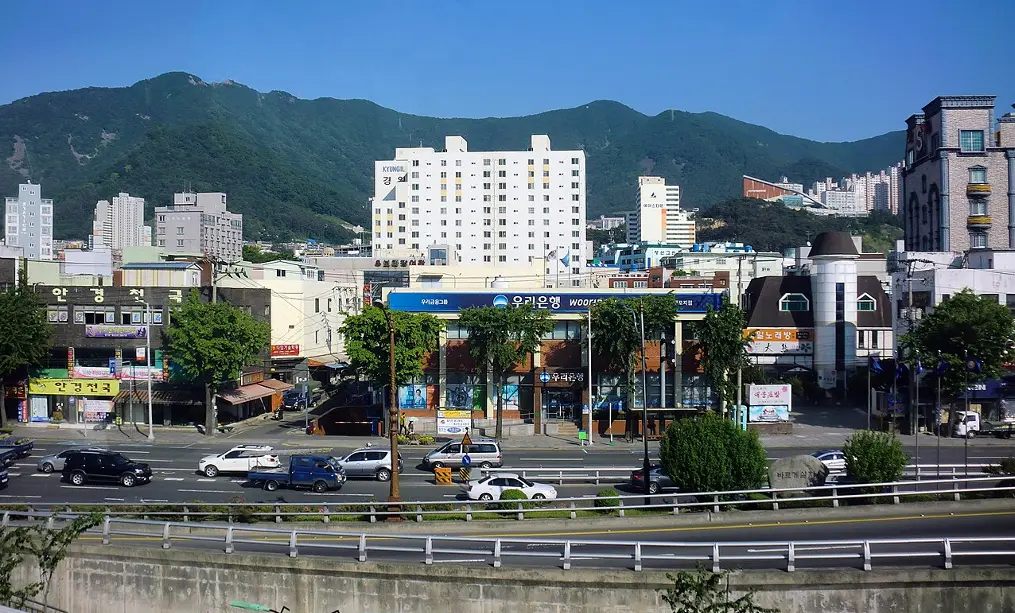
- A Woori Bank branch in Gupo, Busan.: hyolee2, CC BY-SA 3.0, via Wikimedia Commons
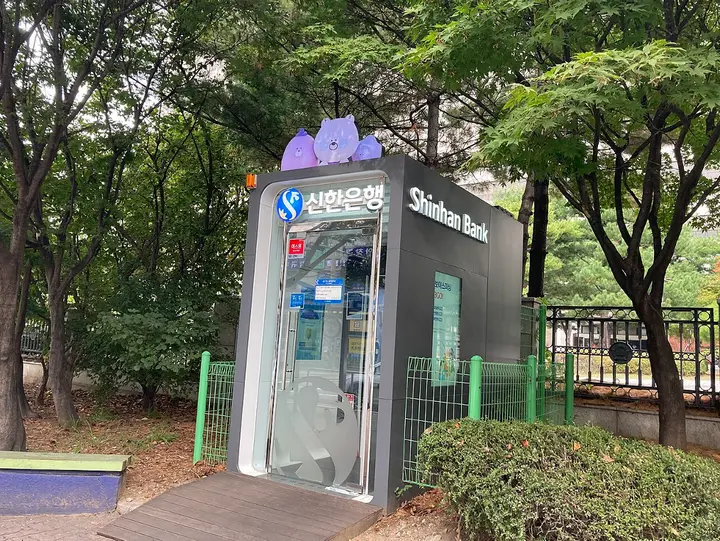
- A Shinhan Bank cash machine booth in Incheon.: Narubaru7, CC BY-SA 4.0, via Wikimedia Commons
Get new jobs in South Korea by email
One email a week with the jobs added since the last one. Free, with no account.
Nothing is sent until you open the link we email you. Choose a role, a pay level or daily emails
We use your address only to send the alerts you ask for, and every email has a one-click unsubscribe link. The privacy notice says how long we keep it, and the terms of use cover the alerts.
We check this guide again by February 3, 2027. Rules change, so confirm visa steps with the embassy and your school before you go. First published November 5, 2026. Spotted something out of date? Tell us. How we write these guides.